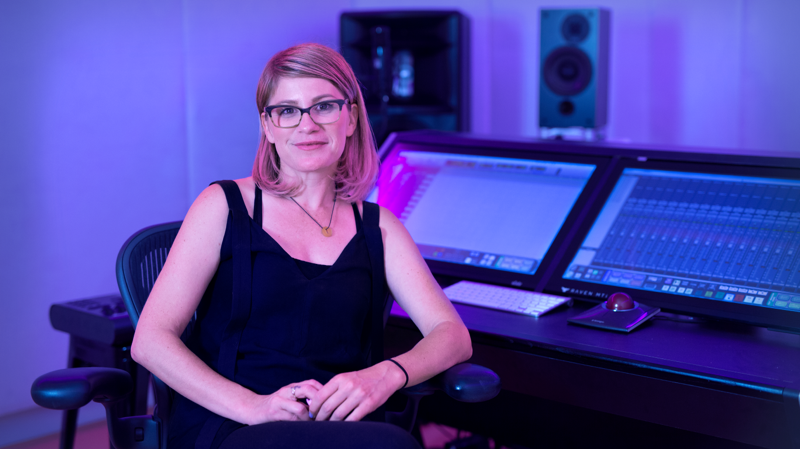
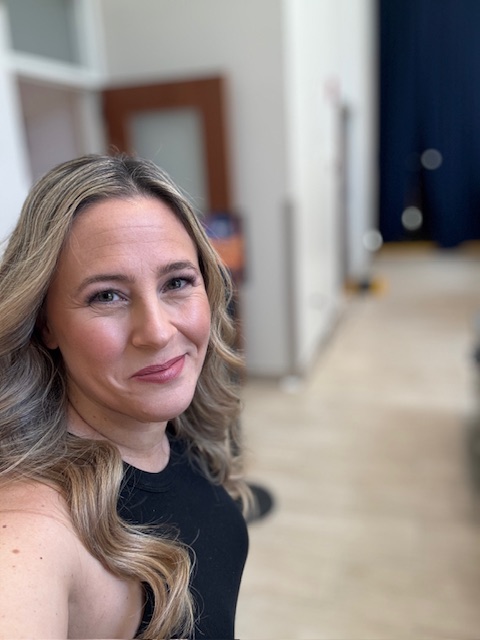
Kat Jackson is an accomplished audio producer, director, and industry educator with over 20 years of experience creating audiobooks, podcasts, and original audio content. She is the founder and principal of Kat Jackson Audio and Editor in Chief of AudiobookRush.com, bringing extensive experience in storytelling, production leadership, and talent development to the spoken-word audio industry.
Throughout her career, Kat has collaborated with prominent voices in entertainment, journalism, and publishing. Her projects include working with Jamie Lee Curtis on three seasons of Letters from Camp, which Curtis executive produced, developed, and starred in; journalist Sheinelle Jones on her audiobook Through Mom’s Eyes; and financial educator Haley Sacks, known as Mrs. Dow Jones, on bringing her message of financial empowerment to audiobook audiences.
Kat began her audio career producing museum audio tours, including three multilingual tours for the Museum of Modern Art’s (MoMA) reinstallation. She later managed CDM Sound Studios in New York City, gaining extensive experience in recording, editing, voiceover production, and directing across commercials, audiobooks, ADR, and other spoken-word formats.
During her time at Audible, Kat played an important role in expanding educational pathways into the audiobook industry. Through the University Outreach Initiative, she introduced acting students at leading drama schools to audiobook narration careers. Recognizing a gap in training for aspiring producers and directors, she developed and taught specialized production workshops at colleges and universities across the country, helping establish educational opportunities that had been largely unavailable when she entered the industry.
A graduate of Drew University with a degree in Art History and Arts Administration, Kat has built her career through hands-on experience, mentorship, and a commitment to excellence in audio storytelling.
Having frequently been the only woman in production environments early in her career, Kat is dedicated to increasing representation and creating opportunities for women in audio. Through her independent production company, she prioritizes projects that amplify women’s stories while continuing to mentor and inspire emerging audio professionals.
Kat’s career reflects a commitment not only to producing compelling audio but also to developing talent, expanding access to the industry, and preserving the power of storytelling through the human voice.
Career Beginnings
How did you get your start in audio?
My first job out of college was producing museum audio tours for a company called Acoustiguide, which is how I first found myself spending a lot of time in a recording studio. I fell in love with studio life pretty quickly, and when the manager of the studio we worked with moved on, I basically pitched myself for his job. I had no traditional audio background, but I knew the work, I knew the studio, and I knew I wanted to be there. They took me on immediately, and I never really left the studio life after that.
What were your first jobs, gigs, or internships like?
I was incredibly focused on starting my career, so even when those early jobs were hard, they didn’t really feel that way to me. I was lucky to be surrounded by really generous people and honestly, the audiobook industry is FULL of them but there was still so much to learn. I said yes to everything: extra hours, more responsibilities, after-hours events, whatever it was. I wanted to be in the room, because every time I was, I learned something. It meant a lot of long hours, but at that point in my career, I was just so excited to be there.
What skills or lessons did you learn early on that still serve you today?
One of the biggest lessons I learned early on was to never say no to an interesting opportunity just because I didn’t already know how to do something. I still operate that way. If something interesting comes my way, I say yes and then it’s on me to figure out how to do it. Maybe I don’t know how to do that particular thing yet, but you can be absolutely sure I’ll learn the skill, deep-dive into the subject, do the research, and figure it out. I’ve never believed that not knowing how to do something today means I can’t know how to do it tomorrow.
Did you have a mentor or someone who significantly supported your growth?
I had lots of people who were generous with their knowledge early in my career, but it wasn’t until later that I was lucky enough to work for former Audible’s Head of Production, NA Mike Charzuk . Mike taught me so much of what I know about managing people and projects, how to scale production without sacrificing quality, and, maybe most importantly, how to be a good human in a field where people and relationships are everything. He taught me that being a strong leader and being a kind one aren’t mutually exclusive. Even though we’ve both moved on, I know I can and do still call Mike for advice.
What barriers did you encounter early in your career, if any?
I was young, I was a woman, and I didn’t come into audio with a technical degree or traditional training, so I spent a lot of my early career feeling like I had to prove that I belonged in the room. I was often the only woman on the production side of the studio, and I definitely encountered people who assumed I knew less than the men around me. My response was to learn everything I possibly could. I asked questions, watched how people worked, learned the technical side, and made sure I knew what I was talking about. I couldn’t control other people’s assumptions about me, but I could make it very hard for them to underestimate me twice.
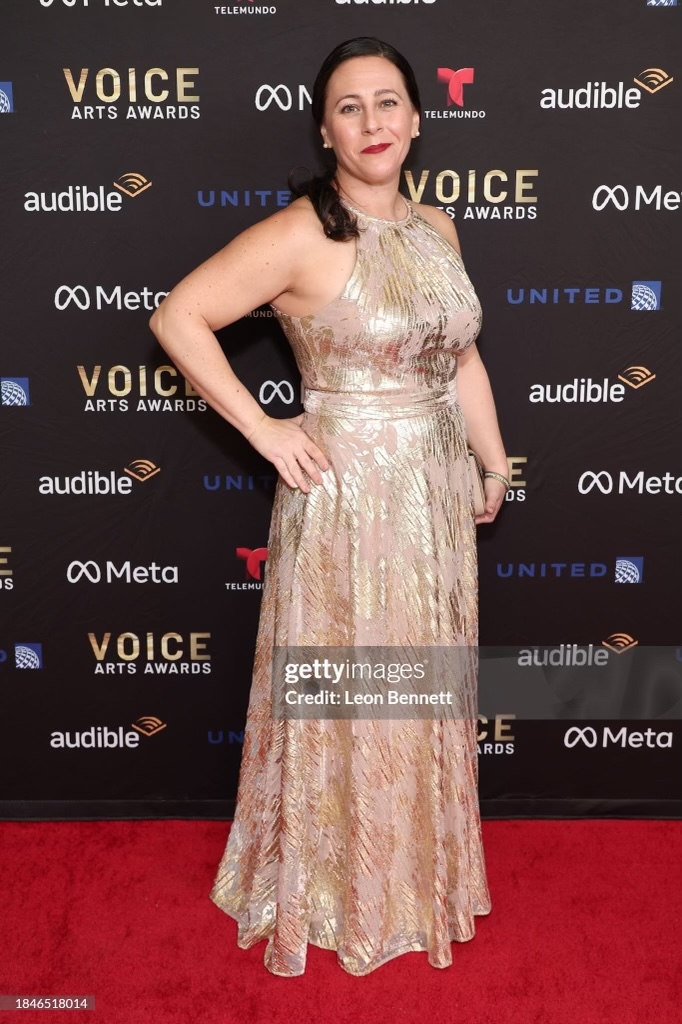
BEVERLY HILLS, CALIFORNIA – DECEMBER 10: Kat Jackson attends 10th Annual Society of Voice Arts and Sciences Voice Awards Gala at The Beverly Hilton on December 10, 2023 in Beverly Hills, California. (Photo by Leon Bennett/Getty Images)
Your Career Today
What does a typical workday look like for you now?
Every single day is different, which I love! My workdays have always been like that, and now that I run my own production company, I get to have even more say in what happens in my day. Some days I’m in the studio for eight to ten hours directing a recording. Other days I’m prepping my next book, meeting with current or potential clients, or connecting with other creatives to brainstorm how we can make something really cool together.
I’m also the Editor in Chief of AudiobookRush, an independent publication dedicated entirely to audiobooks, so part of my week is spent thinking about the industry from a completely different perspective, developing editorial ideas, talking with narrators, authors, publishers and other creators, and thinking about how we can better connect the people who make audiobooks with the people who love listening to them.
And sometimes I get to speak publicly or teach about the work, which will always be one of my favorite things to do. Most days are some combination of all of the above, and that variety is exactly what I want at this point in my career.
How do you stay organized and manage the demands of your work?
Uh, I don’t?
Seriously, this is something I’m constantly working on. I do think there’s some necessary chaos in the life of anyone doing creative work. You need space to fail, to brain-dump every idea you have, and then to sort through the mess and figure out which ideas are actually worth pursuing. I’ve learned not to expect that part of my brain to be neat and orderly.
For the things that absolutely have to get done, though, I need systems. I use a combination of project management tools, spreadsheets, calendar reminders, and good old-fashioned Post-it notes, basically, whatever it takes to get something out of my head and into a place where I won’t lose it.
What do you enjoy most about what you do?
I feel incredibly lucky that I get to help people tell their stories. There are a lot of things I love about what I do, but one of the most fun is recording with an author. You never quite know what it’s going to be like when the person sitting across from you is the person who actually wrote the words, and I’m constantly surprised by how much authors bring to the experience, the stories behind the stories, the moments that suddenly mean something different when you hear them in their own voice, and the trust they place in you to help them tell it well.
What aspects of the job are the most challenging or least enjoyable?
Sometimes I get a book that’s just not my jam. I can almost always find a way to connect with a book or an author, but occasionally the material itself is something I’m uncomfortable with or simply don’t believe in. Now that I’m working independently, I’ve finally found the confidence to turn down projects that don’t align with my values. That’s actually been surprisingly hard for me, so much of my career was built on saying yes to every interesting opportunity and figuring out how to make it work. I’m learning that there’s a difference between saying no because something scares you and saying no because something isn’t right for you. It’s still scary to turn down a gig, but I’m getting better at knowing the difference.
If you tour or travel for work:
I love to travel, I love seeing new places, learning something new, and meeting people I never would have met otherwise. But one of my favorite things about traveling for audio is discovering that, no matter where you go, studios are studios. I remember my first work trip to Japan being really disorienting at first. Then I walked into the studio and started geeking out with the engineers about the equipment, through a translator, and suddenly everything felt familiar. We might not have spoken the same language, but we spoke studio. It didn’t feel quite so far from home anymore.
What do you find most difficult?
Being away from my family. My kids are 11 and 16 now and I’ve always traveled since they were babies.
What is your favorite way to spend a day off or time away from work?
As anyone who runs their own business probably knows, “time off” is a bit of a relative term. But when I do unplug, I love anything live concerts, theater, sports. There’s something about being in a room or a stadium full of people all experiencing the same thing at the same time that I absolutely love. And I’m always happy to spend a day with my family doing something fun, preferably with absolutely no agenda.
Challenges, Growth & Perspective
What obstacles or systemic barriers have you faced in the industry?
Audiobook production and directing still don’t have the kind of established training pipeline you see in other areas of audio. It’s a very specific medium, so you can’t necessarily take what works somewhere else and just drop into it. When I was coming up, there was no obvious path to learn the job, and very few women I could look to on the production side once I got there. So a lot of it was figuring out how to get into the room in the first place and then proving I belonged once I was there.
How have you navigated or pushed through those challenges?
Persistence. Paying attention in any room I was let into. Asking questions and learning absolutely everything I could from the people around me. I also learned pretty early not to wait for someone to decide I was ready for the next opportunity. If I thought I could do something, I put myself forward for it and then, as I said earlier, it was on me to figure out how to do it well.
Have you seen the industry change during your career? If so, how?
The audiobook industry has absolutely exploded. When I started, we were producing two Harlequin romance audiobooks a month; today, hundreds of new audiobooks are released every week. What was once a relatively niche format has become a major part of publishing, and with that growth has come so much more experimentation—in performance, casting, production, and the kinds of stories we can tell in audio.
What still needs to change to better support women and marginalized genders in audio?
We need more women and non-binary audio engineers, full stop. Especially with the enormous growth of romance and romantasy, performers are increasingly being asked to record very intimate material, and we need to think about who is in those rooms and whether everyone feels safe and comfortable doing their best work.
I also think we need to support indie authors (and bookstores). Indie authors are publishing some incredible work, including stories and perspectives that haven’t always been prioritized by traditional publishing. Supporting those authors and making high-quality audio production accessible to them is another way we can make sure more voices get heard.
Advice & Looking Forward
What advice would you give to women or young people interested in entering audio?
Be clear about why you’re in the room and what you bring to it, and don’t let anyone speak down to you. Don’t be afraid to use your title.
At the same time, learn how to ask good questions and then really listen to the answers. There’s a huge difference between not knowing something and not being capable of learning it. You don’t have to pretend you know everything to be confident that you belong there.
What skills technical or otherwise do you think are essential for success?
For directors and producers, I think psychology is incredibly important. You’re working with new people all the time, and you have to figure out pretty quickly how to connect with them and support the way their particular creative brain works. Non-judgment is crucial, too. Someone’s story or their genre may not be familiar to you—or may be completely different from your own experience but it’s still your job to help them tell it, and tell it well.
Technically, I think directors and producers should know their way around a studio and understand how to engineer and edit. I don’t think we should necessarily be doing those jobs regularly, great engineers and editors have incredibly specialized skills, and I value them enormously but you need to be able to speak their language and understand what they’re doing in order to do your job well. And when something goes wrong, you should understand the entire production chain well enough to step in and help solve the problem.
What long-term goals or aspirations do you have?
I want to keep making the path into this industry more visible and accessible for other women, whether that’s through teaching, mentoring, or just being open about what I’ve learned along the way. I’d love to do a TED or TEDx Talk someday. And maybe most importantly, I want my kids to grow up seeing a mom who works hard, loves what she does, and is happy and fulfilled by the life she’s built.
Is there something you wish you had known earlier in your career?
I wish I had known how valuable it would be to be my authentic self. Early in my career, I spent a lot of energy trying to fit the mold of what I thought a professional woman should be, how I acted, what I wore, even the things I talked about at work. As my career progressed, I got more comfortable sharing my opinions and trusting my own point of view, even when someone might disagree with me. And the funny thing is, the more I stopped trying to be what I thought people wanted me to be, the more valuable I became as a resource, a collaborator, and a creative and the more people wanted to hire me. I wish I’d figured that out a lot sooner.
Favorites & Personal Touch
Favorite or most-used gear (and why):
Gear isn’t really my area of expertise—I’m very happy to leave that to the brilliant engineers I work with. But if pressed: great soundproofing. Nothing makes me happier than a beautifully quiet room.
A piece of gear you can’t live without:
Can I say the talkback button? I need to be able to talk to my actors!
A moment in your career that made you feel proud or affirmed:
When I was approached by AudiobookRush to come on board as Editor in Chief for its launch, that was a really proud moment for me. They told me there was literally no one else they could envision for the role, and hearing that at this point in my career meant a lot. Then seeing the first press release go out with my name and “Editor in Chief” in the headline was incredibly surreal. After spending more than twenty years working in audiobooks, having someone look at all of that experience and say, essentially, “We want your perspective to help shape what comes next” felt incredibly affirming.
Is there anything else you’d like to share or contribute?
Nothing else to add except to say thank you for all the work you’re doing! It’s so important that we stick together and support each other, and it’s because of organizations like yours that we can do that!