
The last couple posts have talked about IATSE – details about the union and navigating benefits like Annuities and Pensions for Pink Contracts.
Union Benefits: Annuity and Pension
In this post, we’re going to dive into the two other major benefits for Pink Contracts
Vacation and Health & Welfare
At a regular job you’d get benefits like healthcare and retirement through your employer, but in our industry we change employers regularly, sometimes multiple times a year, making that impractical. The union steps in to bridge that gap. They negotiate our contracts so the employers pay benefits in addition to our salary and the International manages those accounts via IATSE’s National Benefits Fund (NBF).
The benefits we’re talking about are specific to Pink Contracts. These are the contracts for road crews on tour, show crews on Broadway, and some shorter runs like out of town pre-Broadway productions. Locals have their own set up for similar benefits, but they have different rules and requirements, which I don’t know much about, since I’ve only worked on Pinks.
The NBF handles four major categories: Annuity, Pension, Vacation, and Heath & Welfare. I’ll go over some of the basics, but there are plan summaries of all these accounts on the IATSE Benefit Plan website which can give you a much more detailed look at what all of these are.
Vacation
This is the most straightforward benefit. Each pay period, the company pays 5% of your salary earned into a fund that IATSE holds on your behalf. The money is supposed to act like the two weeks of paid vacation you’d receive at a normal job.
The money is taxed. You’ll see it on your paystub under earnings and then it will be withheld and sent to the IA benefits office. You do not get vacation on overtime.
Once a year, usually at the beginning of May, you will receive a check or direct deposit of that money, minus admin fees. Those have ranged from 2%-7% across the 15 years or so that I’ve received benefits. The fund is usually invested in short term fixed income to help offset the costs, but that doesn’t always work out, depending on the market.
If you want to se up direct deposit you can go through the NBF website and find the form under “Vacation” and “Forms and Applications.”
Health & Welfare
There are two plans under Pink Contract healthcare: Plan A and Plan C.
If you’ve already read the previous blog about Pensions and Annuities, you can think of these plans in a similar way. Both are providing healthcare, just in different ways.
Plan A is the default option for larger tours and Broadway, and it offers a high level of coverage for healthcare, vision, and dental (spouses and dependents can also be included in these plans).
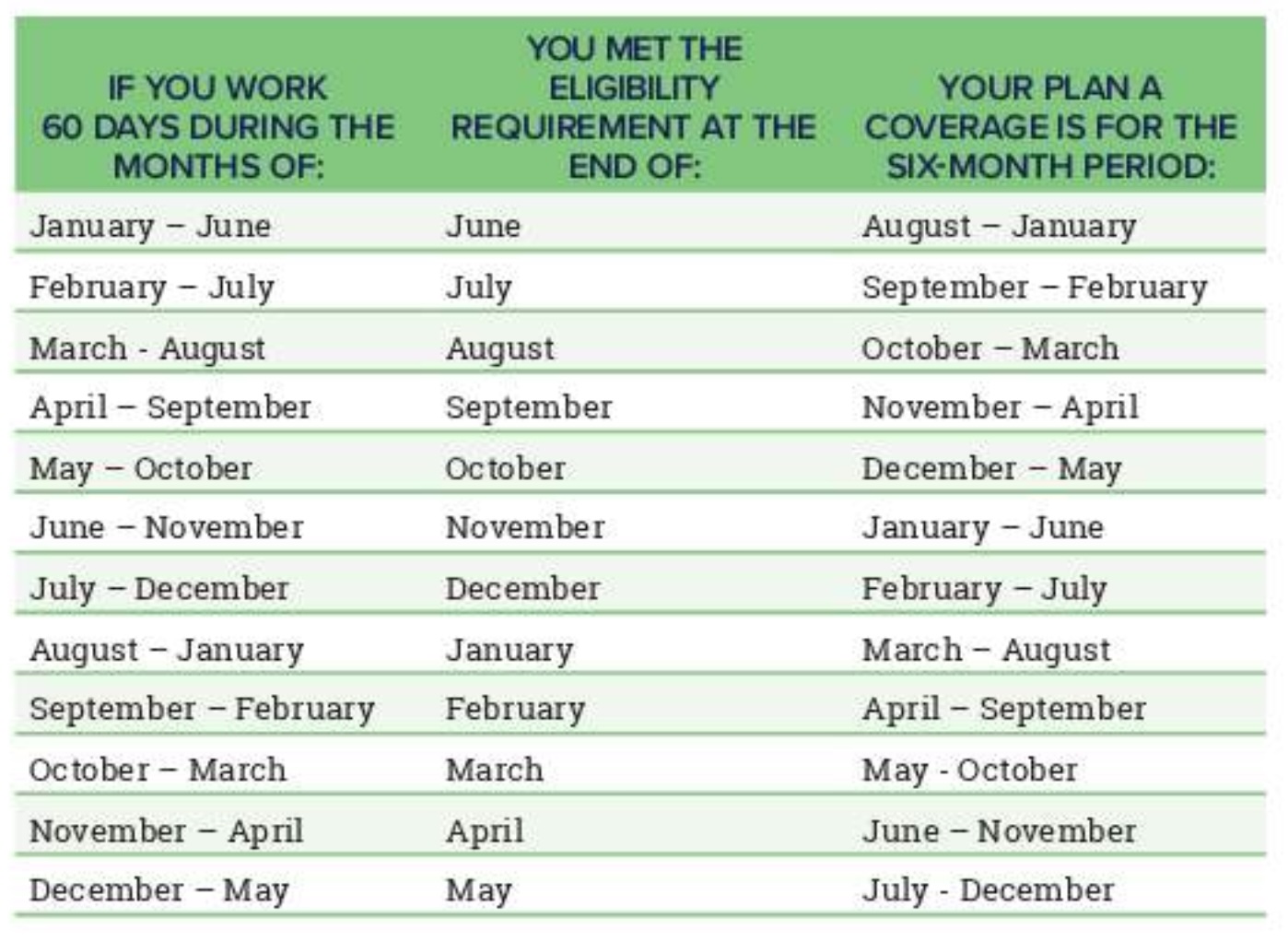
It operates somewhat similar to the Pension where you have to work a certain amount of days on a Plan A contract to be eligible for coverage. In this case, you maintain your coverage by working at least 60 days in a 6-month period. Every six months the count resets and you have to earn another 60 days to qualify for the next 6 months of coverage.
For example: let’s say you got your card and joined a tour at the end of August. Between load in, tech, and the first couple moves, you’re working six days every week for the next couple months, until you hit a layoff in November.
So, one week in August is 6 days, four weeks in September is 24 days (30 total), four weeks in October is 24 days (54 total), and three weeks in November is 18 days (72 total). This puts you over the threshold of 60 days in November.
As soon as you hit the threshold, the next month (in this case December) will be a processing or “look-back” month and the coverage will start the month after, so January 1st. Depending on when you hit 60 days, your accrual period and processing month with shift accordingly.
This extra month exists because the company has to send the payments to the benefits office and then the union makes sure your account is credited correctly. So there’s a built in month of time to make sure the office has time to get the correct number of days into your account. There are some times that days will get mixed up and you’ll have to reach out to the office to get things squared away. It’s a good idea to keep track of your pink contracts in case the NBF office needs them to verify employment.
Once your healthcare starts, your cycle would look something like this
Earn 60 days from December – May (processing in June) gets you coverage from July – December.
Then, earn 60 days from June – November (processing in December) for coverage from January – June.
Rinse and repeat each year. Your coverage might start in a different month, but that’s the general pattern. Earn 60 days in the accrual period, and you’re set for the next 6 months of coverage.
For a full-time job, this is pretty easy. You’ll typically earn closer to 120-140 days, well over the 60 day threshold.
Even though you earn so many extra days, you aren’t able to bank them or save them for later because Plan A relies on the majority of participants being full-time employees. Those extra days help subsidize the Plan A participants that only meet the minimum of 60 days.
That’s the gist of Plan A. Earn your days, keep your healthcare, enjoy low co-pays and deductibles.
If you don’t earn enough days in your 6-month period, your coverage will lapse until the requirement is met. You do have the option to pay for COBRA coverage on a monthly basis to bridge the gap, so you won’t completely lose your healthcare, but that can be expensive.
For example, let’s say your accrual period is May – October (coverage from December – May).
The show you’re on finishes up in May leaving you with 20 days in your account. June – October has some subbing or shop work, only some of which pays into Plan A (shop work will not). You have 20 days from May, plus 10 in June, 12 in July, 0 in August, 9 in September, and 7 in October for a total of 58 days.
Since you didn’t make 60 days between May and October, you won’t have enough days to qualify for coverage for the December – May block. At this point your account starts looking at the last 6 months, rolling forward until you make the 60 days.
Since May – October didn’t have enough days, now we look at June – November. We lose the 20 days from May, but get 15 in November (10+12+0+9+7+15) for a total of 53. Still not enough.
June – November doesn’t work, so next we look at July – December. We lose the 10 days from June, but get 20 in December (12+0+9+7+15+20) for a total of 63, which meets the threshold.
With your 60 days in the bank in December, your accrual period is now July – December, your processing month will be January, and coverage starts February 1st, with a lapse of 2 months.
This means you don’t have to wait a full 6 months to get your coverage back, you just start a new accrual cycle as soon as you earn 60 days.
As you can see, the all-or-nothing aspect of Plan A can be difficult if you’re not working full time or if you take on a lot of different jobs. You have to make sure you know when your accrual period ends and keep an accurate count of the days.
In NYC, everyone understands that people who are subbing still need their days to maintain healthcare. It’s not uncommon for a sub to reach out to the shows they’re covering and say they need a couple extra days to make their 60. Most people will be happy to give you extra days if you let them know you’re going to be a couple short. It’s up to you to stay on top of what you need and don’t be afraid to ask for help.
Plan C works a little differently.
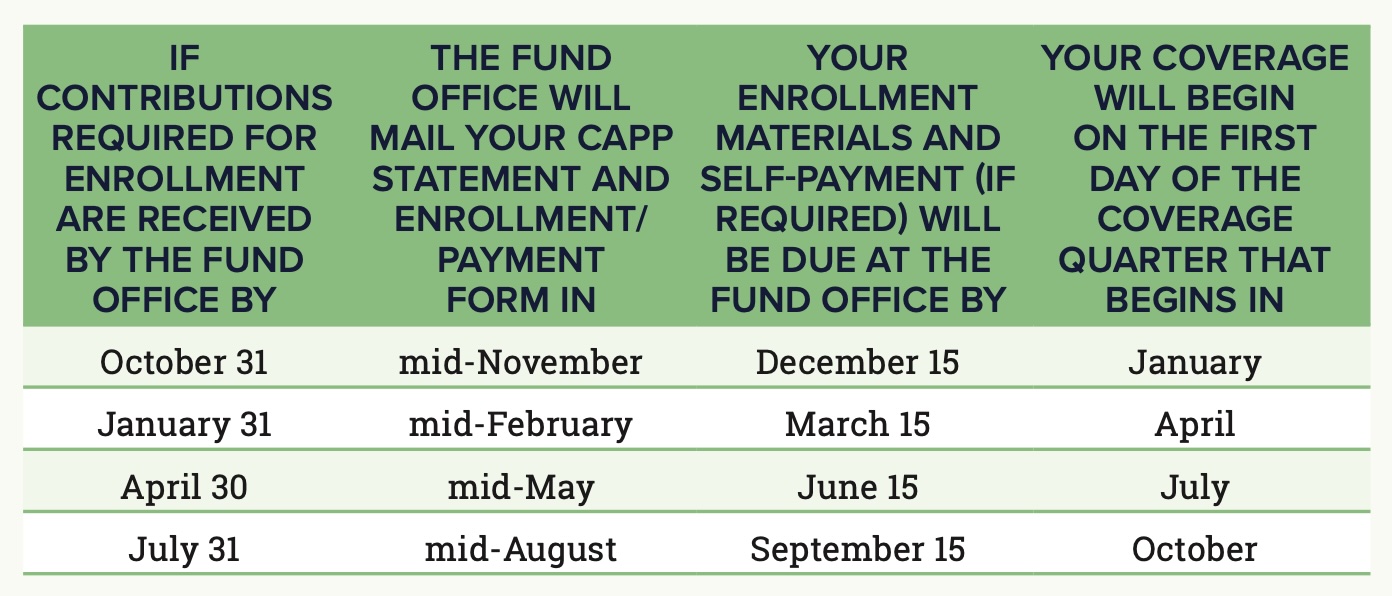
This is the healthcare that you’ll find on smaller tours and design contracts and is set up similarly to the Annuity where the benefit amount goes into an account and you have a little more control over how it’s utilized. Your employer sends the funds to the benefits office, and from there it goes into your personal CAPP account (Contributions Available for Premium Payments). This is money to pay the quarterly premiums or you can submit medical receipts for reimbursement if you have an excess balance (anything over 2 quarters of premium payments).
Unlike Plan A, this isn’t an all-or-nothing approach. If you don’t have enough in your account to pay the premium, you can self-pay the difference out of pocket and keep your coverage. Coverage starts as soon as you have enough in your account to cover one month of C-2 coverage, plus a $150 admin fee.
There are multiple tiers of coverage and you pay a quarterly premium to maintain your coverage
C-1 is a comprehensive plan with both vision and dental and has the lowest co-pays and deductibles. It’s probably the closest to Plan A coverage.
The quarterly premium is $5,964. So, if benefits are paid at the same rate as Plan A (which is $89/day) it would require 136 days of work to pay for a 6-month period (68 days per quarter).
C-2 is also a comprehensive plans with vision and dental, but has slightly higher co-pays and deductibles. Its quarterly premium is $3,045 or 70 days in Plan A contributions to pay for a 6-month period or 35 days per quarter. This is the option most stagehands on Plan C choose because it provides good coverage without the high quarterly cost of C-1.
C-3 is where coverage starts to noticeably decline. It requires you to use an in-network doctor for health-related appointments and hospital stays, and only includes basic preventative dental care and discounts on some vision services. Its quarterly premium is $2,232 or 52 days of Plan A rate for 6-months or 26 per quarter. This is a less common plan, but typically used if you’re not sure how much you will be working, but need to maintain some kind of health coverage.
C-4 in the paperwork is self-described as a “catastrophic plan with a high deductible.” It requires you to use in-network providers and doesn’t provide any dental, but has discounts on some vision services. Its quarterly premium is $1,293 or 30 days of Plan A rate for 6-months or 15 per quarter.
When you start working, you don’t have a choice of which plan you get; your contract will dictate which plan the employer pays into. As you continue on in your career, it’s more likely that you’ll work on a variety of shows, some that pay into Plan A (large contract tours, Broadway), others into Plan C (smaller tours, associate/assistant design work).
If you have an existing Plan C account and move to a show that pays into Plan A, you have two options:
You can switch over to Plan A, and keep your Plan C account for medical reimbursements. You’ll have the Plan C account as long as there is money in it and there’s still some activity within a 2-year period (premium payments, reimbursements, or employer contributions).
Or you can opt to have your Plan A contributions redirected into your Plan C account. This means you keep your Plan C coverage instead of moving over to Plan A and the contributions go into your CAPP account which you can continue to use for quarterly payments or reimbursements. Plan A contributions are usually higher than Plan C, so you can bank the extra money to use in the future if you ever need to take time off or freelance.
Currently, there isn’t the option to request a Plan C account if you don’t already have one, so, if you’ve always been on Plan A, you just continue to stay on Plan A.
But why would you choose to take a lower tier of healthcare when your employer would pay into Plan A? How do you decide between the two plans if you have the option?
If you plan to spend most of your career in full-time employment, that makes it pretty easy to get the 60 days. If you need medications, have conditions that require consistent appointments and care, or if you have a family that relies on your healthcare, Plan A is usually the better option. The biggest downside to it is that 60-day requirement, and if that’s not a problem, it’s excellent healthcare.
The benefit of Plan C lies in its flexibility. If you plan to work on multiple kinds of contracts or have long stretches where you don’t work, Plan C works to your advantage. You keep your medical coverage, can use contributions whether they pay into Plan C or A (if you choose to redirect), and don’t have to stress yourself out counting days.
I spent most of my career on Plan A, and thankfully didn’t have to use it much. I had a Plan C account from an early tour that closed due to inactivity, and never thought much of it until I was ready to get off the road and move to NYC.
In 2023, I was subbing and freelancing. My first accrual period (Jan-June) had mix training and enough coverage that I made my 60 days quickly and didn’t worry about it much. The second period (July-Dec) was a different story. I did production for the 2nd National Tour of Mean Girls which took up most of my August and September, and that only paid into Plan C, so I just barely squeaked by with 70 Plan A days at the end of my 6 month accrual period.
Getting off the road was supposed to give me more control over my time and my work. It was supposed to mean that I could take time to visit my family, work on fun projects that kept me engaged, or take a vacation without worrying about my work schedule. The structure of Plan A and the stress of counting days felt like an incredibly limiting factor, so I swapped over to Plan C.
Plan A was great when I was on the road, and would have been while I was full-time on Outsiders if I’d kept that coverage.
However, my priorities have shifted, and Plan C allows me the flexibility I envisioned when I left tour. I could walk away from Outsiders to help set up the tour and do an out-of-town tryout without worrying about how I’d make my days. After working on Dog Day Afternoon from this January through July, I can take a couple months off, probably sub a little, and work on an Off-Broadway show that won’t pay into my benefits. I can do all that and still maintain my health coverage for at least a year off the current balance in my CAPP account.
In the end, it’s what works best for your circumstances and goals. Each of us will have different needs that require a different application of the benefits that IATSE provides. Hopefully these couple posts were able to shed some light on how these work and what your options are. It’s a lot of information to digest, but knowing what your options are can help you plan for your future.