
If you end up working in the theatre industry, especially if you want to work on tour or in NYC, chances are good you’re going to work with or become part of a union.
Actors and stage managers are both in Actor’s Equity Association (A.E.A.), truck loaders are part of the Teamster’s union, and musicians join A.F.M. (American Federation of Music). Company managers are a part of ATPAM (Association of Theatrical Press Agents and Managers) and designers are USA 829, both of which are a part of IATSE (International Alliance of Theatrical Stage Employees), who primarily represents stagehands for theatre and film.
IATSE has hundreds of chapters across the US and Canada called “locals.” Local 1 is NYC, Local 2 is Chicago, up into the 900’s with Local 918 in Anchorage. Some cities have multiple locals, so you might have one for theatre stagehands and another for film crews, or sometimes the departments themselves are separate with one local for hair, wardrobe, and make up and another for carpentry, props, and electrics. Technically, sound is a subset of electrics, but that rarely comes up unless your Head LX wants to joke that they’re actually your boss or you need to grab some electricians to help sound in a “push by department” city.
Each local has a different process for how you join and many have their own benefit programs for health care and retirement. It gets complicated quickly, so we’re going to take an in-depth look at my own IATSE local, since I know it’s programs the best: ACT.
ACT (Associated Craft Technicians) started as a bit of a catch-all, but today is mainly comprised of touring stagehands who weren’t already IATSE members when they went on the road. The original thought was that we would be on the road for a while, then find a place to settle down and transfer into the nearest numbered local.
The reality ended up that many of us planned to stay on the road indefinitely or settled in areas like NYC where the local doesn’t accept direct transfers. Eventually there were enough ACT members that the International recognized us as our own local and we now have representation at conventions and meetings.
If you plan to be in one place for the next couple years, take a look at IATSE’s Local Union Directory. It’ll give you information on your area’s local and who to contact if you’re looking for more information on how to join, since this post is going to cover a different part of IATSE.
So you want to tour or work on Broadway, which means you’ll eventually have to join IATSE. How do you become part of it?
For tour, this is fairly straightforward: when you join a production (usually through a company like NETworks, Crossroads Live (once Troika), Worklight, or Feld Entertainment), if you aren’t already a member of IATSE, the company will buy you into the union as an ACT member. They’ll pay your dues for the rest of the current year, then prorate your paycheck to reimburse that cost. For me, they paid for two quarters since I joined the tour in August and took out a quarter of the dues for two paychecks.
For context, my ACT dues for 2026 was $540, or $135 per quarter, and each year it goes up by a dollar or two per quarter. ACT members and those on the road typically have to pay for the full year of stamps at once.
Once you have your card, you’re the one responsible for contacting the office and paying your dues for the upcoming year. You’ll usually get a letter and emails to remind you in October or November, so try to pay them before the end of the year, and the office will usually send your new card a couple stops ahead. That way you don’t have to play catch up if it makes it to a city after you’ve already left.
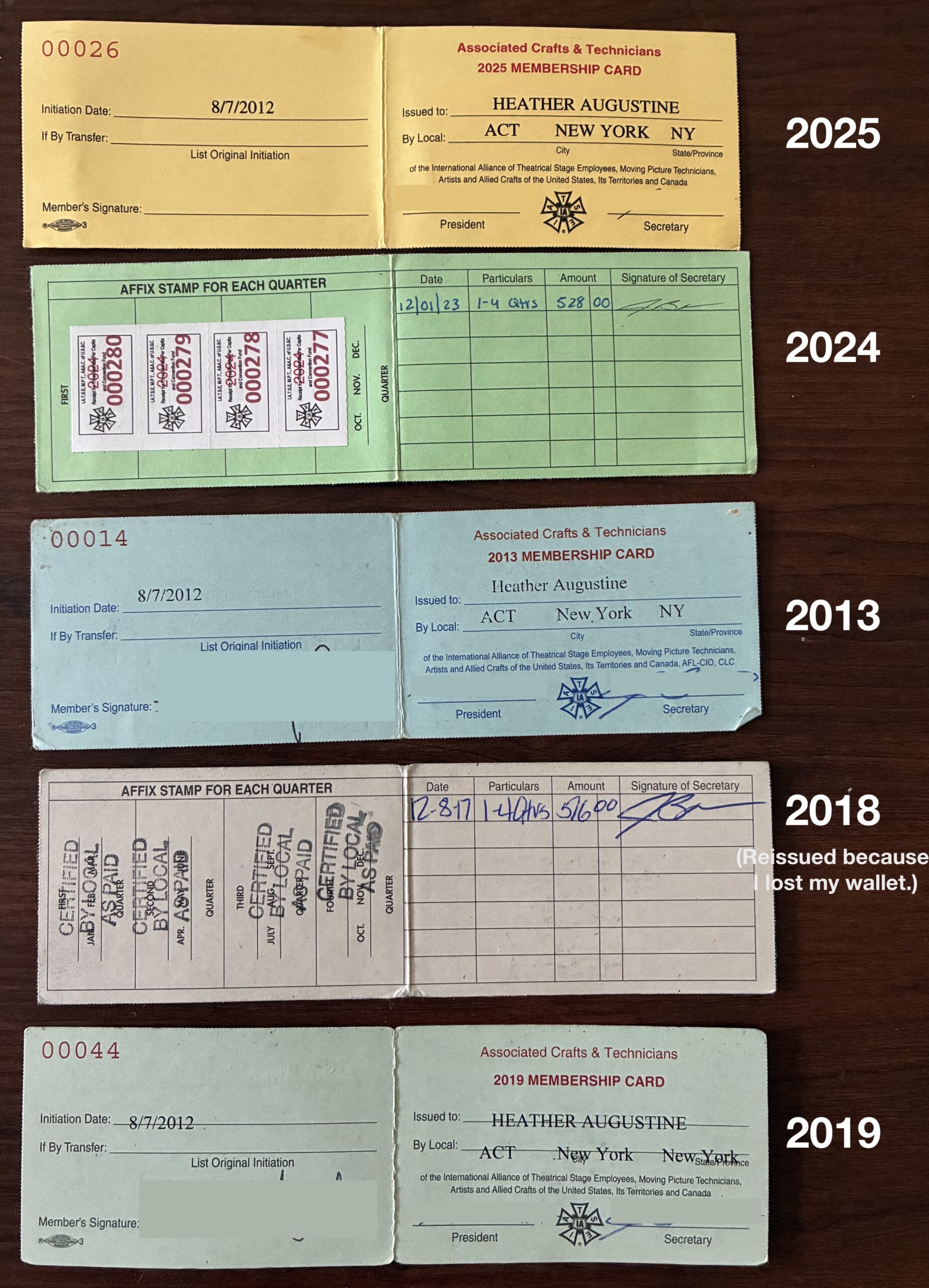
Other locals have different requirements. Some have apprenticeship programs or classes to take. Local 1 in NYC requires that you earn a certain amount of money on their payroll for three consecutive years before you’re eligible to be inducted. Usually this requires working load ins and outs or subbing on show tracks.
Broadway and tour crews work on Pink Contracts. These are positions that can be staffed by an IATSE member, no matter what their local is. This is how I can live and work in NYC while still being a member of ACT, not Local 1.
This is because Broadway and tours operate where you have a two distinct sets of crews: a show crew and a house crew.
In NYC, the house crew is Local 1 and paid by the management that owns the theatre itself. The show crew are on a Pink Contracts, paid by the production company of the show itself. The house crew stays with the theatre, show after show, while those on a Pink will move from theatre to theatre as they work on different shows.
Each show is limited to a certain amount of pink contracts, so those are often positions like automation, pyro, props, mixers, and A2s. Positions that either designers or the production company want some say in hiring.
These allowances were made by Local 1 because shows need specialty positions: you might have a great house carpenter, but not someone who knows the automation system being used. Props people might need specific skills to repair items or handle firearms. Sound is a subset of the Electrics department, so you don’t have a Head Sound in the building on Broadway, let alone someone who can program a console or mix a show the way a specific designer wants.
For a musical like Outsiders the Broadway crew broke down like this:
House Crew:
Carpentry (2): Head Carp, Flyman
Electrics (4): Head Electrician, Assistant Audio, 2 Followspot Operators
Props (2): Head Props, Assistant Props
Show Crew:
Carpentry (1): Head Carp/Automation
Electrics (4): Head Electrician, Pyro Op, Head Audio, Assistant Audio
Props (2): Head Props, Assistant Props
For a play like Dog Day Afternoon, there were different crew needs:
House Crew:
Carpentry (2): Head Carp, Flyman
Electrics (2): Head Electrician, Assistant Audio
Props (1): Head Props
Show Crew:
Carpentry (1): Head Carp/Automation
Electrics (2): Head Electrician, Head Audio
Props (1): Head Props
It was a smaller show with no follow spots, fewer deck tracks for props and carpentry, and no Pink A2.
Wardrobe, Hair, and Make up (sometimes collectively abbreviated to as WHAM) are under different contracts in NYC that aren’t Pink or Local 1, but you’ll usually have a head and an assistant in each Wardrobe and Hair, a Make up artist if you have some special effects, plus multiple dressers, a stitcher, and a laundry person.
Your house crew has to match or exceed the number of pink contracts for everything including show calls, rehearsals, and work calls.
Tour crews are similar in most respects. Where they differ is that show crew for WHAM are on the same pink contracts as the rest of the crew, sound is treated as its own department, so you’ll have an actual house Head Audio in most cities, and there are more people in general on the crew.
Show crews for tours might break down like this:
House Crew:
Carpentry (6): Head Carp, 2 Flyman, 3 Deck Carps
Electrics (4): Head Electrician, Deck Electrician, 2 Followspot Operators
Audio (2): Head Audio, Assistant Audio
Props (4): Head Props, 3 Deck Props
Wardrobe (8-10): Head, Laundry, Stitcher, Dressers
Hair (1-2): Stylists
Show Crew:
Carpentry (4): Head Carp, Automation, Flyman/Rigger, Deck Carp
Electrics (3): Head Electrician, Spot Op, Deck Electrician/Video Tech
Audio (2): Head Audio, Assistant Audio
Props (2): Head Props, Assistant Props
Wardrobe (3): Head Wardrobe, Assistant Wardrobe, Star Dresser
Hair (2): Head Hair, Asst Hair/Make up
There are more people on a road crew because they have to know the show tracks and teach it to the local crew, as well as have enough people to give direction and load the show in. You can look up any of the shows under an IATSE contract and see what their crew requirements are, as per their Yellow Card, or the documentation of union status and labor needs.
Taking a look at the actual contracts, the same structure of the Pink Contracts that apply to Broadway, also cover tours.
However, while there is only one contract for Broadway, there are multiple for tour.
There are a set of contracts for League Producers for when the same people who produced the Broadway version are sending out the tour. There’s another set for the production companies like NETworks, Crossroads Live, and Worklight who typically take the shows and trim them down to make it easier to tour in smaller markets.
These contracts have different tiers, each with different minimums for salaries and benefits.
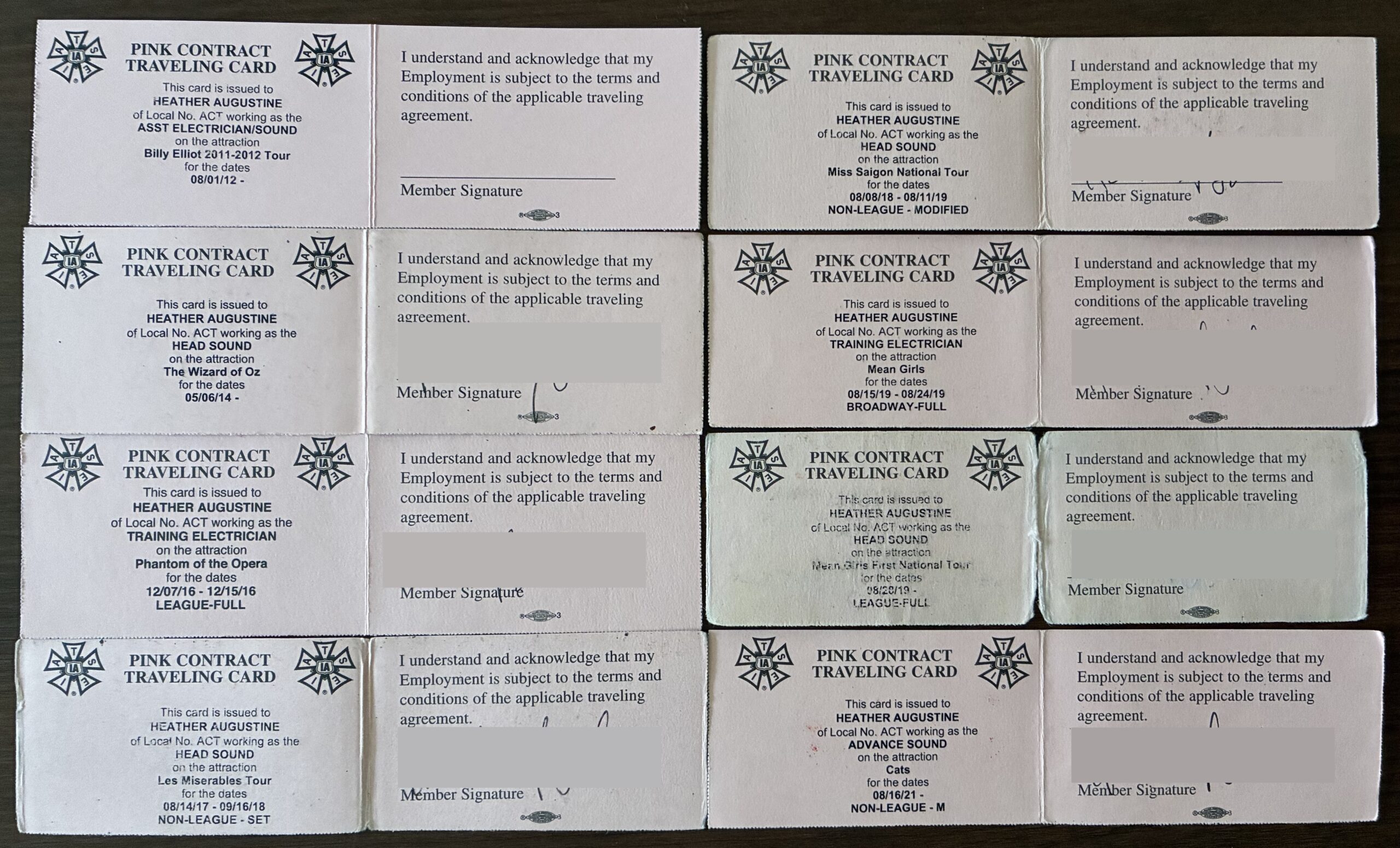
“Full Pink” contracts have lower minimum salaries, but similar benefits as a show on Broadway. “Modified Pink” is a step down with lower in benefits and minimums for a theoretically smaller show.
“SET” or Short Engagement Tours are another step smaller than the Modified, and “Bus and Truck” tours (which originated from when a tour was one bus for cast and crew and one truck of gear) now denotes a small tour that does mostly one-nighters.
When you go on the road, you’ll have your membership card from IATSE showing you’ve paid your dues and are in good standing with the union and a contract (printed on pink cardstock, hence the name) with the show you’re on and the position you occupy.
Some companies are sending digital versions of the contracts, but I always had a physical copy which I kept in my wallet. You just have to make sure it’s somewhere accessible (i.e. not in a workbox on a truck that you won’t see until the end of load in), because there’s a tradition a lot of locals observe called “Cards and Contracts.”
At the first coffee break of load in the local steward will ask the road crew to show their signed and stamped IATSE membership cards and traveling card contracts. Usually, this is an exchange, something like a show of union solidarity, you’ll give them your card and they give you theirs. Some theatres will have you sign a log book as well.
Stewards will give everyone a grace period at the beginning of the year as people are paying dues and the locals and the International are mailing out cards, but plan ahead.
Every once in a while you’ll get a steward who’s trying to test you. They’ll usually take your card, look at it, then ask if you have anything to ask them. If they do that, they just want you to ask for their card.
As an IATSE member, you have a contract negotiated for you with base salaries, rules for overtime and holiday pay, requirements for housing, and benefits that the employer is required to pay into. When contracts come up for renegotiation the union will typically ask the stewards to get their crew’s input on what the priorities are for negotiation and, once the two parties have ironed out the new terms, the membership will vote whether to ratify or reject the contract.
On each show, tour or Broadway, you’ll have a steward elected by the crew. This should be a person who understands the contract and is personable enough to have a conversation with management, but can hold their own if there’s an issue that needs to be resolved. It can be a thankless role, but it’s an important one. They’re the line of communication between the show crews and the International office if there are questions about how the company is interpreting the contract or workplace conditions.
Being a part of IATSE opens up a lot of opportunities depending on what you want to do in your career. It’s well worth looking into what your options are to join a local in your area or contact production managers if you’re interested in touring.
Our unions take care of us in many ways. Not only do they help negotiate fair working conditions, they also have programs for healthcare and retirement benefits. Over the next two blog posts I’ll talk about those benefits for pink contracts and some things you should know to navigate them.