My last post talked about IATSE – what it is, what it does, different paths to get into the union, and how different locals might interact. In my next two posts, we’re going to dive into benefits for Pink Contracts.
At a regular job you’d get benefits like healthcare and retirement through your employer, but in our industry we change employers regularly, sometimes multiple times a year, making that impractical. The union steps in to bridge that gap. They negotiate our contracts so the employers pay benefits in addition to our salary and the International manages those accounts via IATSE’s National Benefits Fund (NBF).
The benefits we’re talking about are specific to Pink Contracts. These are the contracts for road crews on tour, show crews on Broadway, and some shorter runs like out of town pre-Broadway productions. Locals have their own set up for similar benefits, but they have different rules and requirements, which I don’t know much about, since I’ve only worked on Pinks.
The NBF handles four major categories: Annuity, Pension, Vacation, and Heath & Welfare. I’ll go over some of the basics, but there are plan summaries of all these accounts on the IATSE Benefit Plan website which can give you a much more detailed look at what all of these are.
This post will be on Annuities and Pension, and another one will cover Vacation and Health & Welfare.
So let’s get into it:
Both Annuities and Pensions put money aside for your retirement. How they do it is different.
An annuity puts your benefits into an account where that money is invested. At retirement you can withdraw all or part of the funds, or set up a plan where you’re paid a certain amount every month based on your balance.
A pension, on the other hand, counts the days you’ve worked in covered employment for the year and you earn up to one credit based on your count. At retirement you receive a payment based on how many credits you’ve earned and the rate at which those credits were paid.
Here we’ll dive into some details:
Annuity
Your annuity fund is similar to a 401k. Your employer is required to contribute a certain amount (each contract tier will use slightly different percentages), but you can also choose to make pre-tax contributions from your salary.
If you want to contribute, you have to fill out and submit a form. Some employers will include this form with the rest of your onboarding paperwork (W2, I-9, etc) when you’re starting a new show, but for others you’ll have to get it yourself and send it to your company manager. You can find it on the IATSE benefits website.
There are limits to what you personally can contribute to a 401k or other employer sponsored retirement accounts like annuities. For 2026 it’s $24,500, but it can (and does) change from year to year as the tax code tries to compensate for inflation. Make sure you double check what the limit is before you fill out the form. Personally, I usually try to contribute at least 5-10% of my salary, depending on the contract.
As a quick rule to figure out how much I can contribute: I’ll take the limit ($24,500) and divide by 50 weeks (assuming I’ll take some vacation time). That comes out to $490 for 2026. If I know my salary (the rate for a head of department on Broadway is currently $3,200), I can see that $490 is a little over 15% of $3,200. That means if I’m working full time on that salary, I can contribute up to 15% without going over the limit. So, my normal 5-10% will be fine.
Your annuity account collects the contributions from you and your employer and invests them in one or more funds provided by the investment company.
Currently, the Pink Contract annuities are taken care of by a company called Principal. A few years ago it was Wells Fargo. The companies will change, but the funds typically stay the same. The benefits website provides a link to the company’s website where you can create an account to look at your balance and choose which funds your money is invested in.
There are a variety of different accounts:
Fixed Income which are things like bonds or CDs (Certificate of Deposit). These are lower yielding, but typically very consistent.
Equity accounts which follow companies in different categories: Large which are big brand-name companies you’d recognize, Small/Mid which are usually lesser known companies that have room for upward mobility, or International, which are foreign companies. These equity accounts tend have more risk/reward than fixed income because companies either do well and grow, or fail and get removed from the market.
Target Retirement Funds have several options depending on the year you plan to retire (assume when you’re 65). The asset allocation of the fund will shift over time from more aggressive (stocks) at the beginning for growth, to more conservative (fixed income) as you get closer to your retirement age, providing stability.
By default, your money will go into an “IATSE Annuity Balanced Fund.” This is somewhere between fixed income and equity, so more conservative returns, but fairly stable in general.
If your eyes completely glazed over as soon as I said “Fixed Income,” I’d recommend you direct the fund to invest in the Target Retirement fund that best lines up to your age bracket, and forget that it exists.
The only reason I say forget it is because your account will fluctuate with the stock market and other investments. Obsessing over which fund makes more money on a given year is sure to drive you nuts, and many armchair experts can do more harm than good if they keep trying to jump in and out of funds.
Once money starts going into this fund it is yours and it will continue to exist, tracking the success of your investments until you hit 65, even if you leave covered employment. At 65 you can choose to receive the amount of the account as a lump sum (either in its entirety or just part of it), or have the account converted into an annuity that will pay you a certain amount guaranteed for the rest of your life.
There are a couple things you can do outside the normal bounds of the annuity
You can take early or hardship withdrawals, which come with fees and taxes, so they’re typically not recommended, unless there is an emergency or urgent need. I know of a few people who opted to make those withdrawals during COVID.
The other option is similar to having a 401k with an employer that you’ve left. If there are no contributions to your annuity for 6 months or more, you can take your annuity balance and roll it over into a personal IRA (Individual Retirement Account) without incurring a tax penalty. This mean the company that manages the annuity will send all the money in your account to the your bank and they deposit it into your IRA where you can decide what to invest it in.
Just make sure it’s a rollover and they don’t send the money to you. That comes with taxes and fees that won’t happen if the banks handle it.
If you don’t have an IRA, I strongly suggest you open one. This is similar to an annuity, but you’re the only one who’s contributing and you have full control over where the money is invested.
Pension
Pensions are a thing of the past for many people. For earlier generations you’d work for a company for 40 years and then retire with the promise of a guaranteed monthly payment based on how long you’d worked for the company. Some unions, like IATSE, still have pension programs for their members, giving you one more resource to build a comfortable retirement.
Each day worked counts towards a credit in your pension account. You can earn up to 1 credit per year if you work 210 days or more. If you work fewer days than that, you get partial credit. Your retirement benefits count up to a maximum of 25 credits.
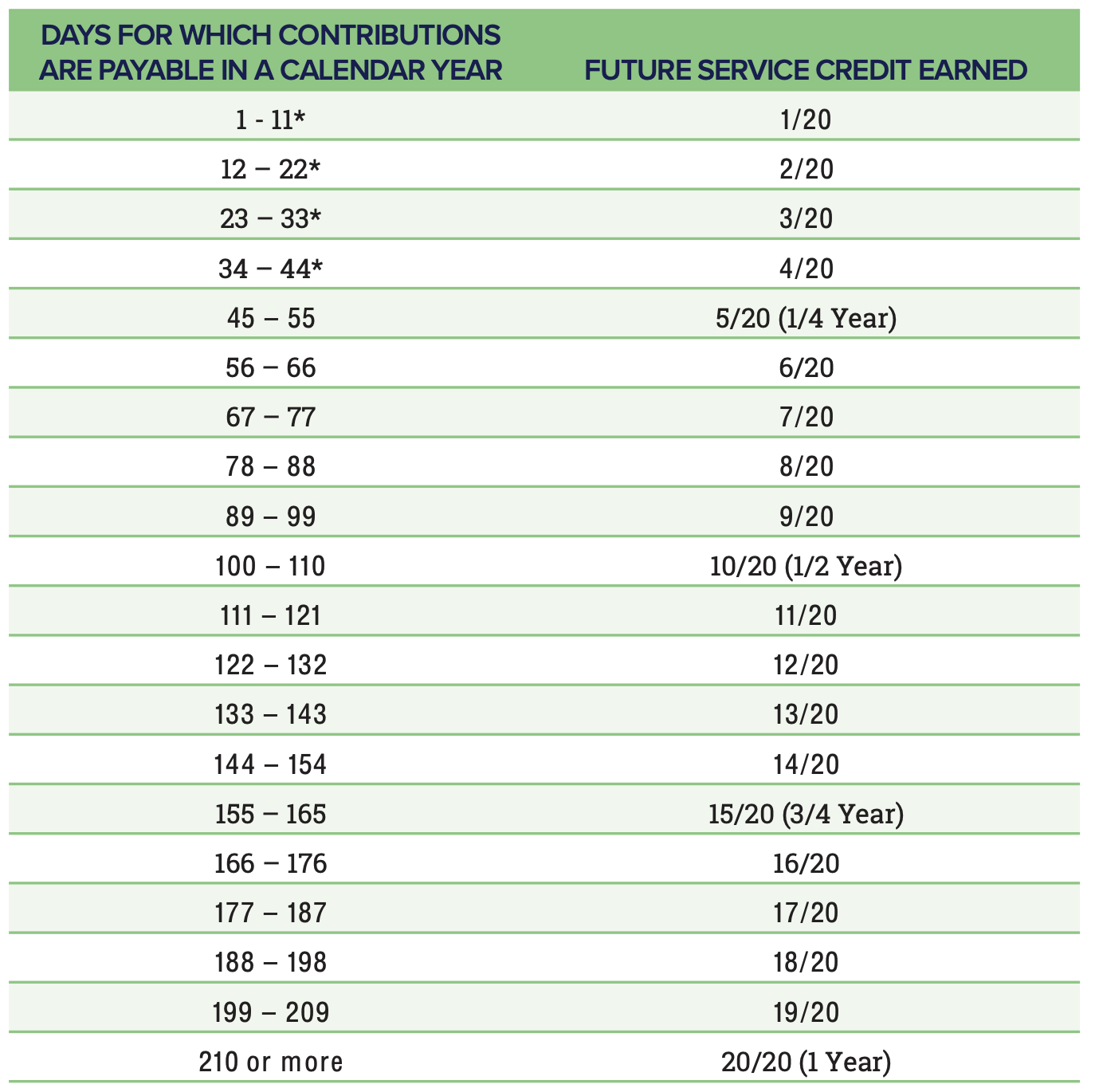
This is what my pension history looks like:
2012 was when I joined IATSE and started touring in August. There was no way I could make it to 210 days, but I got the partial credit for the days I did work.
2013 was split between two tours with a summer off and enough layoff weeks that I didn’t quite hit the 210 day mark.
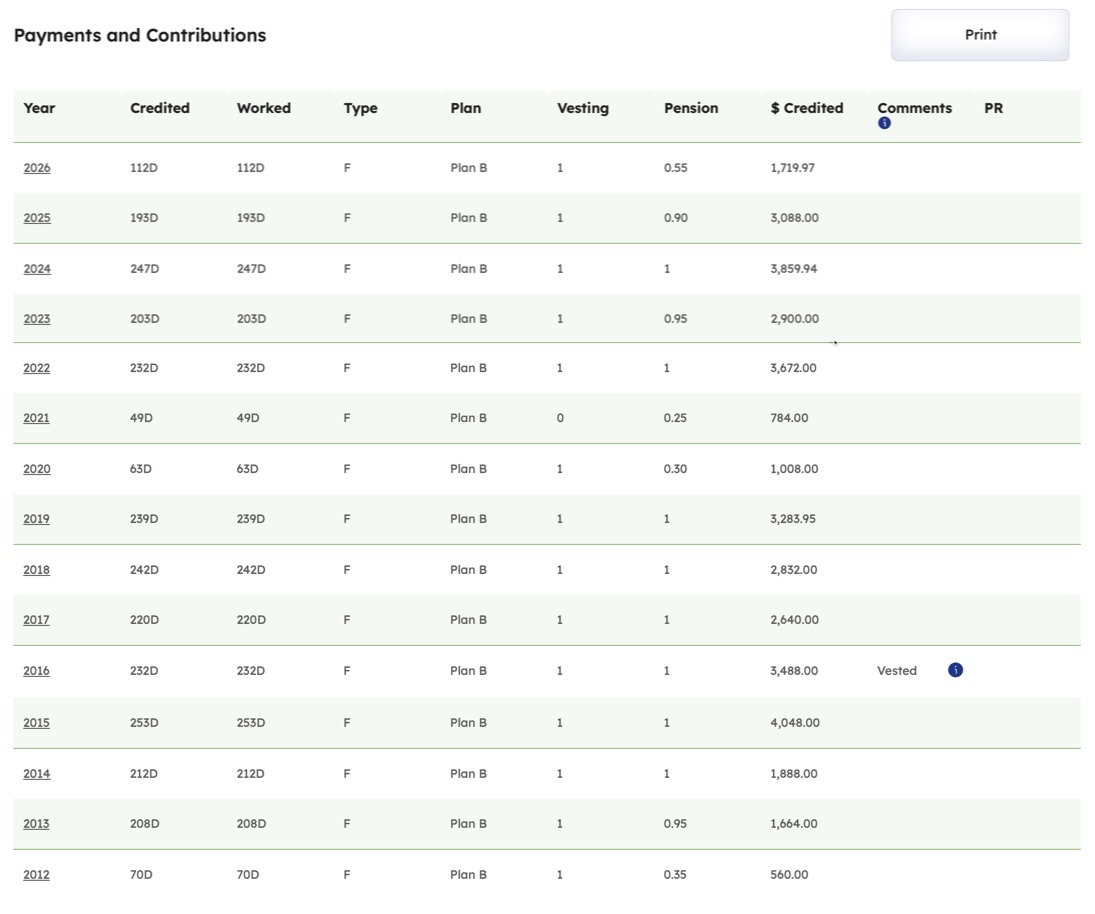
From 2014 to 2022 I was almost constantly on the road and earned the full credit each year (ignoring 2020/21 for COVID).
2023 was when I moved to NYC. Between subbing, production work, and shop builds, I worked well over 210 days, but not all of the jobs paid into my pension, so I ended up with 0.95 credits for the year.
Things like shop work pay well, but if you’re over-hire (only there for the shop build and not on the show run), you don’t receive benefits. Similarly with some design contracts.
For 2024 I was on Outsiders the entire year and made my full credit.
In 2025 I left Outsiders in the summer, look a long vacation, and got back to subbing and shop work. In the fall, I was the Assistant Designer for the Outsiders tour, but that contract paid into Healthcare and Annuity benefits, but not the Pension. So I got close, but not quite to the full 210 days.
2026 is still up in the air. I was full-time on Dog Day Afternoon from January to mid-July, but the fall and winter will likely be scattered with some time off, subbing, and shop work, so it’ll likely be similar to my 2023 year.
I’m not concerned about only getting partial credit for some years. Pension benefits for pink contracts are capped at 25 credits, so looking at the math: I’m 36 years old with 12.25 credits. That means I have a little under 30 years (until I’m 65) to earn the other 12.75.
That feels like plenty of time so I don’t have to rush. I have the freedom to take shop work, go on vacation, or opt to take jobs like the designer contract for the Outsiders tour.
You may have noticed another column next to the Pension credits called “Vesting.”
Unlike the Annuity, where the account is yours as soon as the first deposit goes in, the pension program requires you meet a threshold before you’re eligible for benefits.
To earn an Vesting Credit, you have to work at least 75 days in covered employment in that year, and you need 5 Vesting Credits to become eligible for pension benefits. Once you are vested, you have a guaranteed right to your pension at retirement, even if you leave covered employment. Any year you get 0.40 credits or more, you’ll automatically hit the days needed for the vesting credit.
So, say I made a complete career shift next year. I’m still vested in my pension with 12.25 credits, so at 65 I would receive benefits based on those credits, even though I left the industry for 30 years.
When you retire, your benefits are calculated on how many credits you have (up to 25) and the pay rate of the last 3 years.
Each contract pays a different rate (bigger contract, typically higher rate), and for the current contract cycle a Full Pink contract pays $16.00/day, while a Modified Pink pays $12.00/day, and a Bus & Truck contract pays $8.00/day.
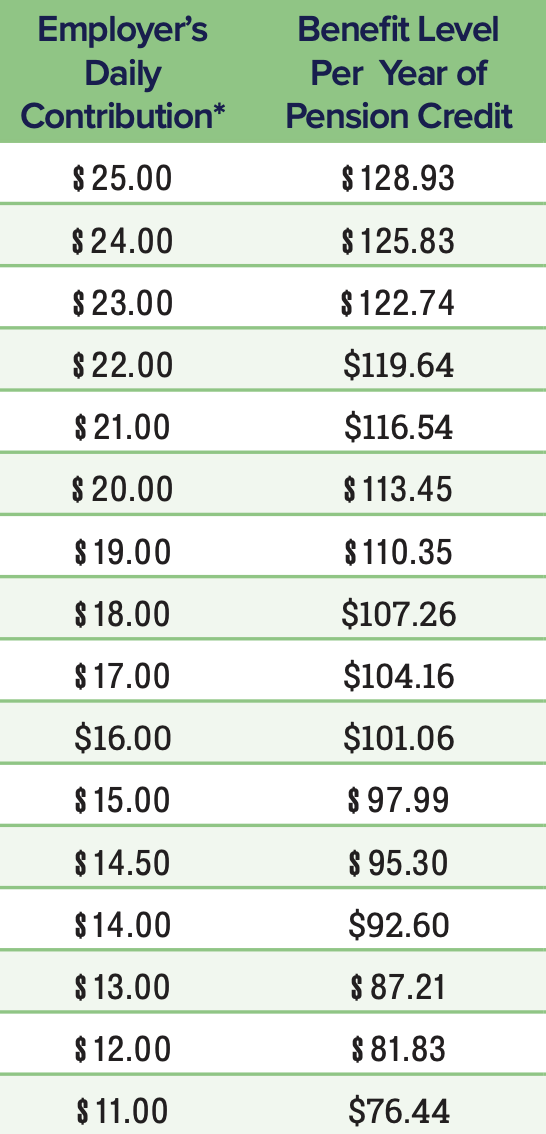
There’s a chart in the formal Plan B description (found on the NBF website or below), and we’ll run two scenarios:
First, let’s follow my previous example. I left the industry with 12.25 credits, and spent my last three years on a Full Pink contract with a $16 rate.
The chart converts the $16 rate into a $101.06 benefit, and that gets multiplied by my 12.25 credits. My monthly benefit at retirement would be $1,237.98.
Or, let’s say I continued working and earned 30 credits and my last three working years had 2 years at the $12 rate, and 1 year at the $16 rate.
The chart converts the $12 rate to $81.83 in benefits and the $16 rate is still $101.06.
The monthly benefit in retirement would be the average of the benefit for my last 3 years: (81.83 + 81.83 + 101.06) / 3 = 88.24. Then that result is multiplied by my credits, up to 25, even though I technically earned 30.
So, 88.24 x 25, for a total of: $2,206 per month.
As you can see, your benefits will change depending on how many credits you have and what kind of contracts you worked on. They only use the last 3 years to calculate because they assume your pay rate will be the highest at the end of your career.
One very important tangent: you should actively plan for your retirement, no matter what life stage you are in or what benefits you expect to receive from your job. If you’ve just entered the workforce, retirement probably seems impossibly far away but that also means you have the advantage of time. Time to let your money grow, time to try things, make mistakes and get back on track. Learning to pay attention to your money is one of the best life skills you can acquire.
I got a wake up call when I was on tour. I listened to men across the country talk about how they hadn’t saved anything for retirement, so they’d be working until they died. Watching men in their 70’s and 80’s still working, struggling to push boxes lit an absolute inferno under me. I made sure I had a plan for my future so I wouldn’t have work until my body gave out.
I know that’s a lot of technical jargon to digest, and retirement is something that’s hard to conceptualize when it’s decades away. But learning what your benefits are and how they work can help you make informed choices and send you down the right path for success.