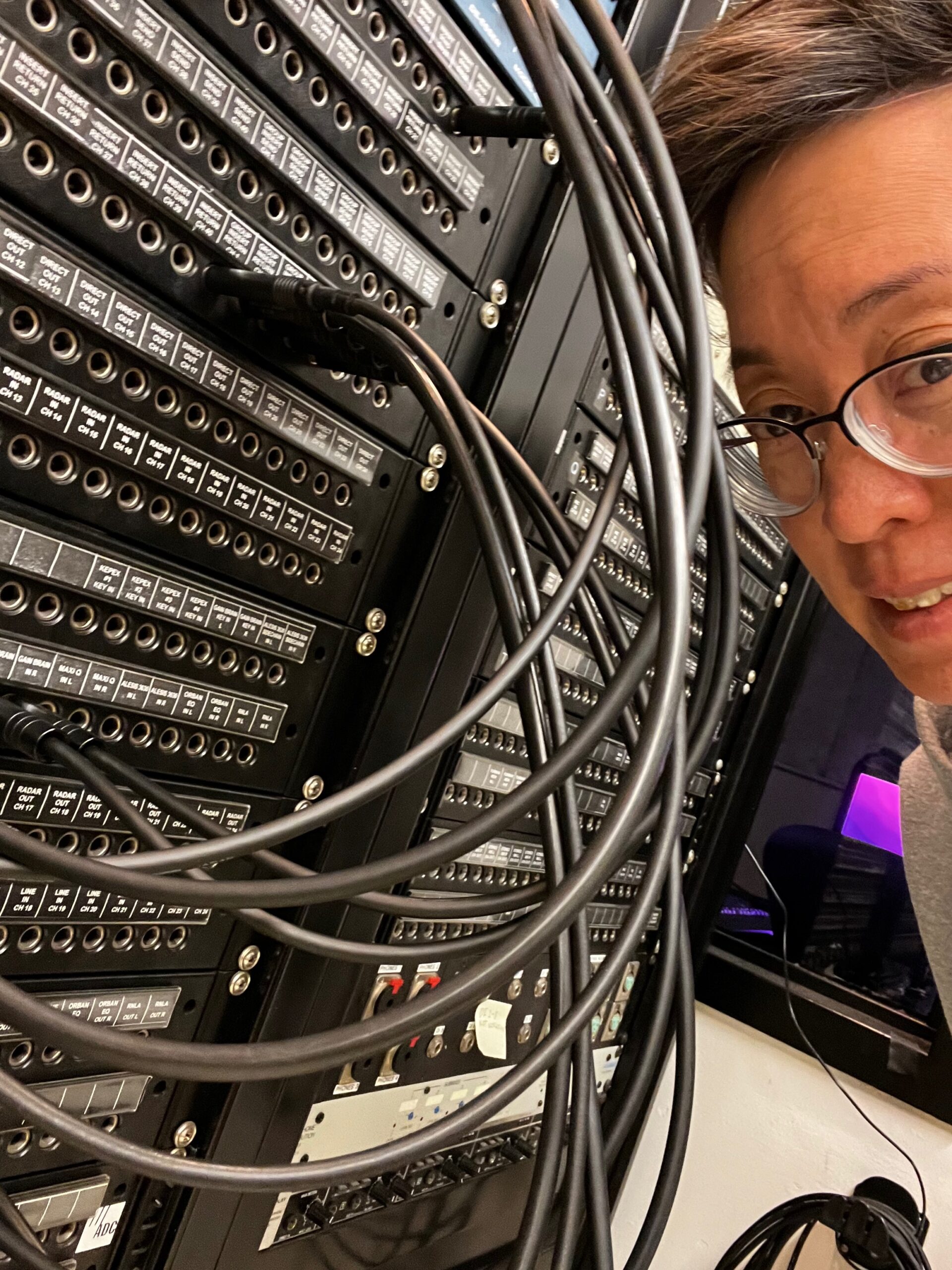
Last year, at a studio event, I was tasked with monitoring sound in the control room for the overflow audience. The event was being video-recorded by a team of community college students from the media department where I took audio classes, so I knew some of the video team members.
One of them, a young woman who was taking the audio recording class, was talking to me afterwards, looking at the patch bay and telling me how intimidating she found it.
I told her, “The first time I went in to work with the patch bay at school, I almost cried.”
She gasped. “I did cry!” she said.
I’m assisting with a live sound class this semester, and my job is to identify students who need support to succeed. One young woman had taken audio classes at another community college, but those classes didn’t include any hands-on training, and she was feeling out of her depth with signal flow and using a mixer.
I spent some time with her in a separate room with an old analog Allen & Heath mixer, talking about how the different controls corresponded with the outputs, and getting her to turn the pots and move the faders. Even with the mixer completely powered off and disconnected, she still hesitated to touch the controls.
That’s real fear. I completely identified with her, because I have that, too. It’s a feeling that a mistake will lead to annihilation. Combined with whatever upbringing or experiences one might have had, it can take the shape of anxiety or techphobia that shunts a person’s whole system into survival mode and blunts understanding.
Everyone has a story. Trigger alert: this paragraph describes an act of domestic violence. Part of my story is that I grew up in a strict household ruled by adults with war trauma, where I studied to get the grade necessary to avoid punishment, but not to understand the material. I was discouraged from trying new things or taking risks. As a teen, I dated an abuser my age who brainwashed me in classic style, in one instance telling me to do a math problem he knew I didn’t know how to do, and then slapping my face and screaming about how stupid I was. Decades later, I know he was lying, but my nerves still remember.
It took me most of my life so far to navigate the fallout from that experience. Now that I’m moving forward with an audio career and have the lens of my past to look through, I’ve identified, viscerally, times that the culture of audio engineering has pushed me back. Often, everyone in the room is well-meaning (though perhaps a bit oblivious). For instance, an overzealous engineer once attempted to frame me as a rising star and gave me my first ever session at that studio (and my second session ever) but didn’t give me the information I needed to prepare. It wasn’t a paying client, but a young band that one of the studio owners knew. At one point, the studio owner, his wife, his daughter, the band, and a team of high school videographers were all in the control room watching me set up the session. The engineer came in and asked if I’d measured the position of the overheads (which I knew to do, but had gotten overwhelmed and had forgotten), and if I’d patched in any hardware processing (I hadn’t). He gave me a look and pushed me aside, undoing what I’d done and setting up the session the way he’d do it.
When I thought about this session afterwards, I could see all the ways it could have been a great opportunity for someone else, but was ill-suited for me. It helped me identify the things I needed in order to gain productive experience: time to prepare, less pressure, and fewer observers. I needed the freedom to make mistakes, and I needed to replace, not relive, lessons learned from belittling experiences.
I realized that, if I was ever going to become a recording engineer, I would need to take control of the circumstances under which I worked. I needed to be honest with myself about how I reacted to certain situations, to analyze those reactions without judgement, and to choose the most effective path forward. Most importantly, I had to let go of the opinions and expectations of others. I can’t go around explaining my whole self to everyone, so they are just going to have to learn to deal with me without knowing.
Sometimes the people in the room are other gender minorities caught in their own form of survival mode. This is possibly the trickiest situation to navigate. I’ve been in “women in audio” groups that stress beating men at their game. This involves maintaining a flawless mask of competency and holding oneself to an impossible standard of professional and emotional perfection in order to force a powerful majority (men) to acknowledge the abilities of gender minorities. But playing the game under these terms is playing a power-imbalanced game, and those in power still declare the winners and losers, even if they themselves are flawed. It also leaves behind questions of race and marginalized identity. It’s ultimately an outdated game with skewed and arbitrary rules that a person could die trying to win.
What happened to me wasn’t my fault, but that’s not the point. There’s no reason to be ashamed of a weakness. We are entitled to our imperfections. We are human beings, and it takes human beings to make art. We can turn to computers for flawlessness, and they will always do “perfect” better than we can. Every deeply flawed moment of our lives is our art. What a pity, to be ashamed of being alive.
In the classroom, packing up the old Allen & Heath mixer, I told the student how I bonded with someone about crying in front of the patch bay. “I’ve had people teaching me, where I’m so anxious that I can’t understand, and then they look at me like, ‘What, are you stupid?’” I’m not sure if I was speaking to her or to myself at this point; it was a little of both. “I know I’m not stupid. This is just hard. And if you learn slow, so what? Take the time, make yourself comfortable. Honor the shape of your journey, I’m serious. Because I think you can do it.”