Empowering the Next Generation of Women in Audio

Join Us

SoundGirls CoronaVirus Relief 

As COVID-19 continues to spread and spark growing concerns globally, the music and film industries are taking preventive actions by postponing or canceling tours, concerts, major festivals, and sporting events to limit the spread of potential infections. This has severely impacted roadies, who are highly skilled professionals, who work on live event productions. While productions are postponed or cancelled, the techs are out of work and will be for the foreseeable future. Many of these people are freelance and do not qualify for unemployment benefits.

SoundGirls has teamed up with Loanne Wullaert of The Ventura Theatre and The Phoenix Collective and Daniella Peters of Rat Sound Systems to help ease the stress, even if in a small way.

The SoundGirls CoronaVirus Relief Fund helps production techs across the globe that are now unemployed due to the CoronaVirus Pandemic by providing a small amount of aid to purchase necessities and slightly ease the stress.

Donate

If you are in a position to assist your fellow techs please consider making a tax-deductible donation.

Online

SoundGirls CoronaVirus Relief Fund

Make checks payable to

California Women’s Music Festival (SoundGirls is under the fiscal sponsorship CWMF is a 501(c)(3) non-profit #47-1361148)

Mail Checks and Gift Cards to:

SoundGirls- Attention Loanne Wullaert

48 South Chestnut St.

Ventura, CA 93001

We are currently providing $100 gift cards (Visa, Target, Gas, Grocery, etc) to qualified techs. We hope to expand the amount in the coming weeks. We will begin sending the gift cards via email on March 20, 2020, and will fill all requests until we run out.

Apply

Make sure you are eligible. 

Apply Here


Educate and Collaborate: Surviving Corona Virus

The concert industry alone is expected to lose one billion dollars during the Coronavirus. As this continues to shut down live events and filming most of our members that work in Live Events and Film are being severely impacted. They face the loss of income until at least May (being optimistic) and as in the past recessions (2008, 911, etc.), they can’t just get another gig.  There are none.

The industry will recover but there will be casualties and when is unknown.  When it does recover it will still not be business as normal, as companies will face an influx of work that they will not have the equipment or crew for, lack of venues, and more.

While many of us are in the middle of panicking and are dealing with shock and denial, anger, bargaining, depression, and finally (hopefully) reaching a place to be proactive. It is critically important to understand that you are not alone and make sure you reach out for support from friends and family, a counselor or therapist, or a support group. If this is not affecting you reach out to friends that are.

SoundGirls is compiling a list of resources to utilize during this forced downtime and unemployment. From best business practices, career development, continuing education, and side hustles to get us through this. If you have ideas and advice and wish to share with our community please email us soundgirls@soundgirls.org

This resource will be continually updated.

We will get through this together,

The SoundGirls Team


What steps can you take to be more prepared and more skilled when it comes time to go back to work?

For those whose work has been cut off in the meantime, something needs to be done to fill the time. Things you can do when you’re out of work unexpectedly.

Business Help

Personal

Resources for Financial Assistance and Support


California Workers

If your employer has reduced your hours or shut down operations due to COVID-19, you can file an Unemployment Insurance (UI) claim. UI provides partial wage replacement benefit payments to workers who lose their job or have their hours reduced, through no fault of their own. Workers who are temporarily unemployed due to COVID-19 and expected to return to work with their employer within a few weeks are not required to actively seek work each week. However, they must remain able and available and ready to work during their unemployment for each week of benefits claimed and meet all other eligibility criteria. Eligible individuals can receive benefits that range from $40-$450 per week. 

For more information: https://edd.ca.gov/about_edd/coronavirus-2019.htm


WEST COAST: GoFundMe Supporting Performing Artists

San Francisco

Sign a Letter to stop Evictions

Los Angeles

Resources

Crisis Response Guide

Where To Get Financial Assistance, Food And More During The Coronavirus

California

Emergency Funds for Freelancers, Creatives Losing Income During Coronavirus

Governor Gavin Newsom: Suspend Rent, Mortgage, & Utility Payments During the Coronavirus Crisis

Seattle – Washington

Texas 

Texas since a disaster has been declared, 1099/contract workers can now apply for unemployment.

Austin

Boston

New York

Minnesota

Canada

U.K.

International

Petitions & Directories

Side Hustles

FlexJobs has over 50 remote jobs categories, with positions ranging from freelance gigs, to part-time work, to full-time jobs, with remote careers varying from entry-level to executive.

Remote.co hand-curates their list of remote jobs. These listings include customer service positions, design opportunities, developer jobs, recruiter and HR roles, sales jobs, and other remote work (including writers, managers, and marketers).

JustRemote is dedicated to building a better remote job platform, allowing job seekers to find their perfect role quickly and easily. JustRemote covers many job verticals including Development, Marketing and Design, HR, and Customer Success positions.

Virtual Vocations’ jobs board features telecommuting positions in job fields like technical writing and paralegal.

Pangian is on a mission to unite all five continents by connecting remote-minded companies with remote employees. Their virtual job board provides a robust list of open, remote positions including web development, UX design, content creation, and digital marketing.

WE WORK REMOTELY With a simple, straightforward layout, this virtual job board is a catch-all of remote work from home jobs from customer service, to web design, to programming.

Remotive is a bi-monthly newsletter for job seekers interested in working remotely. In addition to news about how to get hired at remote jobs and tips on life as a digital nomad, the newsletter also has a robust listing of remote positions.

Skip the Drive a handy resources tab that lists authors to follow and sites to check for advice in the world of working remotely, and a reliable list of remote jobs.

Remote OK is a remote job site that tags all of their job listings, making it simple and easy to set filters for the specific listings you want. You can choose to filter jobs posted by recruiters, by experience level (junior, senior, etc.), by job type (sales, marketing, design, dev, and more), and even whether they’re tech or non-tech related jobs (of course even the “non-tech” jobs—things like analysts and marketers—will benefit from some basic tech skills).

Working Nomads When you sign up for the service, Working Nomads will deliver a curated list of remote jobs directly to your inbox. You can choose daily or weekly emails, then keep moving to the next city while the telecommuting job search comes to you.

Jobspresso features a wide range of curated jobs in tech, marketing, customer support, and more. You can search their virtual job board for openings and post your resume to be searched and seen by potential employers.

EuropeRemotely. This virtual job board is full of job listings from companies that are happy to work with at-home and remote employees who are interesting in doing work based on European time zones.

Jobscribe is a site that sends out daily emails to job seekers with remote job listings at tech startups. Web designers, web developers, mobile app designers, and digital marketers can specify their focus and receive listings for corresponding remote and work-from-home positions.

Wfh.io focuses exclusively on remote digital and tech jobs. They include remote jobs in product management, software engineering, web engineering, customer support, marketing, and more.

Outsourcely pairs up remote workers with employers seeking both full and part-time employees. You can browse for jobs by category: design & multimedia, web development, writing & content, customer service, sales & marketing, and more.

PowerToFly is a dream come true for women job seekers interested in working remotely. PowerToFly focuses on matching women in tech with remote and work-from-home jobs.

Landing Jobs doesn’t have a huge section of their tech job opportunities dedicated to working remotely, they do carefully curate their listings. As a bonus perk—unlike many job boards—their site allows you to filter your search for jobs that are either fully remote, partially remote, or even remote within physical commuting distance.

Authentic Jobs bills itself as “the job board for web professionals.

Dribbble is most often known as a pillar site for freelance web designers to share their portfolios and find their next gig.

AngelList—a top source for startup job listings—you can enter a for a job search and click “Remote OK” when you’re prompted for your search type. Then—tech hub or not—you can find a startup that’s right for you.

Stack Overflow is a go-to source for web development Q&A, but it also has a jobs board with listings for tech positions (especially web developers).

GitHub —web developers use GitHub as a repository from projects they’re working on where they can share code, questions, and discover with other programmers. But, like Stack Overflow, it also has a job’s board, including an entire category devoted to remote jobs. Because it’s GitHub, the jobs are web development-focused, with remote listings from all over the world. GitHub even posts their own job openings on this board

Toptal Business focuses on connecting business consultants with freelance corporate engagements.

Fiverr is a handy site for finding your first freelance gigs and building up a portfolio fast. The Fiverr site focuses on “gigs” or “micro-jobs,” like editing an image in Photoshop, designing a Facebook ad, or brainstorming SEO-rank-worthy article titles.

Upwork features freelance remote job listings in a suite of categories: things like virtual assistants, mobile app developers, and copywriters. Companies like Zendesk, Dropbox, and Airbnb use the site to hire remote freelancers, so if you’re ready to start doing freelance work for some major clients without having to set foot in an office, create your Upwork profile ASAP.

Freelancer.com claims to be “The World’s Largest Outsourcing Marketplace,” and it’s chock full of remote freelancing gigs.

FreelancerMap allows users to search thousands of active IT projects looking for remote, freelance team members. The site has a global reach, with projects currently listed on their front page from companies in the US, Australia, and the Czech Republic.

Coworks is a freelance work platform for creative job seekers (graphic designers, illustrators, web designers, etc). The site has connected over 2,000 clients with freelance work, catering to brands like Decathlon, Starcom, and BBH.

Gun.io is a freelance platform designed specifically for freelance web developers. You can sign up through GitHub (so make sure your GitHub profile is up to date and active), and they’ll help match you up with companies that need your services.

The Muse makes remote job searching feel easy. In addition to being able to search the best remote job opportunities listed on the site, you can avail yourself of The Muse’s top-notch content highlighting remote work opportunities and tips to get started.

Indeed pulls job data from across the internet and around the world, making it one of the most robust jobs search engines going.

Career Builder jobs site claims to be the largest online employment website in the United States. Simply type in “telecommute” or “remote” as a keyword, and you’ll find more than 9,000 part-time, contract, and full-time jobs from brands like Forever 21 Inc, Xerox, and Univision.

Idealist isn’t an exclusively remote job board, but it still has hundreds of remote job listings worldwide (just click on “Remote” under locations). The catch here is that all of these jobs are with organizations and nonprofits that are committed to making a positive difference in the world.

Up to date Information on CoronaVirus

COVID19 updates on live music events WBM Expertise put up a comprehensive mapping of all measures taken against coronavirus in Europe together with EMEE. The info is regularly updated.

Centers for Disease Control 

What is CoronaVirus
 

Self Care/CoronaVirus

Tips and Resources for Self Care for surviving CoronaVirsus

Take a break from social media.  Social media is full of misinformation, negativity, frustration, and fear. Spending your time scrolling through the woes of this disease and the effects it has on our workforce and economy will not help your mental state.

Stay in touch with your peers, tour families, and industry leadership.

Stay Healthy

Mental Health

Take care of your mental health: If it all starts to weigh you down, remember that there online counseling services. You can find help on a sliding scale here

Free Resources

Behind the Scenes: Free Online Behavioral Health Screening Program

Behind the Scenes: Resources

Therapy for Every Budget: How to Access It

SoundGirls Self Care for Trauma

Anxiety Challenge and an Ultimate Anxiety Guide

Coronavirus and your wellbeing

Articles and Blogs

SoundGirls Self-Care: Coping with Anxiety

Self-care: Develop a Routine That Works For You.

Let’s Talk About Mental Health

How to design an effective schedule during stressful times

Finances

Budget. When is the last time you sat down and did a personal budget? Use this time to evaluate where your money has been going each week/month and create a spreadsheet on how you can make financial adjustments moving forward.

Marie Kondo your space

Read: Reading is a great way to keep the mind fresh, focused, and occupied. You can check out books on audio and music for free from The SoundGirls Lending Library.

Journal/Reflect. Write down what is going on inside you. Inventory your thoughts and emotions the good and the bad.

Find your happy spiritual/mental place – Prayer, meditation, yoga, etc. Spend time in thanks and reflection for what you DO have.


Educational Resources

This is a list of free and paid training for sound engineers online, including webinars, courses, and certifications. This list will be updated as we become aware of new resources.

Manufacturer-specific courses for consoles and PAs are listed in a separate section below.


Webinars and Videos

Opportunities

AES Membership Discount

In order to give you access to our wonderful community and resources, we are making a 3-month membership available for just $25 if you join between now and the end of March. Or you can opt to receive 15 months for the price of 12 ($125).

If you are a student enrolled in an audio program, the 3-month membership is $10 or 15 months for the price of 12 ($50).


The Event Safety Guide is now available as a free PDF, which may be downloaded at the following link: https://www.eventsafetyalliance.org/the-event-safety-guide

Registration for our online Event Safety Access core safety training has been reduced to $9.95 through July 1, 2020. Those wishing to sign up may do so at http://eventsafetyaccess.com . Please use the promo code SUPPORT20 at checkout to receive this discounted rate.

Annual dues for individual members have been reduced to $25.00 through December 31, 2020. This rate applies to both new and renewing members. Membership registration can be found at https://www.eventsafetyalliance.org/becomeamember (Note: Discount will be applied automatically at checkout).


Free Courses (with and without professional certifications)

Free Event Technology Training Guide


Free Resources


Paid Courses (with and without professional certifications)


Paid Resources and Books


Manufacturer-Specific Training


Articles and Resources

Misc

Business Basics 101

Below you will find links to The Business Basics Workshop we hosted with 4-Wall Entertainment. The event included information on social media, resumes, AB5 for those in California, Networking, and Negotiations.

Sound Girls Presentation -1-28-2020

AB 5 Summary

Microsoft Word – CA DEAL MEMO no logo.doc

Samples for Business 101

QA list

Podcasts – Making Waves

Spring is almost here! With the Earth gradually awakening, I can feel my own mind coming out of its hibernation. I find myself reading more articles, keeping up with current events, and listening to new podcasts.

Speaking of podcasts, the podcast industry has been receiving attention for some time now. I recently had the pleasure of talking with Fela Davis about podcast audio and what it means for the audio industry. Fela has nearly twenty years of experience in the audio engineering industry. Her list of credentials is very impressive. She also produces and hosts a podcast called The Art of Music Tech Podcast with her business partner Denis Orynbekov.

I became aware of the increasing interest in podcast audio after attending the 2019 Audio Engineering Society’s national convention in New York City. I had listened to a few lectures where Fela and a panel of other professionals talked about their experiences. I had many questions and fortunately, Fela was able to answer all of them.

In the past few years, producing a podcast has become increasingly more affordable. Fela mentioned that most students have the bare minimum needed to put together a podcast. Some kind of DAW to record onto, an interface, and a microphone. Even with the accessibility, how does someone make this kind of work profitable? Fela explained that not only does she work on her own podcast, but many others too. Through 23dB Productions audio services, Fela is able to work with clients who need audio and video services. We both agreed, most people have something they want to say and there will at least be one person willing to listen to it. These can be large-scale companies or organizations or smaller groups or single individuals.

Being mobile and having your own equipment is important, but with the surge of companies, organizations, and individuals looking to use this form of media, being open to its opportunities is key. As a woman in the audio industry, what really intrigued me was, it’s kind of brand new. Fela and I both laughed, but it’s true. This is a part of the industry where women and minorities have the opportunity to flourish. There are no jerks named bob hiring their best friend over you. The pressure to prove yourself is significantly lessened.

In the beginning, most individuals will be playing the role of producer, host, engineer, and editor. Drew Stockero, a student at Michigan Technological University, does just that with his podcast If It Matters Podcast. Stockero said the podcast is about, “ordinary people having ordinary conversations about the things they find extraordinary.” He takes the time to curate each episode and interviewee, he is the producer and hosts every episode, all while recording, mixing, and mastering. After chatting for a bit about his workflow, he did admit that fulfilling every role for the podcast is a lot of work. Typically, indie podcasts are much smaller and only run by one or two people. But, as Fela stated, the option to use remote engineers is there once you start gaining clients or attention.

Radio was brought up in both of my interviews. Stockero mentioned podcasts being an extension of talk radio. Growing up, my father would listen to a lot of NPR on long family road trips. With the shift from cable television to streaming services, it is no surprise we are seeing a move from radio to podcasts. It was also mentioned that podcasting is making more money than radio broadcasts. It is undeniable that there has been a boom in revenue for the podcast industry, but all of this did surprise me. I was starting to have more questions than I started with, and definitely more interest.

I received many great words of wisdom when I asked for advice regarding this topic and its industry. You will want to immerse yourself in the business, or your local chamber of commerce. Networking is always important, but also being someone that has a positive personality and is easy to communicate with is just as important. From an artistic standpoint, being passionate about the topics you are addressing through your podcast is essential. It helps keep the information fresh, the motivation constant, and ultimately something others will want to listen to.

This form of entertainment intrigues me. It is a service where, we as engineers, can have a voice or help others have a voice and be heard. I do agree, I think it is a place that women can flourish in the industry. Not only is there a supply of work where women and minorities can be at the top, but we can also have a voice. Having the ability to not only strengthen myself, but the ones around me is an opportunity that I value. More of these conversations, podcasts, and articles need to exist for our current community and the future community. It is conversations and the spread of information such as this, that makes me feel awake and ready to take on the industry.

I hope you all have a wonderful spring and do not forget to check out the wonderful people that I got to chat with for this article. Fela Davis can be found on LinkedIn and her website felaaudio.com. The Art of Music Tech Podcast is available on Apple Podcasts, Spotify, Google, IHeart Radio, and Youtube. Drew Stockero’s podcast If It Matters is also available on Apple Podcasts, Google, iHeart Radio, listennotes, and player.fm.

The Power of Podcasting Roadie Free Radio, and panelists Fela Davis (The Art Of Music Tech Podcast), Lij Shaw (Recording Studio Rockstars), Chris Graham (The Six Figure Home Studio Podcast) and Matt Boudreau (Working Class Audio).

Women in Audio Podcasts

Women in Audio Podcasts

The SoundGirls Podcast New Episodes Every Tuesday.

Episode 1 – Beckie Campbell and Susan Williams from the Orlando Soundgirls Chapter interview one of the founding members of SoundGirls, Michelle Sabolchick Pettinato, in the inaugural episode of Resonating Beyond Sound.

Behind the Beat is a Gender Amplified original podcast highlighting the work of female and non-binary music producers.


Sisters of Sound Podcast


 Roadie Free Radio


Tape OP Podcast

Working Class Audio Podcast:


Women in Audio Podcast


Storyophonic 

Episode 17 – LYNNE EARLS A producer-engineer-mixer-composer and player: Irish-born, Liverpool-educated Los Angeles transplant Lynne Earls’ credits include recording K.D. Lang, Calexico, Rumer, Lizz Wright, Wayne Shorter and many others. In this conversation, she compares recording to photography, instinct and intuition guide her as she captures the authentic soul of a sound in the optimal instant.

EPISODE 16 – BONNIE MCKEE: She’s an “American Girl,” one of the “California Girls,” and a “Teenage Dream” who can “Roar.” Artist, songwriter and producer Bonnie McKee might be best known from her multiple award winning collaborations with Katy Perry, as a recording artist, or as a guest vocalist with dance provocateurs Kygo and Armin Van Buuren. If you listen to pop music, you have heard her songs for Britney Spears, Kelly Clarkson, Adam Lambert and many others. Meet the luminous, glamorous and fabulous Bonnie McKee.

EPISODE 12 – LESLIE ANN JONES: Engineer, producer and mixer Leslie Ann Jones has been behind the board for everyone from Rosemary Clooney and Kronos Quartet to Herbie Hancock and Alice in Chains. As Director of Music Recording and Scoring for Skywalker Sound, she records scores for video games and feature films including Apocalypse Now, Requiem for a Dream and Happy Feet. A multiple Grammy Award winner inducted this year into the NAMM TEC Hall of Fame for her achievements, Leslie Ann Jones is an Audio Icon of the first order.


Backstage Chats

A podcast amplifying the voices and careers of women in music. Hosted by Thea Wood, the show is part of the Backstage Chats Foundation, a nonprofit organization offering grants and scholarships to women in music. Women are underrepresented on stage, on-air, and behind the scenes in the music biz, so it’s our mission to create gender harmony by sharing the voices and stories of female music makers. Backstage Chats with Women In Music connects music fans with female artists and industry insiders who remind us to be dreamers, to be rule breakers, and that we are all rock stars!


PSNEurope podcast Women in Audio

Pensado’s Place


Gear Club Podcast


TONEBENDERS PODCAST

The Tonebenders podcast is a resource for anyone involved in post sound, with insights on everything from field recording to editing, designing and mixing in the studio.


The Right Scuff Podcast


Shure Signal Path Podcast


Other Podcasts

Introducing Women in Audio Spotify Podcast

On my last blog, I talked about recording Posival. I know I promised my next one would be about the mixing process for this album, but we are going to take a pause on that. The reason we are taking a pause is that one of my very good friends that is also a (badass) live sound engineer just dropped the first episode of her new podcast called “Women In Audio” today! I was lucky enough to be her very first guest too. What I am going to do is break down some of the key conversations that took place during the podcast.

Work Ethic

Tangela and I talked about music and what it means to us, amongst many other things. I’ll break down here the topics that specifically pertain to audio engineering. The first thing she asked me (that was audio-specific) was how I record my bands’ music. I know I’ve written about the recording process for my band’s music before, so I won’t go too much into that. What I will mention is the reason I am able to record my own bands’ music out of different studios. I am able to do these things because, from the moment I started engineering, I was a go-getter. A question Tangela asked me was *essentially*, “How do you gain those people’s trust, and how do you get to that point?”. I recommend from the moment anyone starts this journey that they DIVE right in. Be the first one there, and the last one to leave. Study. Learn. Ask so many questions. Be the first one to get up during a session when the head engineer is needing a microphone fixed. Don’t be shy in that regard. People will notice your work ethic, and opportunities will flourish from there. Another interesting question she asked me that I’ll lump into this topic is “Did you feel like you had to work harder (as a woman)  to be good?” My answer was, yes I did, but this industry is so hard, to begin with, EVERYONE has to. I explained how I was very lucky to be at a tech school where I never felt talked down to, or out of place even though I was one of four women there at the time. I know that’s not always the case especially at tech schools for audio. I did touch on a couple of situations that were slightly sexist (that had nothing to do with where I’ve interned or gone to school) but all in all, I’ve been very lucky to have had a good experience as a woman in this field. I think that comes from me knowing to set boundaries very early on in my career.

Credits

Credits, and how to obtain them as an hourly worker. Credits have always been a struggle for me because it does take you having to ask for them. Most audio engineering work is hourly, and once you are done with a project- you are done. That doesn’t mean we shouldn’t get credits on huge platforms though. I’ve struggled to become a part of The Recording Academy for years because you have to have 12 separate credits on AllMusic.com. The way to get these credits onto AllMusic.com is by submitting a PHYSICAL copy of the album. That is crazy to me because in this day and age not that many people are recording albums. I record more singles than anything and most artists/bands are not printing any physical copies of their single. That doesn’t make the work I have done invalid, or *not professional*. That’s just what the industry has been moving towards for years, and we need to move with it.

Payment

Being paid is something I’ve written about before and how do you figure out what to charge someone when you’re first starting out? How to make a contract? How to be confident enough in your work and when it’s time to up your prices. When she asked me these questions I put it simply. My music business teacher asked me “How much do you need to live?” We made a template and broke down all my bills and figured out how many bands I need to reach out to a month and how many bands I  need to be working with on a monthly/yearly basis to survive. When I first started out I charged the bare minimum of what I needed to survive. Luckily, I had other jobs supplementing my income so I didn’t have to rely solely on freelance engineering. I think being as logical as possible when it comes to pricing is the best way to go about it. Ask yourself those questions, and be honest with yourself about where you are in your career. Whether you are just starting out and maybe charging too much or you’ve been doing it for years and you’re charging too little. Either way, (this goes without saying and I’ll end this here) KNOW YOUR WORTH.

Please go listen to my friend, Tanglea Lamb, and her podcast, “Women in Audio”. She is having intelligent conversations with the amazing women that occupy this field. It’s so important for our experiences, knowledge, and stories to be heard on platforms like what Tangela is starting, and what SoundGirls has been doing for a good chunk of time now.

Spotify  Women In Audio podcast

SoundGirls List of Women in Audio Podcasts


Word Clocks, Clock Masters, SRC, and Digital Clocks

And Why They Matter To You

Three digital audio consoles walk into a festival/bar and put in their drink orders. The bartender/front-end processor says, “You can order whatever you want, but I’m going to determine when you drink it.” In the modern audio world, we are able to keep our signal chain in the digital realm from the microphone to the loudspeaker longer without hopping back and forth through analog-to-digital (and vice versa) converters. In looking at our digital signal flow there are some important concepts to keep in mind when designing a system. In order to keep digital artifacts from rearing their ugly heads amongst our delivery of crispy, pristine audio, we must consider our application of sample rate conversions and clock sources.

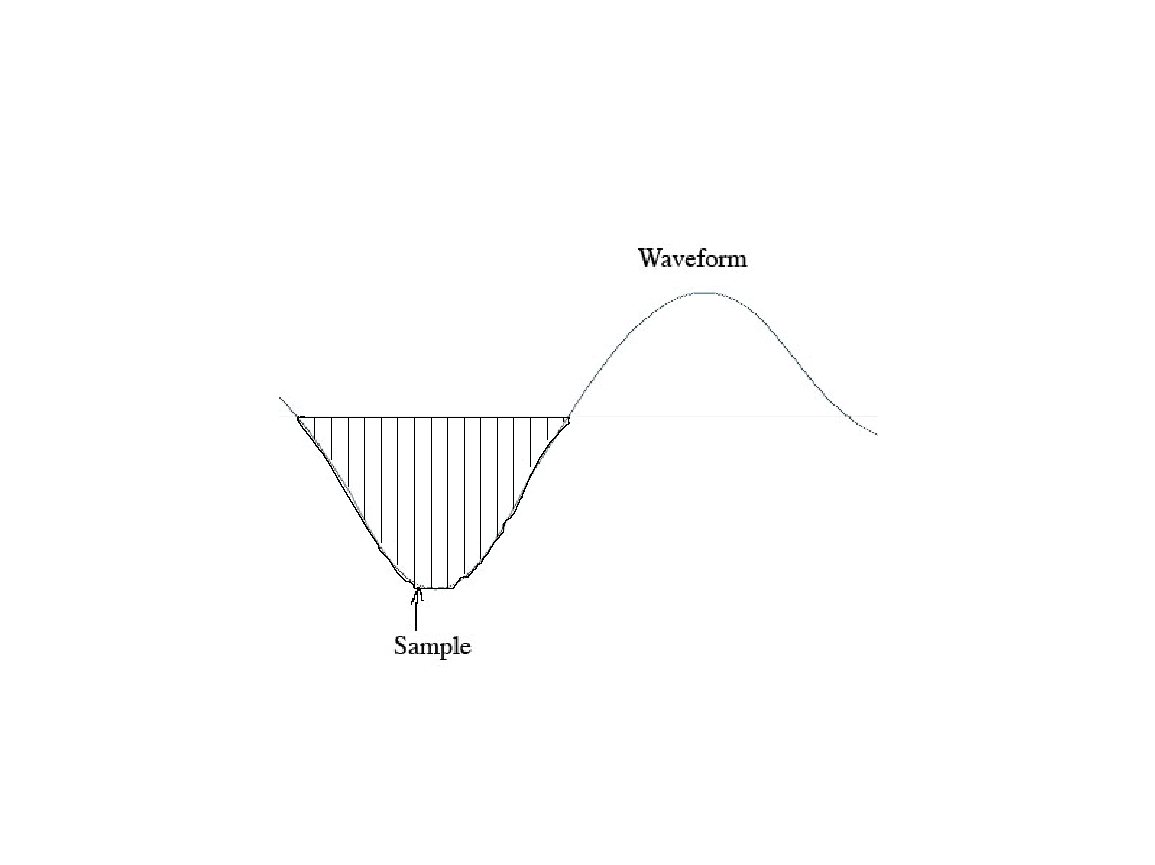
Let’s back up a bit to define some basic terminology: What is a sample rate? What is the Nyquist frequency? What is bit depth? If we take a period of one second of a waveform and chop it up into digital samples, the number of “chops” per second is our sample rate. For example, the common sample rates of 44.1 KHz, 48 KHz, and 192 KHz refer to 44,100 samples per second; 48,000 samples per second; and 192,000 samples per second.

A waveform signal “chopped” into 16 samples

Why do these specific numbers matter you may ask? This brings us to the concept of the Nyquist theorem and Nyquist frequency:

“The Nyquist Theorem states that in order to adequately reproduce a signal it should be periodically sampled at a rate that is 2X the highest frequency you wish to record.”

(Ruzin, 2009)*.

*Sampling theory is not just for audio, it applies to imaging too! See references

So if the human ear can hear 20Hz-20kHz, then in theory in order to reproduce the frequency spectrum of the human ear, the minimum sample rate must be 40,000 samples per second. Soooo why don’t we have sample rates of 40 KHz? Well, the short answer is that it doesn’t sound very good. The long answer is that it doesn’t sound good because the frequency response of the sampled waveform is affected by frequencies above the Nyquist frequency due to aliasing. According to “Introduction to Computer Music: Volume One”, by Professor Jeffrey Hass of Indiana University, these partials or overtones above the sample frequency range are “mirrored the same distance below the Nyquist frequency as the originals were above it, at the original amplitudes” (2017-2018). This means that those frequencies sampled above the range of human hearing can affect the frequency response of our audible bandwidth given high enough amplitude! So without going down the rabbit hole of recording music history, CDs, and DVDs, you can see part of the reasoning behind these higher sample rates is to provide better spectral bandwidth for what us humans can perceive. Another important term for us to discuss here is bit depth and word length when talking about digital audio.

Not only is the integrity of our digital waveform affected by the minimum number of samples per second, but bit depth affects it as well. Think of bit depth as the “size” of the “chops” of our waveform where the higher the bit depth, the greater discretization of our samples. Imagine you are painting a landscape with dots of paint: if you used large dots to draw this landscape, the image would be chunkier and perhaps it would be harder to interpret the image being conveyed. As you paint with smaller and smaller dots closer together, the dots start approaching the characteristics of lines the smaller and closer together they get. As a result, the level of articulation within the drawing significantly increases.


Landscape portrayed with dots of smaller sample size


Landscape portrayed with dots of larger sample size


When you have higher bit depths, the waveform is “chopped” into smaller pieces creating increased articulation of the signal. Each chop is described by a “word” in the digital realm that translates to a computer value by the device doing the sampling. The word length or bit depth describes in computer language to the device how discrete and fine to make the dots in the painting. So who is telling these audio devices when to start taking samples and at what rates to do so? Here is where the device’s internal clock comes in.

Every computer device from your laptop to your USB audio interface has some sort of clock in it whether it’s in the processor’s logic board or in a separate chip. This clock acts kind of like a police officer in the middle of an intersection directing the traffic of bits based on time in your computer. You can imagine how mission-critical this is, especially for an audio device, because our entire existence in the audio world lives as a function of the time domain. If an analog signal from a microphone is going to be converted into a digital signal at a given sample rate, the clock inside the device with the analog-to-digital and digital-to-analog converter needs to “keep time” for that sampling rate so that all the electronic signals traveling through the device don’t turn into a mush of cars slamming into each other at random intervals of an intersection. Chances are if you have spent enough time with digital audio, you have come into some situation where there was a sample rate discrepancy or clock slipping error that reared its ugly head and the only solution is to get the clocks of the devices in sync or change the sample rates to be consistent throughout the signal chain.

One of the solutions for keeping all these devices in line is to use an external word clock. Many consoles, recording interfaces, and other digital audio devices allow the use of an external clocking device to act as the “master” for everything downstream of it. Some engineers claim the sonic benefits of using an external clock for increased fidelity in the system since the idea is that all the converters in the downstream devices connected to the external clock are beginning their samples at the same time. Yet regardless of whether you use an external clock or not, the MOST important thing to know is WHO/WHAT is acting as the clock master.

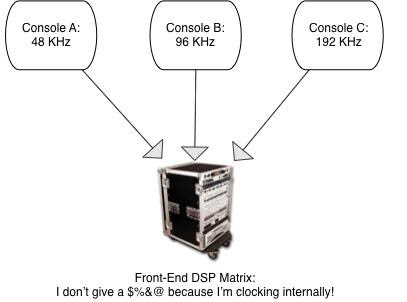
Let’s go back to our opening joke of this blog about the different consoles walking into a festival, umm I mean bar. Let’s say you have a PA being driven via the AES/EBU standard and a drive rack at FOH with a processor that is acting as a matrix for all the guest consoles/devices into the system. If a guest console comes in running at 96 KHz, another at 48 KHz, another at 192 KHz, and the system is being driven via AES at 96 KHz, for the sake of this discussion, who is determining where the samples of the electronic signals being shipped around start and end? Aren’t there going to be bits “lost” since one console is operating at one sample rate and another at a totally different one? I think now is the time to bring up the topic of SRC or “Sample Rate Conversion”.

My favorite expression in the industry is, “There is no such thing as a free lunch” because life really is a game of balancing compromises for the good and the bad. Some party in the above scenario is going to have to yield to the traffic of a master clock source or cars are going to start slamming into each other in the form of digital artifacts, i.e. “pops” and “clicks”. Fortunately for us, manufacturers have thought of this for the most part. Somewhere in a given digital device’s signal chain they put a sample rate converter to match the other device chained to it so that this traffic jam doesn’t happen. Whether this sample rate conversion happens at the input or the output and synchronously or asynchronously of the other device is manufacturer specific.

What YOU need to understand as the human deploying these devices is what device is going to be the police officer directing the traffic. Sure, there is a likelihood that if you leave these devices to sort their sample rate conversions out for themselves there may not be any clock slip errors and everyone can pat themselves on the back that they made it through this hellish intersection safe and sound. After all, these manufacturers have put a lot of R&D into making sure their devices work flawlessly in these scenarios…right? Well, as a system designer, we have to look at what we have control over in our system to try and eliminate the factors that could create errors based on the lowest common denominator.

Let’s consider several scenarios of how we can use our trusty common sense and our newfound understanding of clocks to determine an appropriate selection of a clock master source for our system. Going back to our bartending-festival scenario, if all these consoles operating at different sample rates are being fed into one system for the PA, it makes sense for a front-end processor that is taking in all these consoles to operate its clock internally and independently. If the sample rate conversion happens internally in the front-end processor and independent of the input, then it doesn’t really care what sample rate comes into it because it all gets converted to match the 96 KHz sample rate at its output to AES.


Front-end DSP clocking internally with SRC

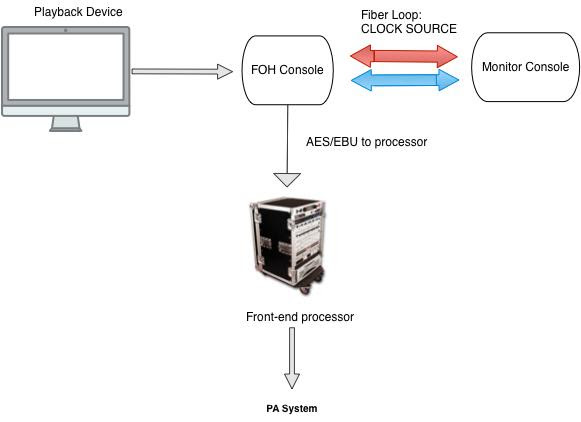
In another scenario, let’s say we have a control package where the FOH and monitor desk are operating on a fiber loop and the engineers are also operating playback devices that are gathering time domain-related data from that fiber loop. The FOH console is feeding a processor in a drive rack via AES that in turn feeds a PA system. In this scenario, it makes the most sense for the fiber loop to be the clock source and the front-end processor to gather clock and SRC data from the AES input of the console upstream of it because if you think about it as a flow chart, all the source data is coming back to the fiber loop. In a way, you could think of where the clock master comes from to be the delegation of the police officer that has the most influence on the audio path under discussion.


Fiber loop as chosen origin of clock source for the system


As digital audio expands further into the world of networked audio, the concept of a clock master becomes increasingly important to understanding signal processing when you dive into the realms of protocols such as AVB or Dante. Our electronic signal turns into data packets on a network stream and the network itself starts determining where the best clock source is coming from and can even switch between clock masters if one were to fail. (For more information check out www.audinate.com for info on Dante and www.avnu.org for info on AVB). As technology progresses and computers get increasingly more capable for large amounts of digital signal processing, it will be interesting to see how the manifestation of fidelity correlates to better sample rates, bit-perfect converters, and how we can continue to seek perfection in the representation of a beautiful analog waveform in the digital realm.

The views in this blog are for educational purposes only and the opinion of the author alone and not to be interpreted as an endorsement or reflect the views of the aforementioned sources. 

Resources:

Hass, Jeffrey. 2017-2018. Chapter Five: Digital Audio. Introduction to Computer Music: Volume One. Indiana University. https://cecm.indiana.edu/etext/digital_audio/chapter5_nyquist.shtml

https://avnu.org/

Ruzin, Steven. 2009, April 9. Capturing Images. UC Berkeley. http://microscopy.berkeley.edu/courses/dib/sections/02Images/sampling.html

www.audinate.com

**Omnigraffle stencils by Jorge Rosas: https://www.graffletopia.com/stencils/435


X