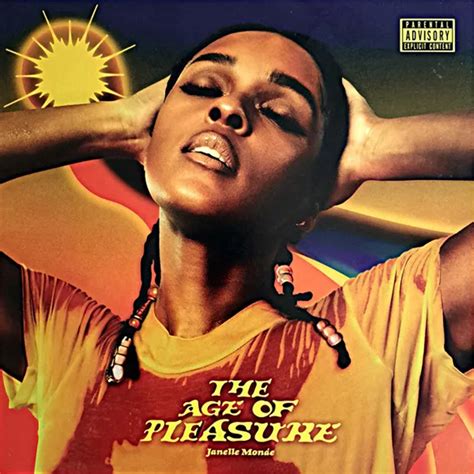
Why Does This Sound So Good Vol. IV: The Age of Pleasure by Janelle Monáe
June is a beautiful month of celebration. From Pride month to Juneteenth to Black Music Month, there is plenty to be joyful about during this month. There is an album that underscores all the celebrations of this month that I have found myself revisiting— “The Age of Pleasure” by Janelle Monáe. This project creates a different sonic universe than other projects by Monáe, but her Afroruturism roots are still present here. In “The Age of Pleasure” by Janelle Monáe, they combine unequivocally Black sounds, such as Reggae, Rap, and Afrobeats, to create a universe of what pleasure means to her as a Black queer woman and activist. Lipstick Lover, Know Better, and Only Have Eyes 42 are standouts on the project that highlights Monáe’s queer Black pleasure.
Lipstick Lover
Monáe shows us early that her pleasure is deeply rooted in Black culture with Lipstick Lover. The producers are Janelle Monáe, Nate Wonder, Nana Kwabena, and Sensei Bueno. From the start of this track, the infectious Chop sets the scene for Monáe’s romantic endeavors. Chop is the offbeat rhythm Reggae is known for. It is played on harmonic instruments such as the guitar and keyboard. To read more about Reggae style, see here. Not only does Chop set the mellow energy of the track, but so do Monáe’s smooth vocals. Ambient laser-like synth sounds punctuate the background space of the song as she floats over the beat. As we reach the pre-chorus, the background vocals engulf the stereo array. The song’s supple production matches the effortless yet sensual tone of Monáe’s lyrics.
Monáe not only smoothly explains her pleasure with her lipstick lover, but she also underscores how her pleasure is diasporic. Her interview with Apple Music highlights this diasporic sound. She is playing the Chop in one instant, but stops mid-song to state that the funk-inspired bass walk-up is integral in Lipstick Lover. The blend of Jamaican Chop, Black American Funk, and so much more on this record not only highlights Monáe’s wide net of musical influence but also the love she has for Black music across the world.
Know Better
The producers on Know Better are Janelle Monáe and Nate Wonder. The amazing features on the record are CKay, Seun Kuti, and Eygpt 80. Egypt 80 is Fela Kuti’s band. Fela Kuti is an activist commonly known as the father of Afrobeats. His son, Seun Kuti, is one of many keeping his legacy alive. CKay is a perfect addition to the track as he is a Nigerian artist and record producer known for mixing alternative sounds with the sounds of his homeland.
The song starts low with echoing harmonic synth sounds. Horns then set the tone of this track. They are sensual and direct. Monáe even samples the saxophone from Darkest Light by Lafayette Afro-Rock Band. Monáe and CKay’s voices are panned wide. Vocal stacking is utilized to make the texture thick. Their voices are clear and direct, like the meaning of this song. And the short reverb tail on their vocals adds to the clarity and forward feeling of their voices. The lyrics from both Monáe and CKay underscore the slow sensual nature of this song with lyrics like, “You try the fast wine but the slow better,” and, “Hold me/steady and slowly” (wine is a dance move that involves moving your hips in a circle, commonly used when dancing to Afrobeats, Reggae, and some variation is present in dances across the diaspora). This song is not only a cultural nod to the roots of Afrobeats, but it also underscores the sensuality and confidence of movement. The music moves you. The lyrics talk about this sensual movement. And the production choices support the pleasure and sensuality present in every aspect of the song.
Only Have Eyes 42
One of the final records of this project continues the steady and slow rhythm of pleasure. Only Have Eyes 42 is produced by Janelle Monáe, Nate Wonder, Nana Kwabena, and Sensei Bueno. The song invites us in with the Chop and laser-like synths again. Monáe’s singing starts low in her register with background vocals accompanying her. The background vocals make this song quite full and are produced in a way that makes the layers of the song seem more bountiful than they actually are (never underestimate the power of vocal stacking!). They act as a response to her call at times, as soaring chords at others, and as emphasis to her lyrics in other moments. The use of vocal stacking could also underscore the content of the lyrics. Janelle Monáe seems to be speaking about her love with two people, an ode to her polyamorous endeavors. The song comes to a climax and falls into the outro with the addition of strings. Every element of the song reminds us of the pleasure of intimacy in every layer.
Pleasure Received
Janelle Monáe surprised us with this project, a slight detour from her typical Afrofuturist lane. When talking about the album in interviews, she refers to it as a “letter to the diaspora”. That energy is felt and heard due to the Chop of the guitar, the feeling of the Funk, the bite of the Afrobeat horns, and the production that ties the music to the meaning of pleasure. As we close out Pride Month and Black Music Month, I am forever grateful for artists like Janelle Monáe who unabashedly make space for their identities and express them through their artistry. Because of “Age Of Pleasure,” many listeners have received an invitation to be unabashed in their pleasure as well.