Empowering the Next Generation of Women in Audio

Join Us

Theatre Sound Heroes: Overview of the role of a Production Engineer


There’s an unsung hero in the world of theatre sound: the production engineer (PE).

As shows get bigger, sound systems become ever-more complex. Someone on your team has to make it all work together, and that person is the production engineer.

Put simply, the production engineer “works with the sound designer to physically and logistically realise the entire sound system from the microphones to the speakers and the kilometres of cable in-between” (Gareth Fry, Theatre Sound: Who Does What?, Lighting and Sound International, April 2015).

Every designer will approach a show from a unique perspective. Some designers focus on the creative aspect; others have a more practical hands-on approach. Most designers will have a definite idea of the speakers and other equipment they want to use and where. The PE makes this happen to the best of their ability and also suggests modifications to make it reliable, effective and adaptable enough to handle every quirky requirement that may come up during tech.

As with sound designers, PEs have different specialties, so it’s important to choose one that suits your show and the way you work as a sound designer. If networking is a crucial element of your show, it won’t make sense to hire a PE who is a master rigger but less knowledgeable when it comes to media networking technology.

Ideally, the PE should get involved with a show at the same time as the sound designer so that the sound design process can be as open as possible with all the creative team. Discussions with the production manager about the budget and integration of the speakers (and associated cabling) within a set are of particular importance.  Involving the PE early on in the process can also help pre-empt tricky situations down the line, for example, when a speaker position doesn’t work for the lighting designer.

The first job for a PE after initial discussions with the sound designer is to look at the size of the venue or space where the show will be staged. They’ll consider what the show needs, what the sound designer wants, how much it will cost, and build a system spec from this. As well as evaluating potential speaker positions, the PE also has to factor in whether the venue can physically support and accommodate the system. Where will racks and radio worlds be stationed? Is there enough power available where it’s needed? Where can cable runs go? Is the proscenium arch stable enough to support the hangs – an important consideration when you’re dealing with theatres that can be 100+ years old, as is quite common in the UK.

Once a system spec has been drawn up, it goes to the production manager to tender out to hire companies.

Having solid technical sound know-how is an indispensable part of a PE’s job. Just as important is their ability to manage relationships with three key stakeholders: the sound designer, the hire company, and the manufacturer(s).

The ideal relationship between a sound designer and PE is two-way. The sound designer needs to communicate their requirements so that the PE understands the show from the creative aspect as well as from a technical perspective. This way they can make informed decisions about the system without involving the sound designer at every stage. Is imaging or coverage more important for the show, for example? Does the design need to allow for high SPL, or is it more important for the speakers to be discretely integrated into the set? The better the PE understands the show, the more trust the sound designer will have in their ability to realise the design with the hire company.

The relationship between the hire company and the PE is important, as a lot of what the PE does is dictated by how the hire company works. Production engineers will, therefore, prefer to work with hire companies they know. Often a single hire company won’t be able to offer the exact system spec, in which case the spec will be redrawn and hire companies will suggest alternatives. It’s a balancing act: the PE needs to include all sound (and related AV and stage) elements of the show within the spec, and they also want to work within the resources of the hire company.Kirsty-Gillmore-Aug2016-pic2
At this point, a PE may want to involve different manufacturers to find alternative solutions for aspects of the design outside of the resources of the hire company. Keeping clear lines of communication with manufacturers is important. They can offer product-specific support as well as solutions to problems, based on their in-depth knowledge of their products. A PE may like to involve a particular manufacturer in the system spec to help them create a kit list before it’s sent to hire companies.

Of course, everything revolves around the budget. One of the central roles of the PE is to make practical decisions given the resources they have at their disposal. They may need to negotiate a compromise with the sound designer, convincing the sound designer of an effective alternative approach.

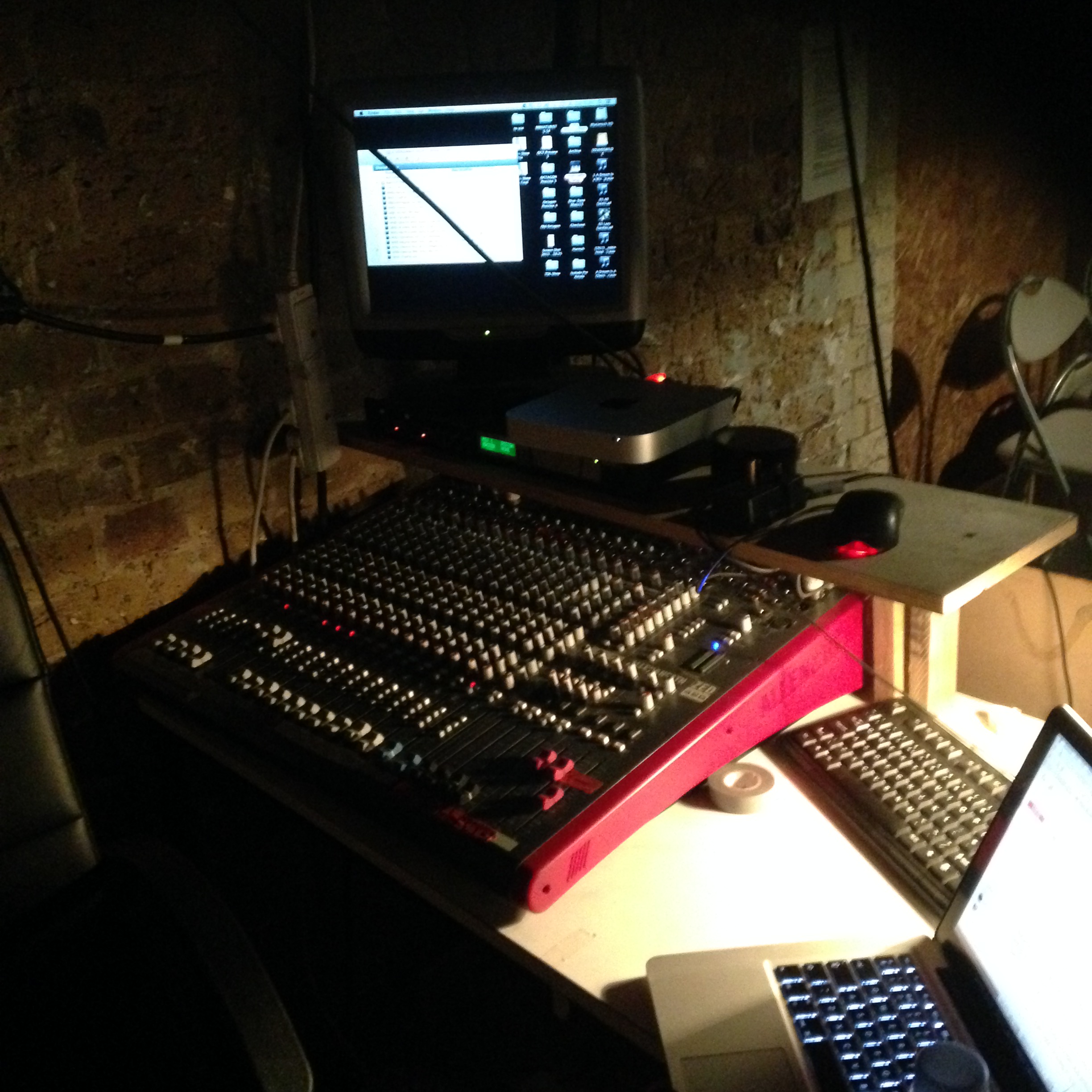
Once the spec is approved, the next step is for the PE to build the kit: stage racks, fly racks, multis, looms, the Deputy Stage Manager (DSM) post,  radio worlds and more. As well as realising the agreed spec, the PE must allow for changes that will invariably happen during the technical rehearsals, e.g. extra runs in the multicore for additional speakers. Then there’s evaluation, testing, and installation in the space, which may take days or even weeks for a large show. Followed by more testing, modifications, expansions and problem solving during the tech and dress rehearsals and previews, and finally, sign off when the show is up and running.

As you may have gathered, a great production engineer is worth their weight in gold. So if you’re a current or aspiring production engineer, let me know! I may have a job for you in the future.



A Brief History of Theatre Sound Consoles with Autograph Sound

Last Monday the Europe Chapter of Soundgirls.org had the opportunity to learn about theatre sound from one of the top names in the business: Autograph Sound.

Autograph has been at the forefront of theatre sound in the UK, and internationally, since the early 1970s. Before this time, theatres dictated the sound of every show. Their sound equipment wasn’t designed specifically for theatre use, and as there was no consistency in the sound systems between theatres, one show could sound very different in different theatres.

In the late 1960s, the music industry started to hand over production of their live shows to other companies. Around the same time, Andrew Bruce, who was Head of Sound at the Royal Opera House in London, noticed a need for theatre shows to sound the same in each venue – for each show to have a sonic “signature.” As Peppe Mallozzi, Sales Engineer for Autograph explained, this idea formed the company’s name: once a signature becomes recognised, it becomes an autograph.

Autograph Sound Recording was founded in London, U.K. in 1972 by Andrew Bruce. Theatre sound technology of the time centred on fixed input consoles, like the Trident Fleximix, a live sound console that was used for the production of A Chorus Line in London, 1976. But the requirements for musical theatre sound differ from sound for live music shows. In a very general sense, where the driving factor for music shows is often volume, the primary consideration for theatre sound is clarity, of dialogue as well as songs.

Manufacturers caught on and started producing consoles to accommodate the new specific requirements of theatre sound. Theatre sound took a step closer to achieving the clarity that its engineers desired with consoles like the Midas TR, used for Cats in 1981. This console had an output matrix, which allowed you to split a signal to different speakers to achieve all-important high-frequency coverage, crucial for hearing dialogue and singing with absolute clarity.

By the 1980s, shows were getting bigger and designers needed more inputs, outputs, and more flexibility. In 1982 Autograph commissioned a console from British company Cadac for Little Shop of Horrors at the Comedy Theatre (now the Harold Pinter Theatre), London.

From this first console, christened “The Coffin” for its shape, Cadac’s analogue console have remained in use in theatres up until the present day – Wicked, at the Apollo Theatre in London, will be the last big show to use an analogue Cadac console.

The next step for Autograph was to develop consoles with Cadac for use with any show. This lead to the A-type, used for Les Miserables in London in 1985, which was succeeded by the J-type and E-type. These consoles included automation, using an external computer to send cues to trigger the central VCA section of a console, with VCAs and programmable control groups becoming standard. Early automation was the start of something that became important for theatre sound: being able to operate a show from a central area on a console instead of running up and down a lot of channels.

As shows became bigger, other areas of automation and being able to save settings for individual scenes became crucial, as operators found they struggled to adjust settings manually for expanding numbers of performers. Bruce and his colleagues were also under pressure from producers to find a smaller alternative for the large analogue consoles that took up valuable seat space.

In the early 1990s, Bruce was approached by Soundcraft, a console manufacturer who was exploring the development of a fully assignable digital console for theatre sound. Bruce wanted a console that could digitally save EQ settings, scene snapshots and had the option to save volume levels (or not). Their collaboration led to the Soundcraft Broadway, the first digital theatre sound console.

The Soundcraft Broadway could control analogue input and output racks and be installed for the 1996 production of  Martin Guerre at the Prince Edward theatre in London but never used. Continual bugs and repeated failures with the networking technology of the time meant it couldn’t handle the requirements of the show, and a J-type Cadac replaced it. Soundcraft abandoned its digital theatre console project soon after.

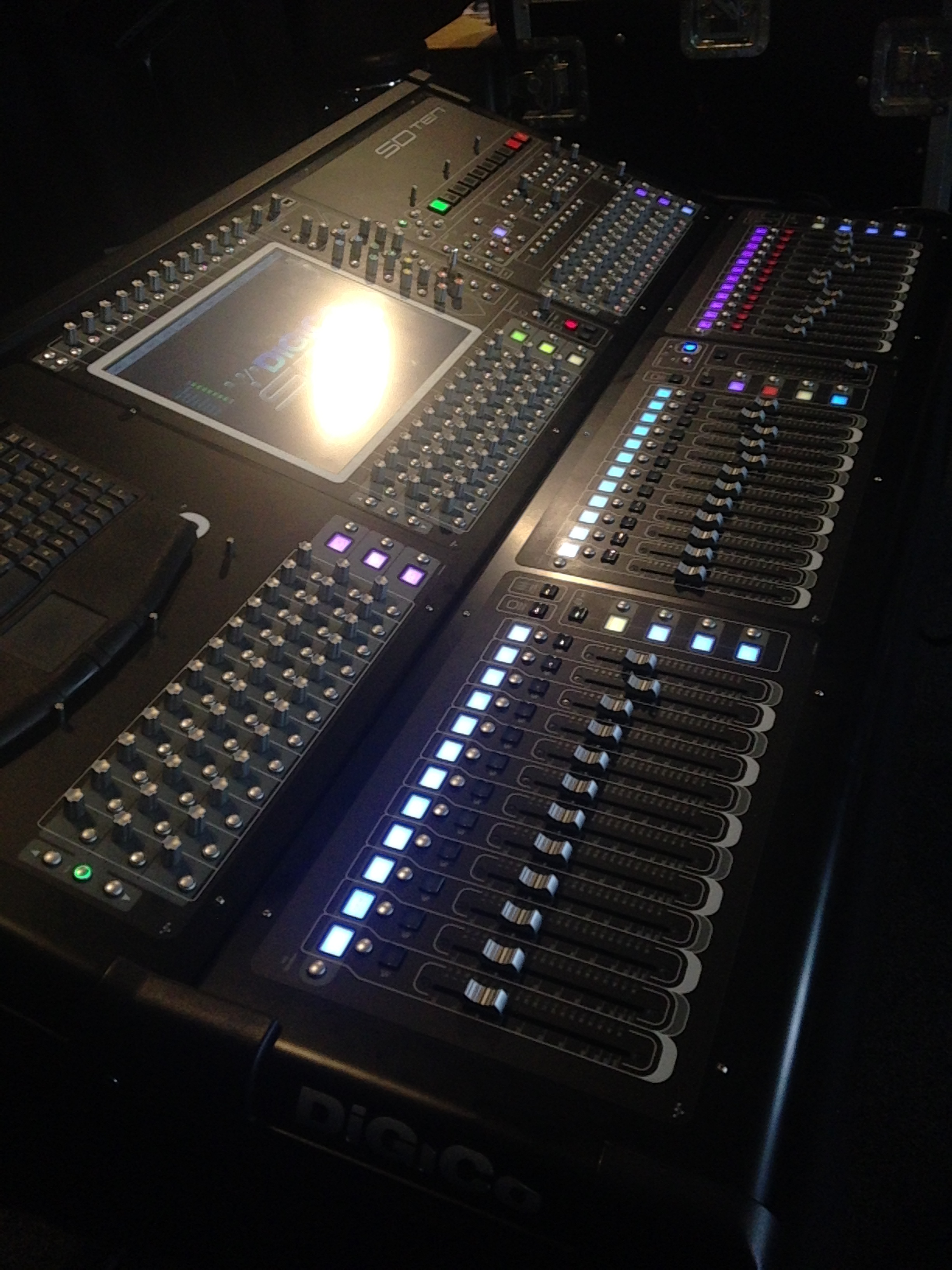
Back at Cadac, analogue consoles were still being produced with digital automation. However, there was another company with an eye on the digital console market: Soundtracs, producer of analogue consoles for studio and live sound since the 1980s. In 2002 the decision was made to launch a new brand focussed on digital consoles for live events. The new company, DiGiCo, and a new digital console, the D5 Live, were launched almost immediately.

James Gordon, the founder of DiGiCo, had already spotted the potential need in the theatre sound market and approached Andrew Bruce directly to develop theatre sound-specific software for the new DiGiCo console. Three months and a lot of research and development later, they launched the D5T: a digital DiGiCo D5 console with “T” (theatre) software, specifically designed to meet the needs of large-scale musical theatre shows. As computer automation control changed the game for theatre sound engineers twenty years earlier, theatre-specific software like T-software took it to a whole new level.

Anyone who has worked on a major West End or Broadway musical knows how complex the sound can get. Thirty-plus performers, all with radio mics, who need to be heard with perfect clarity solely or in duos, trios or choruses that change with every scene. Speaking one minute, singing the next, and wearing a hat (which completely changes the sound of a mic) one minute after that! Every line must be crystal clear for every audience member, no matter where the actors are on stage. And that’s all before you get the musicians involved.

It’s a big ask for the designer to make sure the balance of every one of hundreds of cues is perfectly calibrated. Let alone for the sound operator to set levels, EQ and FX for all actors in one scene, then change it all again with a moment’s notice for a new scene, with a new set of performers.

Theatre-sound-specific hardware and software like the DiGiCo consoles with T software were developed to meet these challenges. They allow for controlled and accurate line-by-line mixing, where each mic is only live when lines are sung or spoken, by pulling groups of channels into the central VCA section. Control of the channels is placed right under the operator’s hands, saving them from to running up and down a long console riding faders for individual channels

They also allow an operator or designer to save settings for individual channels in individual scenes (or even multiple “snapshots” in a single scene) and recall them in an instant. And going one crucial step further – to save different versions of the same channel, with varying settings (“aliases” in DiGiCo terminology), to accommodate understudies playing the same roles, and hats!

As Peppe says, “no one waits for sound.” When a director suddenly decides to jump from the big chorus dance number in Act 1 to the intimate duet between the leads in Act 3, Scene 2, or they suddenly want the lead actor to wear the hat they wore in the very first scene, they don’t want to wait for the sound operator.

Back in the 1980s and even the 1990s with the ability to save only a limited number of settings, jumping between scenes and changes to positions or costume would have meant a break for the company as the sound operator reset everything manually. Now, it’s a matter of a few clicks. What used to take weeks of technical rehearsals can be conquered in a few days.

Many thanks to Peppe at Autograph Sound for putting on a great day for our European Chapter members. We look forward to the next one!


It Doesn’t Sound the Way You Think it Does.


I first started working on plays about ten years ago at the National Theatre on London’s South Bank. The first show I worked on that made an impression on me was Pillars of the Community, Sound Designer Ian Dickinson. The preshow soundscape was set in a dockyard, and it sounded good. (I have done a lot of dockyards since and they are always based on it) I remember thinking how realistic it sounded, and it opened up to me how much fun that side of Sound Design could be. (more…)

What you’ve always wanted to know about being a Theatre Sound Designer

 … but didn’t know one to ask.

Recently, I was invited to teach a seminar on sound design to the Stage Management and Technical Theatre students at the Academy of Live and Recorded Arts (ALRA) in London. During the Q&A, I realised the questions they were asking are ones I’ve been answering for most of my career, and not only from students. Directors, producers, other designers, and colleagues in other sound disciplines all have one question in common: what does a Theatre Sound Designer do? (more…)

Sound Design for Theatre


Sometimes people ask me what I do, and I say, “I’m a Sound Designer.” The more I mix with people who work in Sound but not in Theatre I realize it is a role that doesn’t exist in other areas of live sound. The theatre Sound Designer is a bit different from the Sound Designer role in other disciplines.
(more…)

X