Empowering the Next Generation of Women in Audio

Join Us

Let’s Load in!


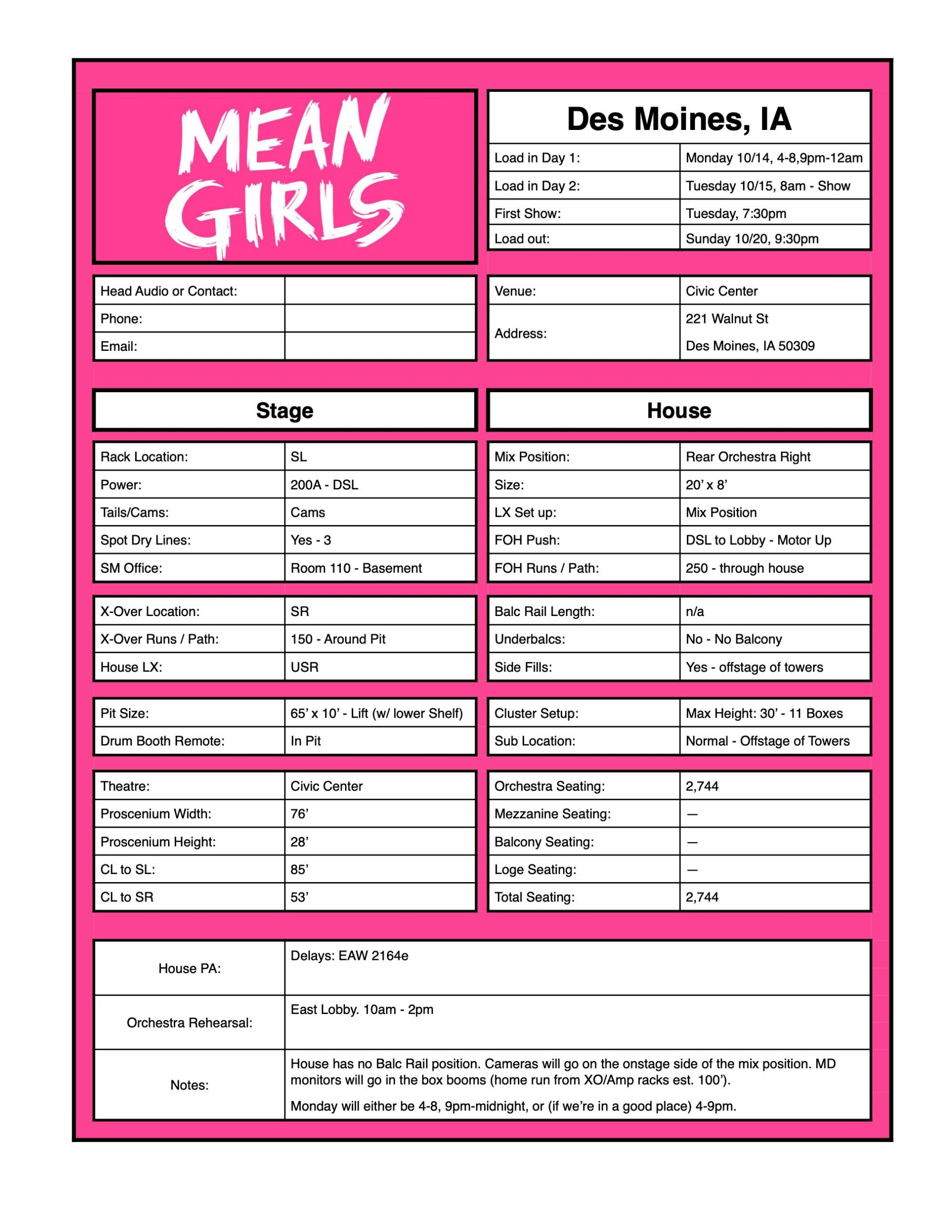
One of the biggest components of a stagehand’s job on tour is load in. We often joke that we’re not paid to run the show, we’re paid to load it in and out and fix problems. (As an A1, your job is also about mixing the show, but the sentiment still holds true.) For me, I start prep work for load in even before we get to the venue: I chat with the house head and make up an advance for each city we go to. There will almost always be something that changes, but it’s easier to tweak a few things onsite than have to figure everything out from scratch.

(As a note, this is for larger tours that move once a week or less. It isn’t really sustainable to advance a tour that moves multiple times a week. Those smaller tours are the ones where your system is smaller so it’s more feasible to walk in and figure things out at the venue. That’s where you learn a lot of your problem-solving skills, which you’ll continue to use when you are on larger tours with more moving pieces that have to fit together. Tours rarely get easier; they just get bigger.)

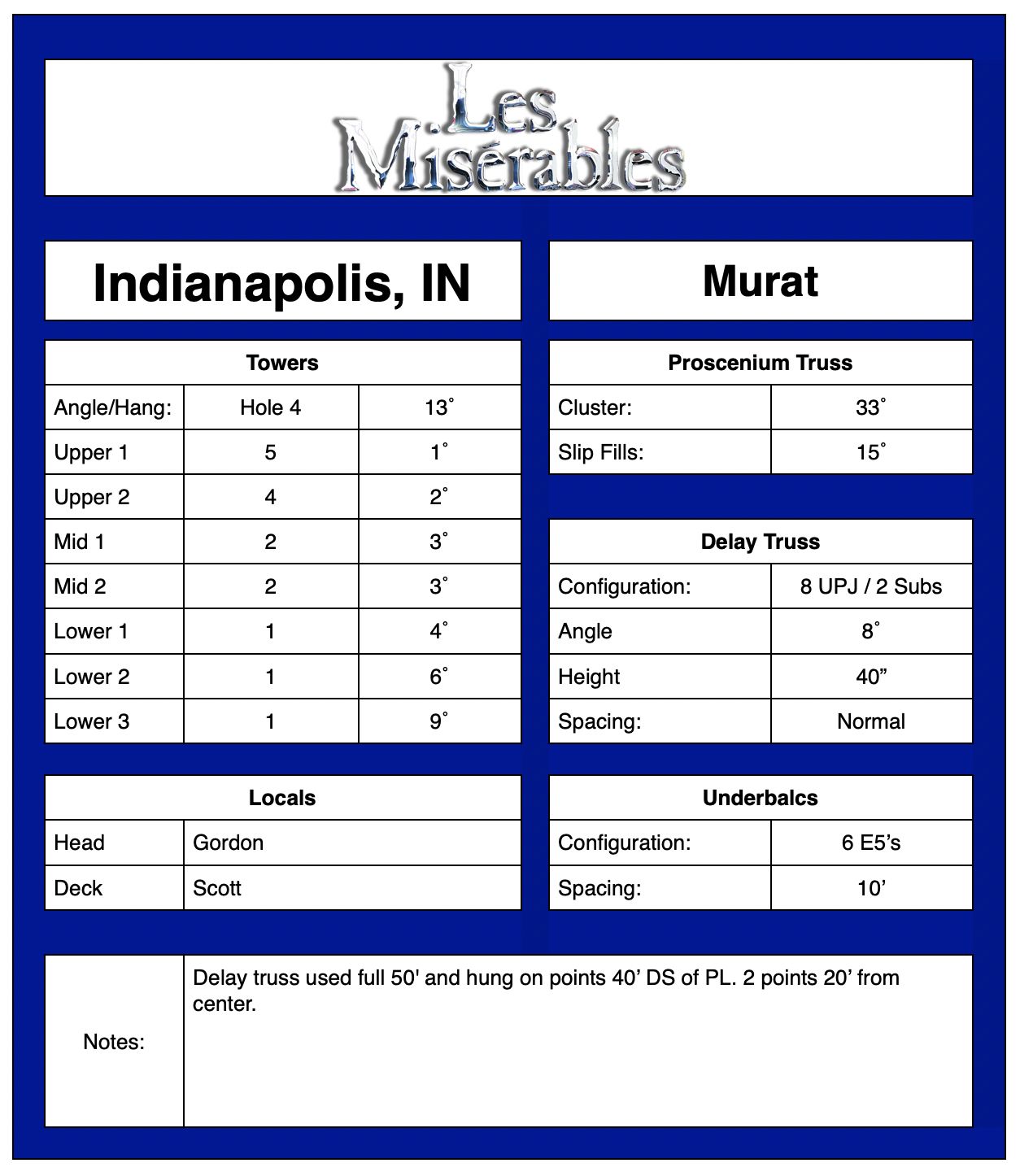
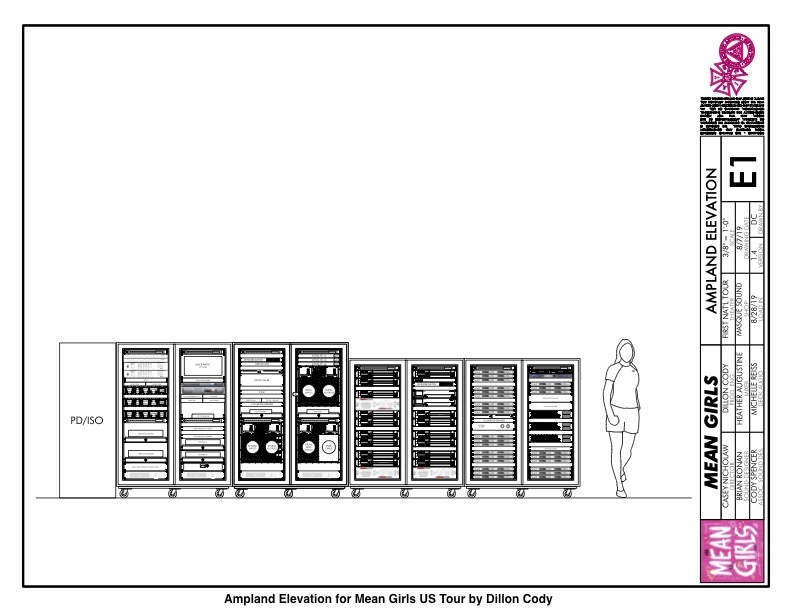
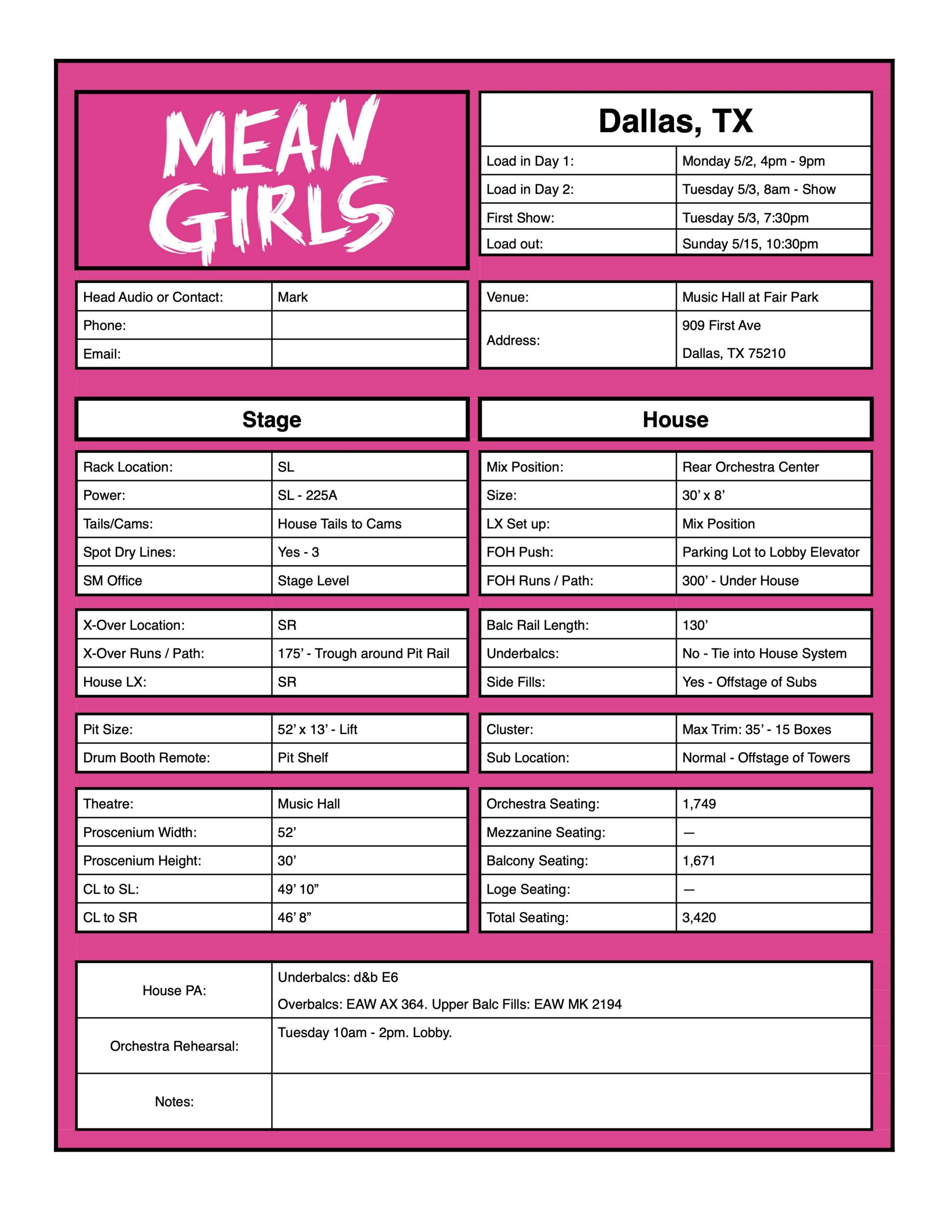
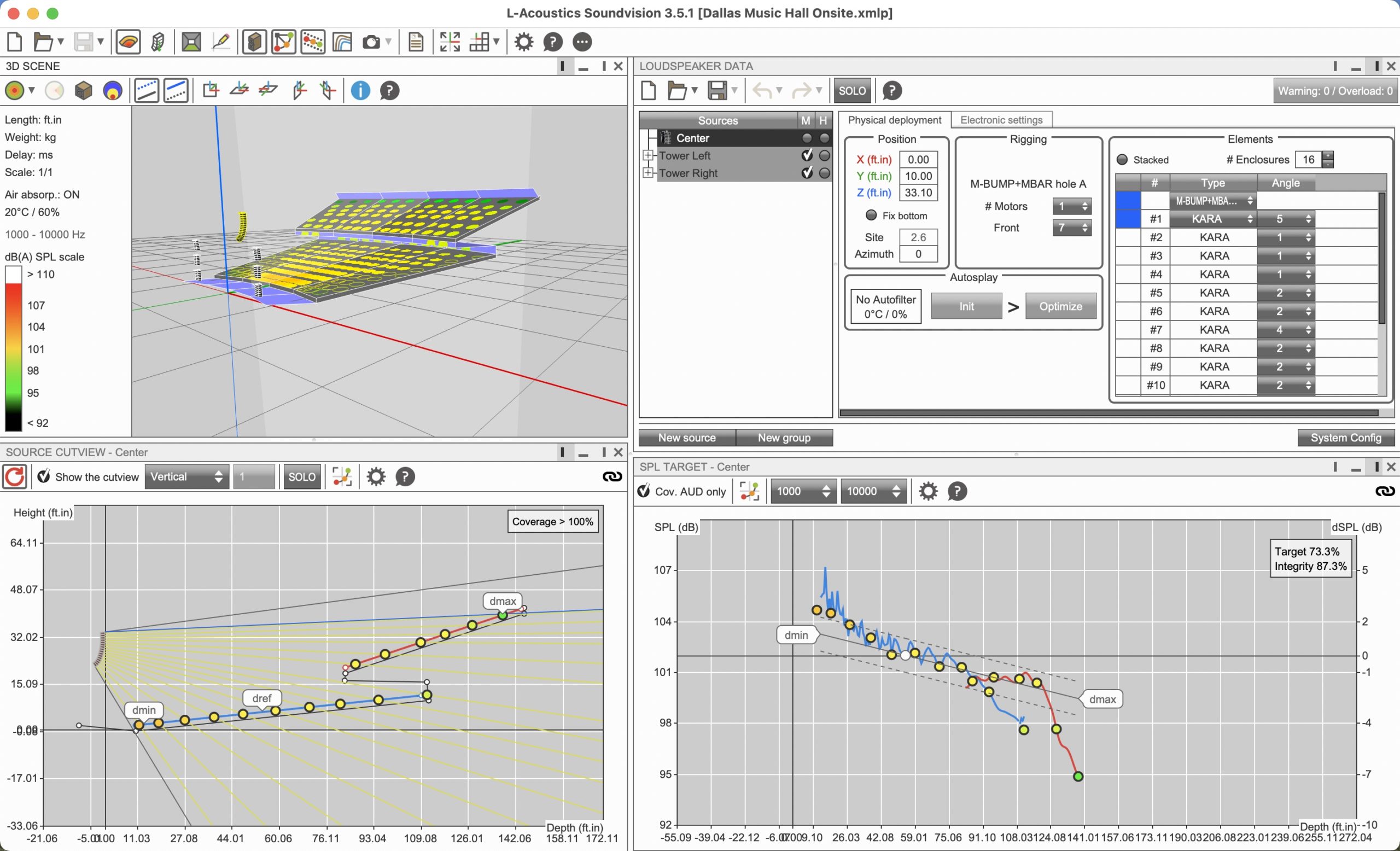
One part of my advance is an excel document that’s an overview of the venue and how we fit into it: what the dimensions of the stage are, where the amp racks will go (this is called Ampland), and how high the theatre ceiling is over the pit so I know how far I can trim the cluster out (which also tells me how many boxes I can use), etc. The other part is a summary from speaker prediction software: on Les Mis and Saigon, I used Meyer’s MAPP and on Mean Girls, I use L’Acoustic’s Soundvision. This tells me what angle I should use for point source boxes or what I’ll need to set the splays to for the arrays.
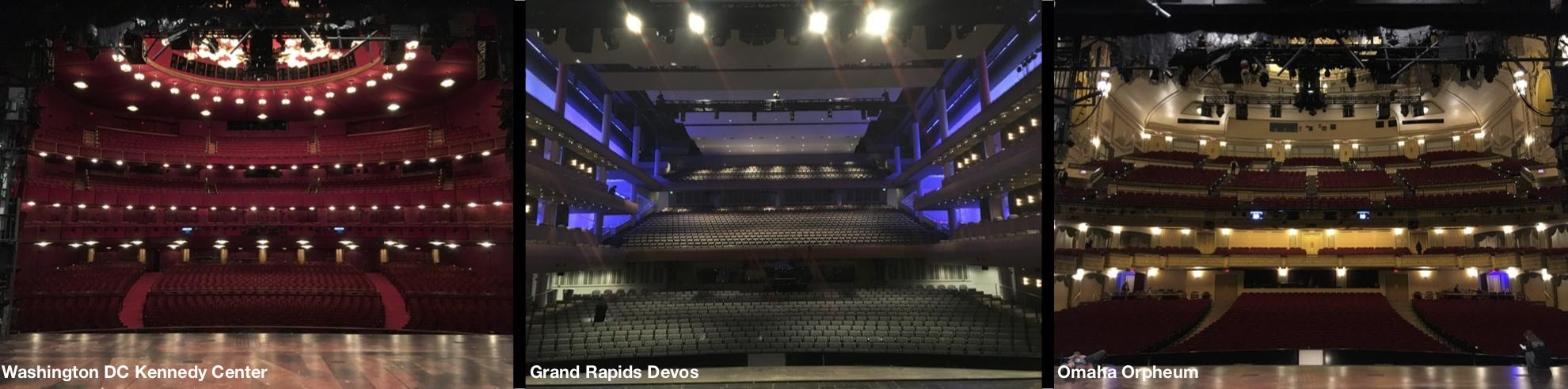
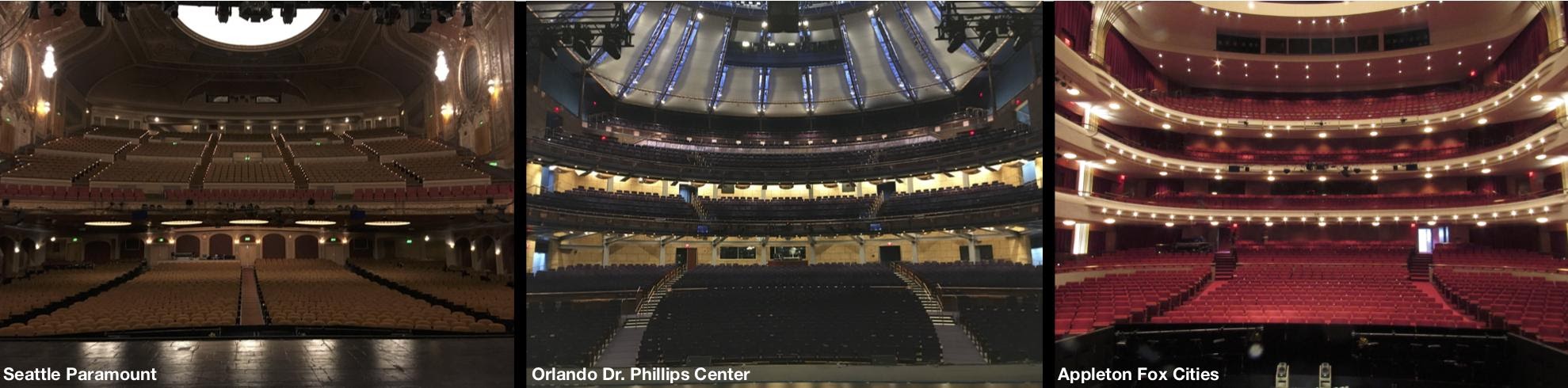
Once we get to the venue, the first step is to take a look around and talk to the audio house head. I’ve been on the road for a decade at this point and have been to all but maybe 8 of the 68 cities that we hit on Mean Girls. So for most of the venues, I have archival photos and paperwork and know roughly what I’m walking into, but things always change. New management, new crew, post-Covid renovations, at this point I can’t assume that it’s the exact same space I came to two or three years ago.

So you get the lay of the land and try to identify any problems with the plan. If the venue left the house cluster up, now is the time to take it down or fly it further out so I can hang mine. Are the holes to run cable under the stage too small for all the cable we have? Let’s talk to the house head about running it around the pit rail.

I’ll use a disto with an inclinometer (so it can give me both distance and angle) to double-check the accuracy of the room for Soundvision and the measurements for how high the cluster will actually be able to trim out. Going back to Soundvision, I put in the new info and see if I have to make adjustments or if I have to cut (or maybe can add!) boxes on the cluster.
 

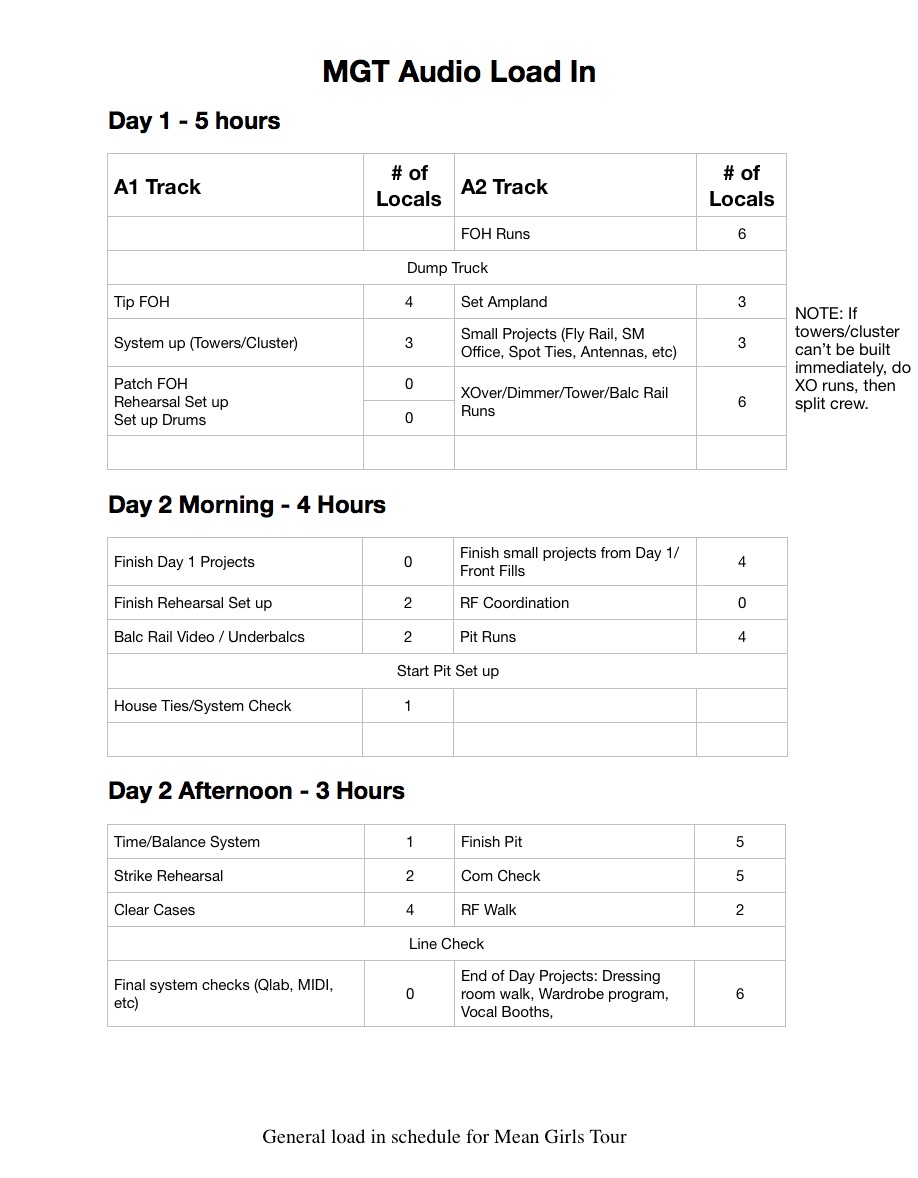
A normal load-in on Mean Girls has a spotting call an hour before load-in starts. This is when the Carpenters measure out where motors will go on the floor and I have some time to take the measurements of the house. Load in itself starts with a 5-hour call on Monday evening. Then we break for the night and come back at 8 am Tuesday morning where we’ll work through the day (with a lunch and dinner break) until the end of the show around 10:30 pm.

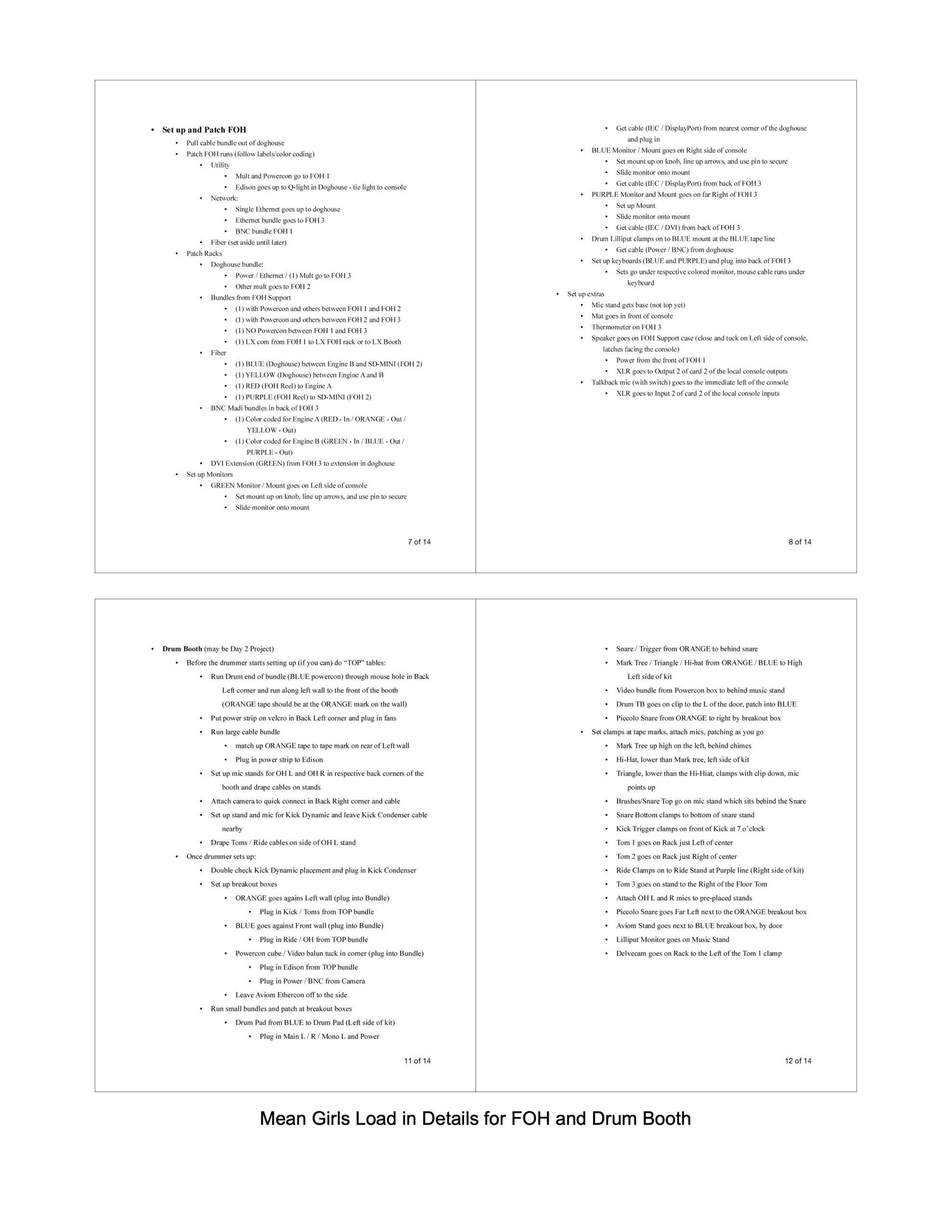
So at the end of the spotting call, load-in begins and the trucks start unloading. Most of the trucks will be packed by department: Audio has a truck for most of our gear, Electrics (LX) has one for theirs, Carpentry has one for the deck, another (or maybe two) for set pieces, Props has another, Wardrobe and Hair one more. However, the first truck is usually mixed to give every department something to get started. (On smaller shows it’s more likely that most of the trucks are mixed.) Carpentry will get drops to hang and motors to rig so LX can hang truss, Audio can hang towers, and Carpentry can build scenic pieces. Audio and LX usually get cables we can run. On the first truck, we get our FOH (Front of House) runs that will connect Ampland that’s backstage to the console out in the house. These are usually the longest and most complicated cable runs, so it’s better to throw the entire local audio crew on the project and get it done and out of the way.

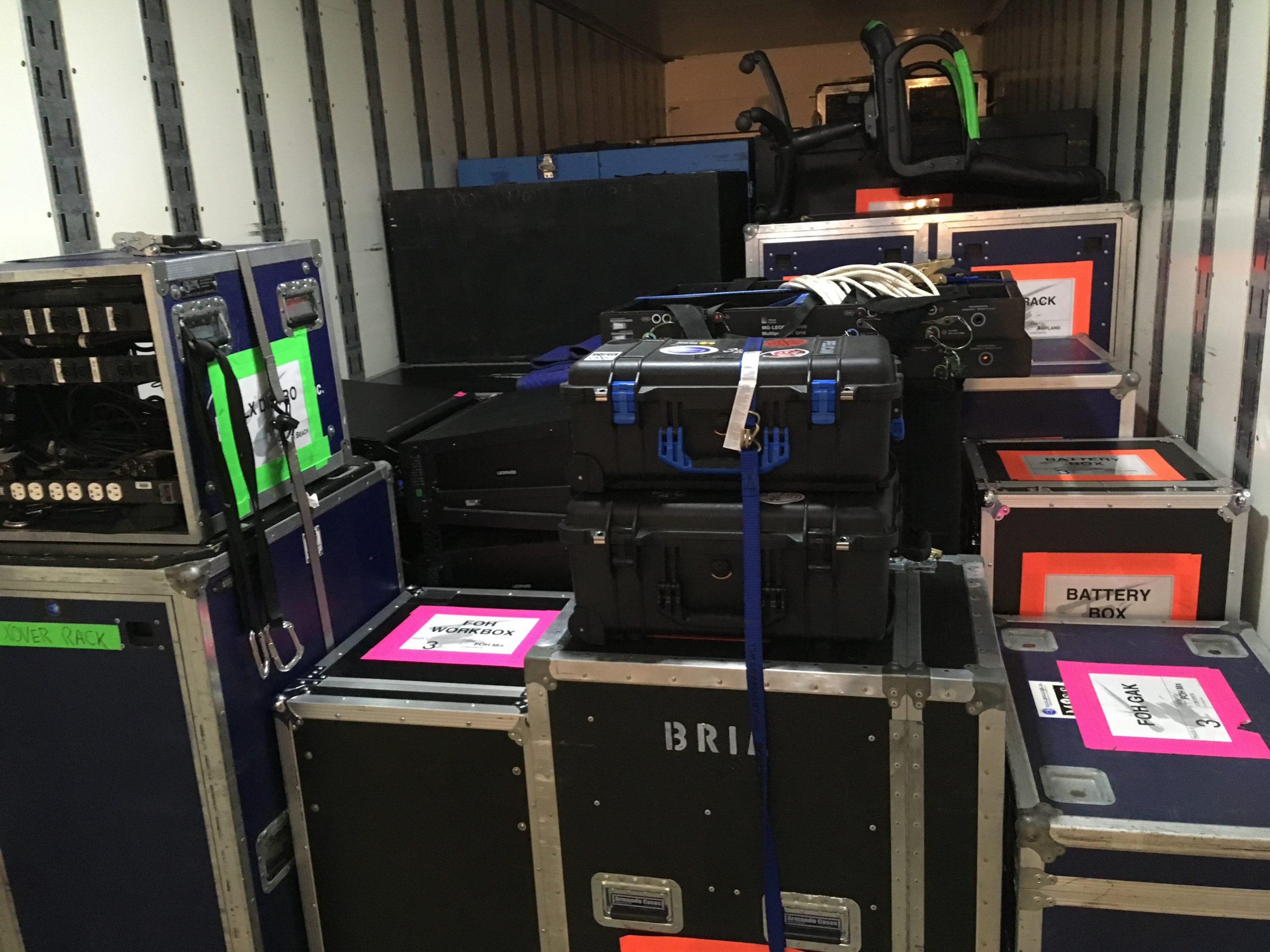
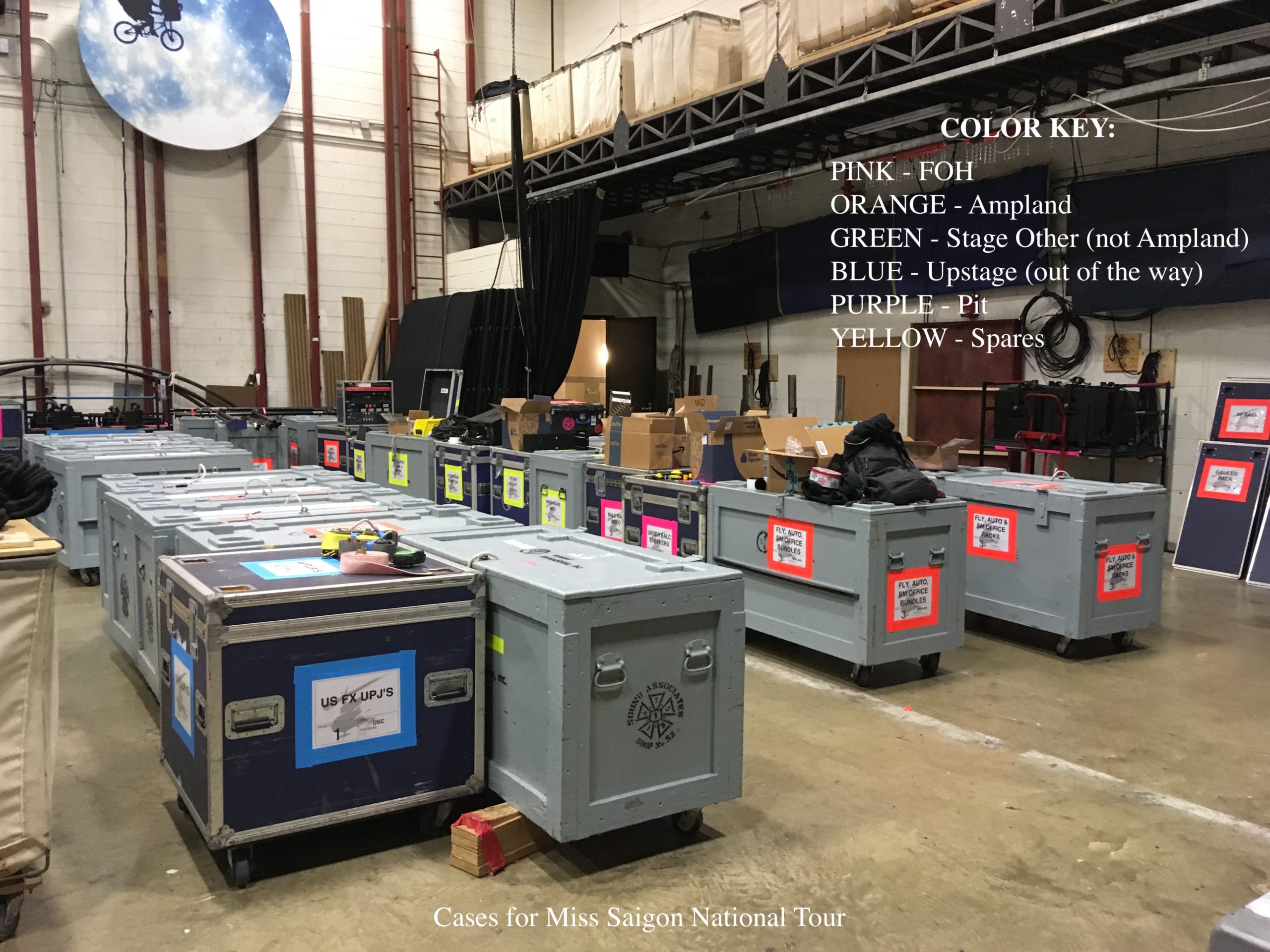
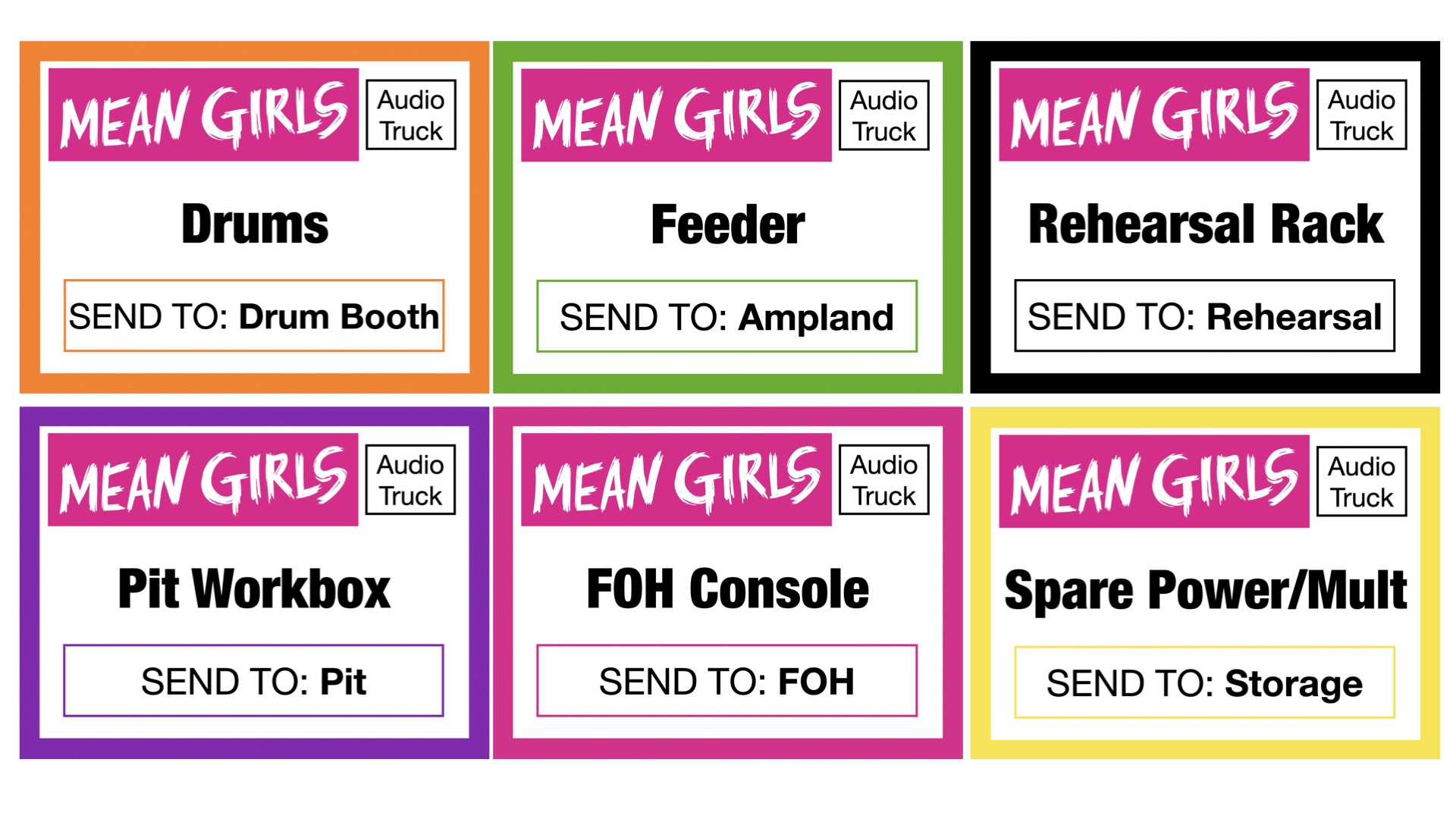
When our truck is ready to unload, we’ll dump all the cases, carts, and racks and find a place to put them in the theatre, usually denoted by a color code on the case label. Some, like spares (YELLOW), just go somewhere out of the way like down the side of a hallway or a rehearsal hall we’re using for storage. Others have consistent places: FOH (PINK) will always go to the theatre lobby, and Pit cases (PURPLE) will go down in an elevator to the basement level or off to the side to eventually ride down on the pit. Cases like Ampland (GREEN) change depending on the venue and where we end up putting our amp racks.

Once everything is off the truck, it’s time to work on projects. Most of the time the A1 will take care of getting the system set up: tip the console at FOH, build the towers and the cluster. The A2 will cover everything upstage of the proscenium: running all the cable (cross-stage, towers, cluster, pit, remote musicians, etc) and setting up com stations and onstage monitors. Some things, like the pit, can fall to either one. I’ve set it up as an A2, but on this tour, it worked better with the flow of load in that I, as the A1, set it up. This is where people and time management skills come into play. On most tours, I have 6 locals on the load in crew for audio, so my A2, Sherie, and I trade off crew so each of us has enough people to complete each job.

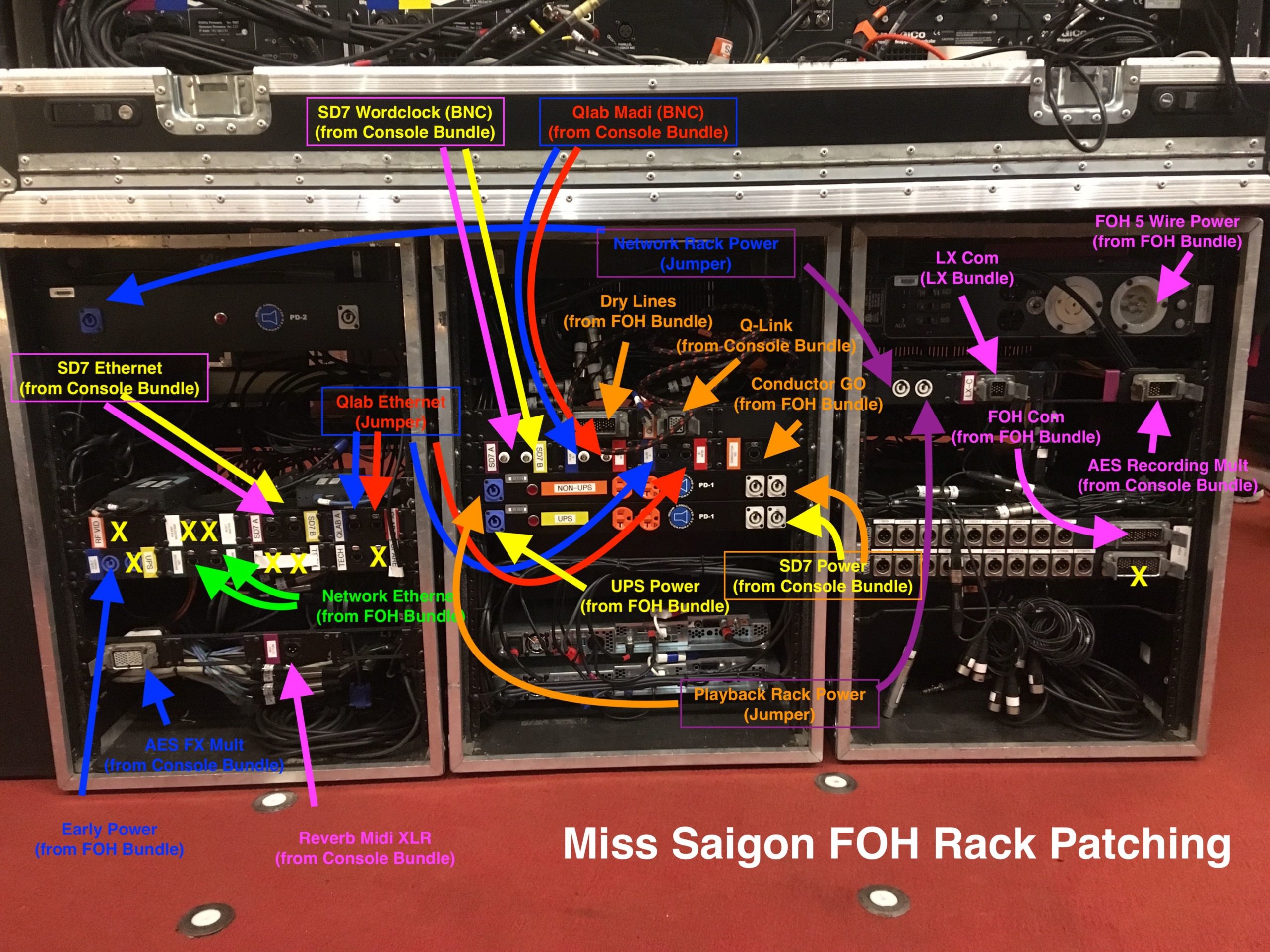
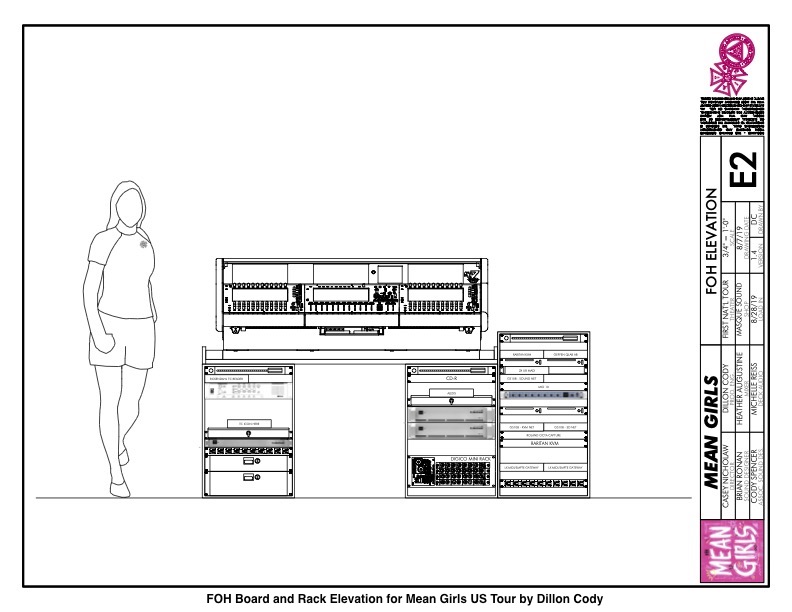
So, with all the cases off the truck, I’ll take the majority of the crew to FOH to tip the console: taking racks out of their cases to form a table and setting the console on top. It sounds easy until you remember that the SD7 (with part of the flight case) weighs around 400lbs. So I need at least 4 people to help me set that up safely. While I have the crew, Sherie has some time backstage to get the racks set where she wants them and start patching the FOH bundles we ran when they came off Truck 1. Then we split the crew and I take three people to build the towers (stacking three sections one on top of the other and bolting them together) and cluster (taking two carts, re-splaying the speakers, and connecting them all together to fly out), while Sherie gets the other three to start working on smaller projects like tying in feeder into power the racks or starting on com runs.

Load-in for Les Miserables tour (2017-2020) in Nashville, TN. (You can see the towers being built at the 0:22-0:27 mark)

After I’m done with the towers and cluster (and get rid of the large carts that the towers and cluster travel into clear space for others to work), I can send my crew to Sherie so she has everyone and can start on the longer cables runs that go across the stage, or into the pit, or to the Dimmer Racks (for cameras and stage monitors we have built into their truss).

While they’re working on those, I’ll make sure that we are clear of the pit (it’s usually an elevator that can come up to stage level to give us more space to build large pieces like truss or the towers) so Props can take the pit down and get ready to set up chairs and stands for the musicians.

Next, I can start on smaller, solo projects while Sherie continues with the crew. I prefer to be the one who patches things into racks. I’ve had enough well-meaning local crews that have accidentally plugged in something upside down, into the wrong place, or managed to slam an NL4 into a Powercon socket, that it’s easier and faster if I do it myself. So I finish setting up my console, patch everything in (with the help of more color coding), and power up.

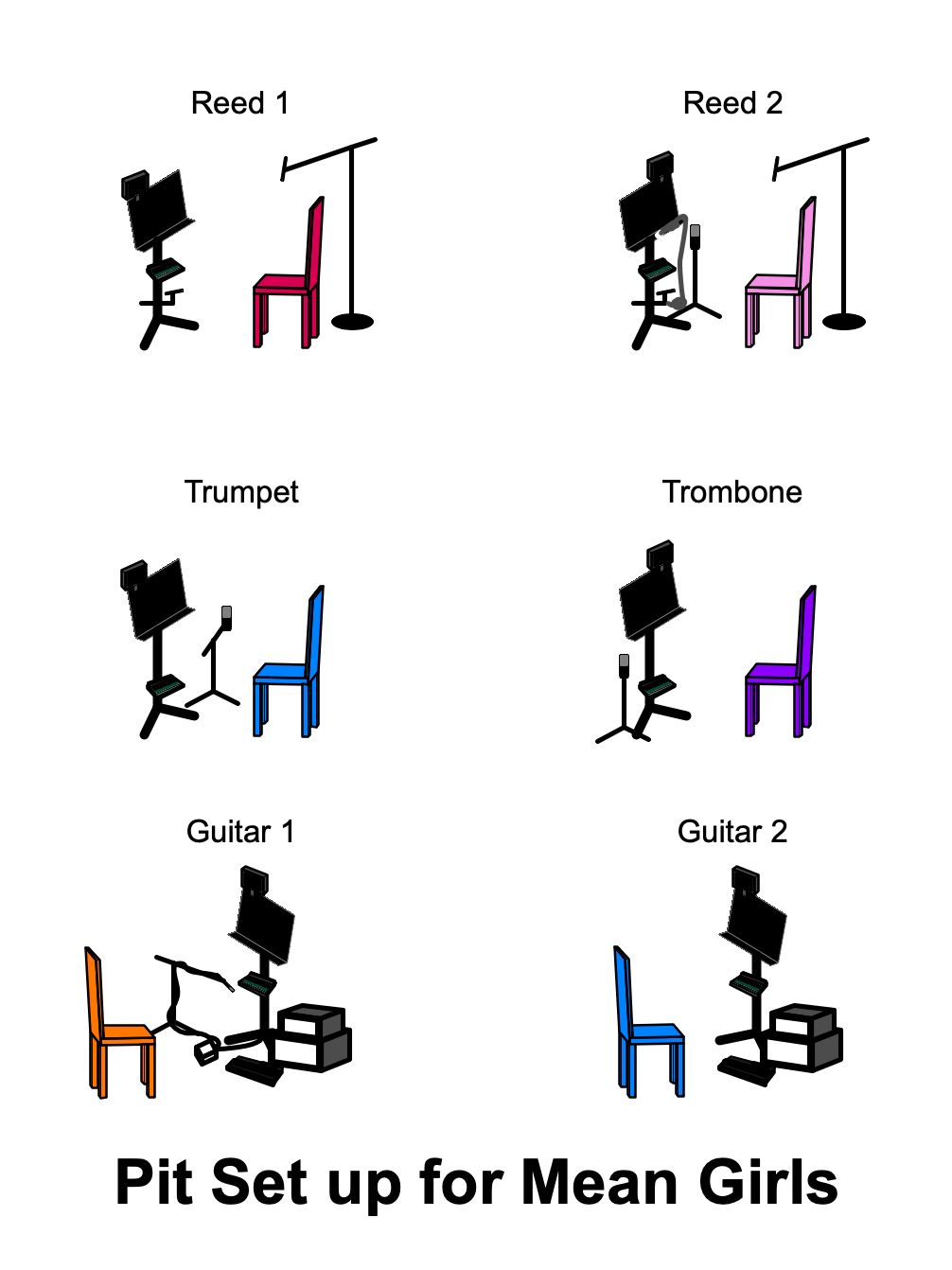
Then, I’ll head to the band rehearsal and work on that. This is something we only use during load-in so our show band (3 keyboards, drums, and a guitar) has a few hours to rehearse with the local musicians (2 reed players, trumpet, trombone, bass, another guitar, and a percussionist). This system consists of two speakers on stands (I get help for those, they’re heavy), and cables to run from a rackmount console to the various stations for all the electronic instruments.

This marks the end of Monday. My usual goal is to have the towers and cluster up so the pit can go down (or be ready at the top of the day on Tuesday) and most, if not all of the cross-stage runs are done. If we hit that point, we’re on track for the next day.

Tuesday morning we start our 4-hour call, power everything up, and continue working. I’ll take some time to make sure the towers sections are set at the correct angles (that disto comes in handy again) and I have sound coming out of all the right places, including any house system that we tie into to help supplement the touring system (under-balcony speakers or delays up in the balcony).

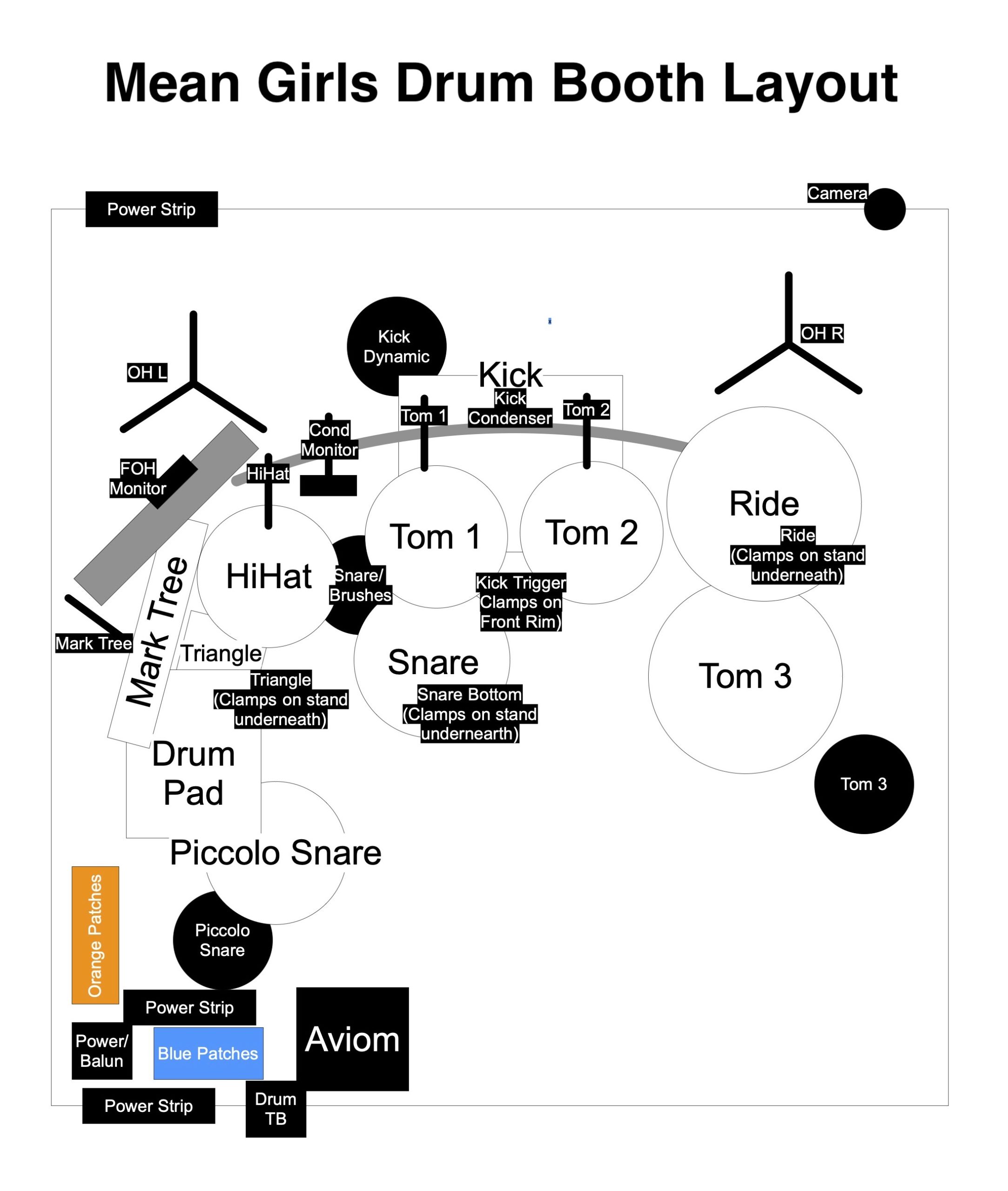
Once Props is done setting up chairs and stands in the pit, I’ll head down with a few locals to set up mics, conductor monitors, Avioms, and make sure everything is patched correctly for the musicians. While I’m in the pit, Sherie will work on deck with the rest of the crew to lag Front Fills in and continue setting up com stations as automation, the fly rail, and stage management gets set onstage.

Before we break for lunch, I’ll make sure that all my outputs are functioning and that SMAART and my wireless mic are set up for Quiet Time. (This is ideally when the Carpenters, Props, and LX are on their lunch break. I have an hour without people making noise on stage and they don’t have to listen to pink noise and loud music, so win-win.)

For Quiet Time, there are two general approaches: by ear with music and a disto, or using SMAART and an SPL meter. You use whichever your designer prefers, which on Mean Girls is the SMAART method. First I walk around with the SPL meter while a local is at the console to adjust levels and mute and unmute outputs as I tell them so I can set a consistent volume level across the house. Next, I’ll trade off with them, and give them the wireless mic to set at seats I’ve taped off so I can use SMAART to set the delay times for the matrix outputs. Finally, I’ll play music and walk the house to make sure that the delay and levels I set sound correct, making adjustments as needed.
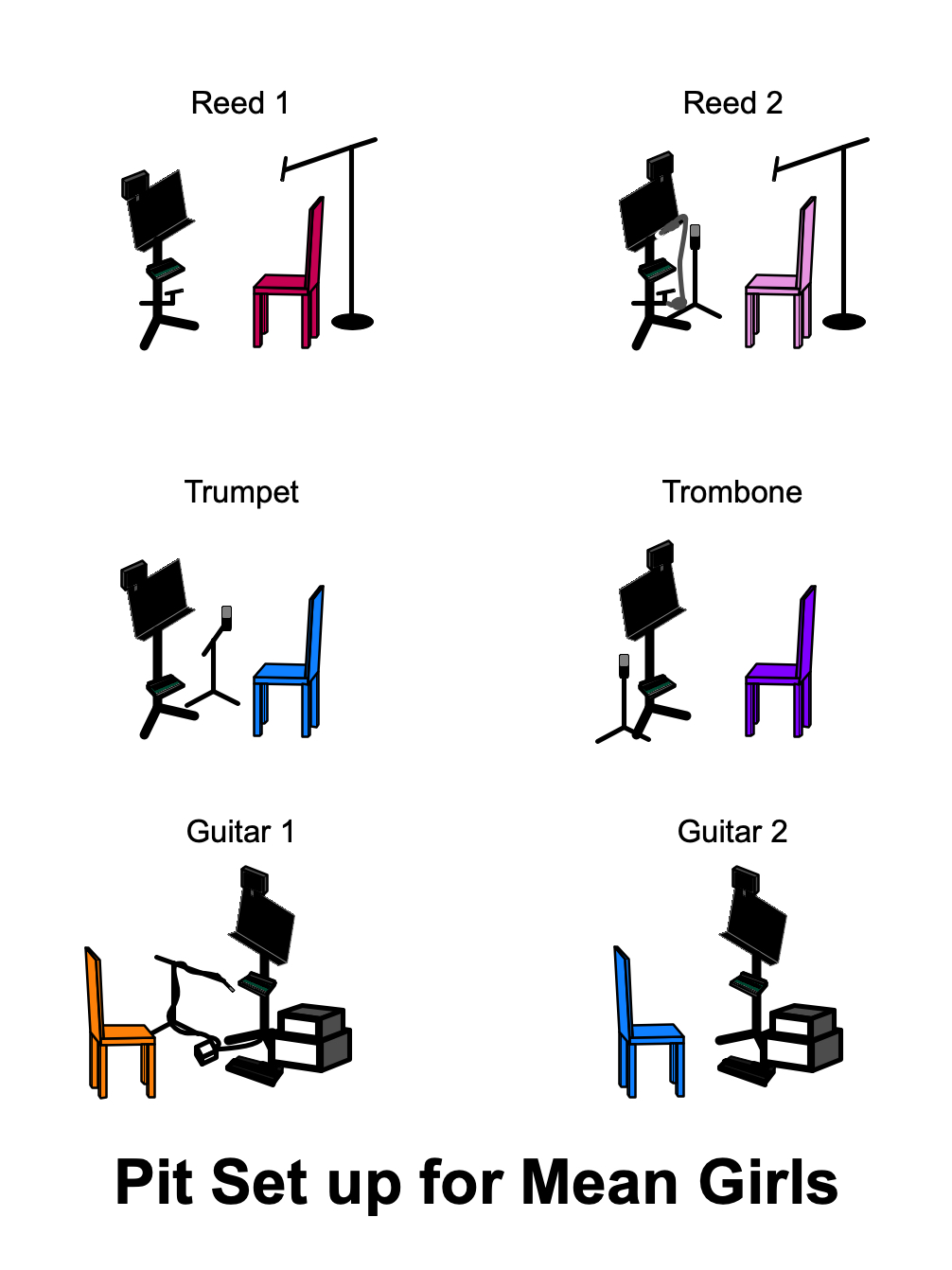
After Quiet Time we have about 2 hours to finish everything up before the dinner break. That involves sending the local crew to strike the band rehearsal I set up the day before, getting percussion set up in the pit and our drummer set up in his booth, and checking that everything is coming into the console at the right places.
At the same time, Sherie is working on tuning RF, focusing the onstage cameras that Stage Management and Automation use during the show, making sure all the onstage monitors are set up and having the local crew neaten up or tape down cable and sending cases to get backloaded on trucks or tucked away in storage.

When we’re show ready, we break for dinner, then come back for soundcheck. Sherie will battery up and get the mics ready for the actors while I’m in the pit adjusting mic positions for the musicians as they settle in. Then we’ll do half an hour with just the band, setting levels for the local players and adjusting the mix in the house. The last half hour adds the actors onstage and Sherie will come out front to mix the songs while I walk around the house to make sure there’s a good balance between the band and vocals and it sounds consistent in all the areas of the theatre.

Once sound check is done, I’ll make sure we’re set to start the show (MIDI checks, the console is in the right snapshot, etc) and Sherie will set out any practicals as part of her preset and walk our local audio through the cues they’ll have during the show.

At this point, we’re done with load in itself and ready for the show. Post-show usually means heading to a restaurant or bar for some late-night food and a drink or two to celebrate getting the show in. Then we look forward to tomorrow and the touring stagehand tradition of No-Alarm Wednesday!

Load-in for The Phantom of the Opera tour (2013-2020) in Ft Lauderdale, FL.
Saving the Show

We all like to think we’re absolutely indispensable, especially in the theatre world. There’s the old adage “the show must go on,” so we push ourselves to get tours into theatres where they barely fit, come to work even when we’re not feeling well because who else can run the show? Once, an actress asked what the A1 and A2 would do if one of us were sick. I told her that whoever’s not sick would mix the show, so she asked what happened if we were both sick. I replied, “then whoever’s less sick mixes with a trashcan at FOH.” Thankfully neither of us ever had to do that, but everyone on the road has a war story of doing a show despite illness or injury, bragging how quickly they came back or how stoically they soldiered through.

Trying to fit the old tour life we knew into a new landscape where Covid dictates so much have proven challenging to say the least. But some good has come from it: now more than ever, we’re focusing more on our physical health. Which is wonderful, and long overdue. However, sailing in uncharted waters leads to so much uncertainty in our lives. That constant stress takes a toll on the mental health of the company. We’re on rigorous testing schedules that race against the efficiency of an ever-evolving virus that threatens cancellations or unexpected layoffs if enough people in the company test positive. Before 2020 most of us would have cheered some unexpected time off and made plans to relax, but now there’s a nagging worry in the back of our minds that our entire industry could shut down again or our show could close for good. We find ourselves half tempted to stay locked in the hotel room in the hope that somehow that will keep a positive test at bay, all the while knowing that our quality of life will suffer drastically if we try to avoid each other completely.

We’re now at a point where being indispensable is a liability, not only to the company but to our own mental well-being. Even more so for the handful of company members who have become linchpins in a Covid world: people that, if they test positive and have to quarantine, have no replacement or understudy onsite to cover, and the show will have to shut down until they can return to work. In most cases, there’s someone, somewhere that could fly out to the tour to cover, but even that would involve at least one or two canceled shows.

At the beginning of January, I ran into both of those situations. Mean Girls had an outbreak of cases and had to cancel a week of shows, which had already happened on a handful of other tours. I found myself with some unexpected time off, but that didn’t last for long because our industry is a very small one. On my first day off, I got a call at 9 pm asking if I could leave on the first flight the next day so I could fill in for the A1 on the My Fair Lady tour, and Tuesday at 10 am I walked into load in to help the A2 get the show-up and running.

This was a job that brought a lot of perspectives. It was a d&b main system and Helixnet com, neither of which I’d toured, and a Yamaha PM10 console, which I’ve never touched before (I have worked on Yamaha consoles, and thankfully that knowledge of the software transferred!), plus a design team that I’d never worked with before. Walking in, I’d toured for long enough that I was able to get the general lay of the land, and the A2 and I worked through setting up FOH and getting the system timed with a few phone calls and emails to design and the A1 to make sure we had the right patches and were getting reasonably close to the original intention of the design.

It was gratifying to see that I’d come far enough in my career that I could take unfamiliar gear in stride or at least know who to ask for help. It also showed me the gap between what we know as someone who runs the show constantly, and what a fresh pair of eyes actually see. Taking that back with me to Mean Girls, I’m starting to covid-proof my system to the best of my ability. So far I’ve added better labeling and color-coding to my FOH setup, taking more pictures of what things look like, and creating a Dropbox folder that I can send someone a link with most of the pertinent information they’d need to load in, run, and load out the show.

Luckily, this leans into one of my strengths. If you threw a dart at a collection of my blogs, you’re almost guaranteed to hit one that either mentions or completely focuses on some kind of paperwork: scripts, console programming, venue advances; I love a solid set of paperwork and some detailed documentation.

One of my projects on the post-Covid version of the tour was creating documentation of the show and my stint at My Fair Lady gave me a better idea of what I want to include:

For some, this sounds like overkill, but I find peace of mind in the idea that I might give someone too much information, but hopefully never too little. I also have a lot of practice doing this kind of documentation because it’s similar to what I’ve done for some of the shows I’ve left, specifically those where I didn’t have much time with my replacement to help train them. The only difference is that this would be a temporary replacement with who I’d have absolutely no crossover, other than answering questions on the phone as I sit in a hotel room in quarantine.

At this point in the touring world, it’s no longer about job security, it’s about sustainability. Eventually, we may move to a point where Covid won’t shut shows down for weeks at a time, but we’re not there yet. Until we make it to that point, we all have to be prepared for the when — not if — of being the person who’s in quarantine. For me, that means lots of time typing on my computer so I can rest just a little easier knowing I’ve done everything I could to make my replacement and my crew’s life as easy as possible.

Production Audio


Before Mean Girls was planning to hit the road again, I got the opportunity to work on the re-start of the Cats tour as the production audio. That was a job I had never considered myself remotely capable of pre-pandemic, but as the world started to open back up, I was itching for a chance to get back into a theatre and more than ready for what I now viewed as a challenge instead of an impossibility.

I’m sure more than a few people reading this have never heard of production audio before. It’s not a job that’s billed on the front of the playbill like the designer, and they’re only with the show to get it up and running, so you’re not going to see them in the theatre when you go to watch a show. So what do they actually do?


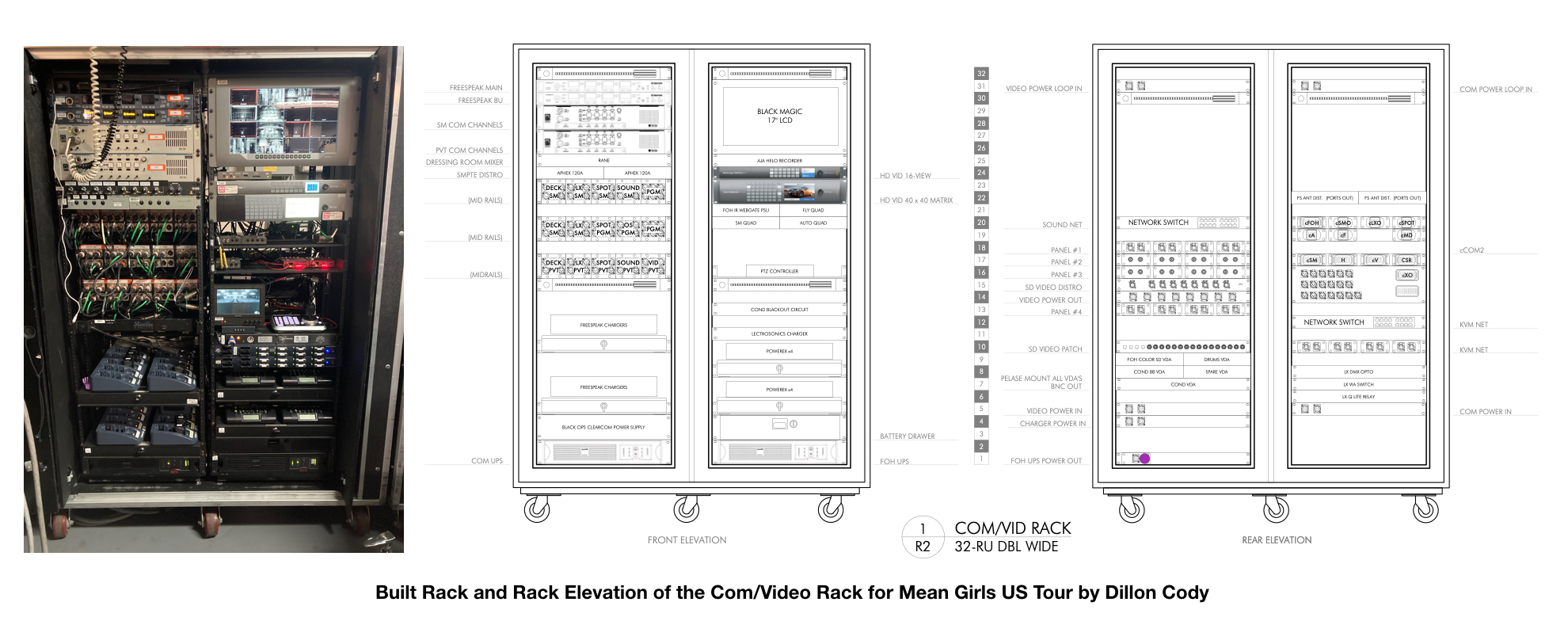
So. Very. Much. They’re responsible for the logistics of taking a show from theory to reality. Given paperwork from the designer, they interface with production, design, and the shop to get all the equipment needed and figure out how everything goes together. How will all the gear fit into racks? What cables do you need to connect everything? Do you need infrastructure for MIDI or timecode? Networked computers so you can operate amps, consoles, or programs remotely? Who in the crew will need com and/or video and how does it get to them? Which speakers will need rigging hardware and do you know where they’re going to go or should you bring multiple options?

It’s a parade of endless questions

Which requires an extremely organized person, a good communicator, and a lot of technical knowledge. My pre-COVID hesitation had always been the last part. I knew I was organized and could keep people in the loop, but I know the tech-heavy aspects of sound don’t hold my interest nearly as much as the more artistic side of things, and I’d always assumed that meant I would be a disaster in such a job.

Thankfully, with the tour re-mounting instead of being a brand new production, the system was already built and sitting in a warehouse. That removed the most complicated technical part of the job from my plate, plus I’d worked with the original designer and production team before, so I was familiar with how they built their shows. That was actually why I got the call for the job: I may never have done production before, but I knew how to tour and what I’d be working with.

With that part already taken care of, my job was mostly coordination and improving efficiency. On a new show, the crew has two or three weeks in the shop to get all the gear, rack it up, cable, and test everything. For the remount, we took the existing system back to the shop and we had two weeks to make the changes the designer and production manager had agreed on so the show could load in and out faster. (It was going to a schedule with shorter stops and more frequent moves.) I had a list of items that were getting cut (under-balcony speakers, remote com stations, etc) and substitutions that were being made (drums mics swapping out for an e-kit, the console changing over from an SD7 to an SD10), as well as evaluating anything we could tweak to make the touring crew’s life easier.

The shop crew consisted of me as the production audio, the A1, A2, and a few locals who are audio people that work on or around Broadway. I was in charge of hiring the local crew which was something completely new to me, but I was fortunate to have friends in the NYC area who were veterans of plenty of shop builds and were both available to work and willing to help me navigate a job I had never done before. Pro tip: hire people smarter than you and listen to them. A large portion of the success of the show can be directly attributed to my shop crew. They helped me work through technical questions, pointed out when I’d missed things or might have incorrect information, and offered advice when I needed help or they knew a better solution. With their help, I didn’t have to know all the technical answers and could lean on their expertise.

At the end of the two weeks, we packed everything on a truck, and the A1, A2, and I went to tech. Now I was back in familiar territory, just in a different role. Instead of loading in the show in my usual role as the A1, my job as production was to take care of setting up anything that the road crew shouldn’t have to touch on a normal load in or out: cameras that live in electrics truss, speakers that are mounted to set pieces, setting up for an orchestra rehearsal that would only happen in tech, etc. My goal was to always be one step ahead of everyone else, whether that was having tech tables set up before designers came in, making sure speakers had the correct hardware and were ready for the crew to set up, or ordering supplies to make sure we had everything we’d need.

I liked this part of the production process the best. After almost a decade on tour, I’d tried many ways to streamline shows and I knew what worked, what didn’t, and what could make a project less of a pain. So I rigged up speakers, spiked placement, color-coded cables, and did my level best to make the system as easy as possible to move.

All in all, I consider my first go at production a success. Did I do everything perfectly? Nope, definitely not. But the fact that I was willing to ask for help and advice meant that most of the problems I encountered were minor or the crew knew it was an honest mistake and were willing to give me some grace while I fixed it. Am I going to change my career trajectory now that I know I wouldn’t be an abject failure at production? Again, no. It was empowering to try something new and I truly enjoyed the work, but in the shop I still found myself wishing every once in a while that I was the one building the racks instead of answering endless emails and phone calls, printing labels, and fielding questions. In tech, I occasionally itched to push faders instead of sitting at my tech table placing yet another online order and looking over what seemed like endless lists of projects to do and fixes to make. On the other hand, I wouldn’t automatically turn down the opportunity as I had in the past. It was gratifying to see my to-do list slowly dwindle down as we went through tech and I loved the feeling of accomplishment when I knew I’d made some part of the tour just a little bit easier to load in. Since it was the A2’s first tour, I was also able to give him advice of pitfalls he should avoid and the best ways I’d found to speed up my workflow. Touring is a very odd combination of skills, and it was good to know I could pass on my accumulated knowledge to make someone else’s life easier.

This past 18 months of pandemic gave me a good opportunity to reevaluate my skills and realize that, not only was I capable of more than I thought, but I had a wonderful community around me who wanted to see me succeed and was willing to help make that happen. So, maybe, as the entertainment world comes back to life, try something new. You might find yourself pleasantly surprised!

Tips for Touring


Within the past couple of months, life has started to pick up, and start dates for live events seem more and more like true beginnings and not the “fingers crossed!” of last year. But after a year and a half, the landscape looks a little different. People who had been on the road for decades suddenly had extra time at home and realized that they didn’t want to head back. Others who were on the cusp of starting their careers can finally see opportunities pop up and are ready to hop on the road.

If you’ve never been on tour before, here are some tips and tricks to get you started. (For clarity’s sake, I’ve only toured in the theatre world. I would assume that some of this translates to concerts, but I’m not saying that it absolutely does.)

Most of the tour advice boils down to: don’t be an idiot and don’t be an asshole

If nothing else, remember that. So much of our life is dealing with different personalities, across departments, the touring company at large, and your local crew. If you and the people around you are pleasant to work with, your day gets immediately better. So, keep in mind:

Moving on to the nuts and bolts of touring

When you start a new tour, you’ll have a couple of weeks of shop prep when you head up to the NYC area and get all the gear (speakers, console, com, processing, RF, cables, etc.) and put it all together.

This also applies to cases. If you can, color code labels according to the case’s destination


As you start moving the show, another set of organizational skills comes into play. You develop a flexible routine, which sounds like an oxymoron, but the reality is that there will always be a few cities thrown in the mix where things just won’t be able to follow the usual plan. However, the individual tasks in your routine should retain a flow that you follow as much as possible.

Finally, some general housekeeping tips

I’ll say it again: if you follow nothing else on this list, don’t be an idiot and don’t be an asshole. Some common sense and a positive attitude go a long way in an industry that is so much smaller than you think.

Mixing a New Musical


Getting any show up and running is hard. Layers upon layers of new information are being added to the piece once the actors move from the rehearsal space to the performance venue, and it’s all happening very quickly. As a show’s A1, I am hard at work preparing my script, generating paperwork, programming the console, and in some cases also working as a hand on the shop build and/or load-in. Design elements are coming together throughout the tech process. Ideas are tried, then retooled, and tried again. However, one thing that usually isn’t changing is the actual script of the show. Not so on new work!

New pieces, and especially new musicals, come with their own set of unique challenges. Sometimes members of the writing team are present throughout the rehearsal process, making rewrites and changes to the piece as it gets staged. Rehearsal reports sent out by the stage manager will include new script pages and/or change logs, all of which can make it harder to get familiar with a show in advance of tech and previews. Songs may be moved around in the script, new scenes or characters might be added, entire sections may get cut. The entire product is constantly evolving!

Personally, new musicals are my favorite kind of shows to work on, despite all these added challenges. In fact, part of why I love them so much is precisely because of these added challenges! It’s really special to be part of a work that is being shown in its full form for the first time, and it really does keep me extra engaged when I’m in the tech and preview process. The audience has no preconceived notions of what the show is going to look or sound like, and as the mixer, my role in facilitating the storytelling is even more crucial, because no one has ever heard it before!

So, how should one approach the preparation process when mixing a new musical? In general, the process is the same as with existing work, just with a few added hurdles.

Do your homework as per usual

Familiarize yourself with the material in advance as best you can, whether it’s through demo recordings or by watching run-throughs in the rehearsal hall. The new musical I am currently mixing was meant to be produced in 2020, but due to the pandemic, it was adapted into a radio play and released on audible, with the fully staged production postponed to this summer. So, since a new musical likely won’t have a cast album yet, I was able to use that audible recording to do my “homework” of getting to know the general feel of the scenes and songs, even though I knew that the show would likely change a lot in the year that passed between when the radio play was recorded and this summer when we would finally get to do the show for an audience.

Prepare for new pages

This is probably the most labor-intensive part of the prep process on a new musical. As the script changes, whoever is tracking those changes (usually someone from the writing team or stage management) will bring you new replacement pages to insert into your book, or a change sheet with lines that you should write in on your own (some shows do one or the other, on my current show, Row, they do both). This means you’ll be doing quite a bit of transferring your notes from old pages to new ones. For that reason, it’s all the more important to develop a shorthand for yourself that you like, so that you can do all this rewriting as quickly as possible. For example, I will abbreviate my Band Master fader as “B” and my Vocal reverb fader as “V”, then I use musical crescendo/decrescendo markings for my dynamic moves. Writing “B < -5” is a lot faster than having to transfer the full words over and over again every time a new page comes in! Other little symbols I like to use are up and down arrows for pickups, slashes for when characters’ lines overlap, and my favorite, a little glasses symbol for when you should look at something specific for a cue (this is a common practice among musicians to remind themselves when they should watch the conductor).

Don’t get rid of your old pages!

As Gibbs’ Rule #11 teaches us, “Everything is subject to un-change.” A new scene might not work, and you might go back to the old scene. Keep all your change logs and cut pages handy in case you need to re-insert them or reference them for any reason. Fun fact: I once did a new musical whereby the end of the run, my stack of cut pages was basically the size of the finished script!

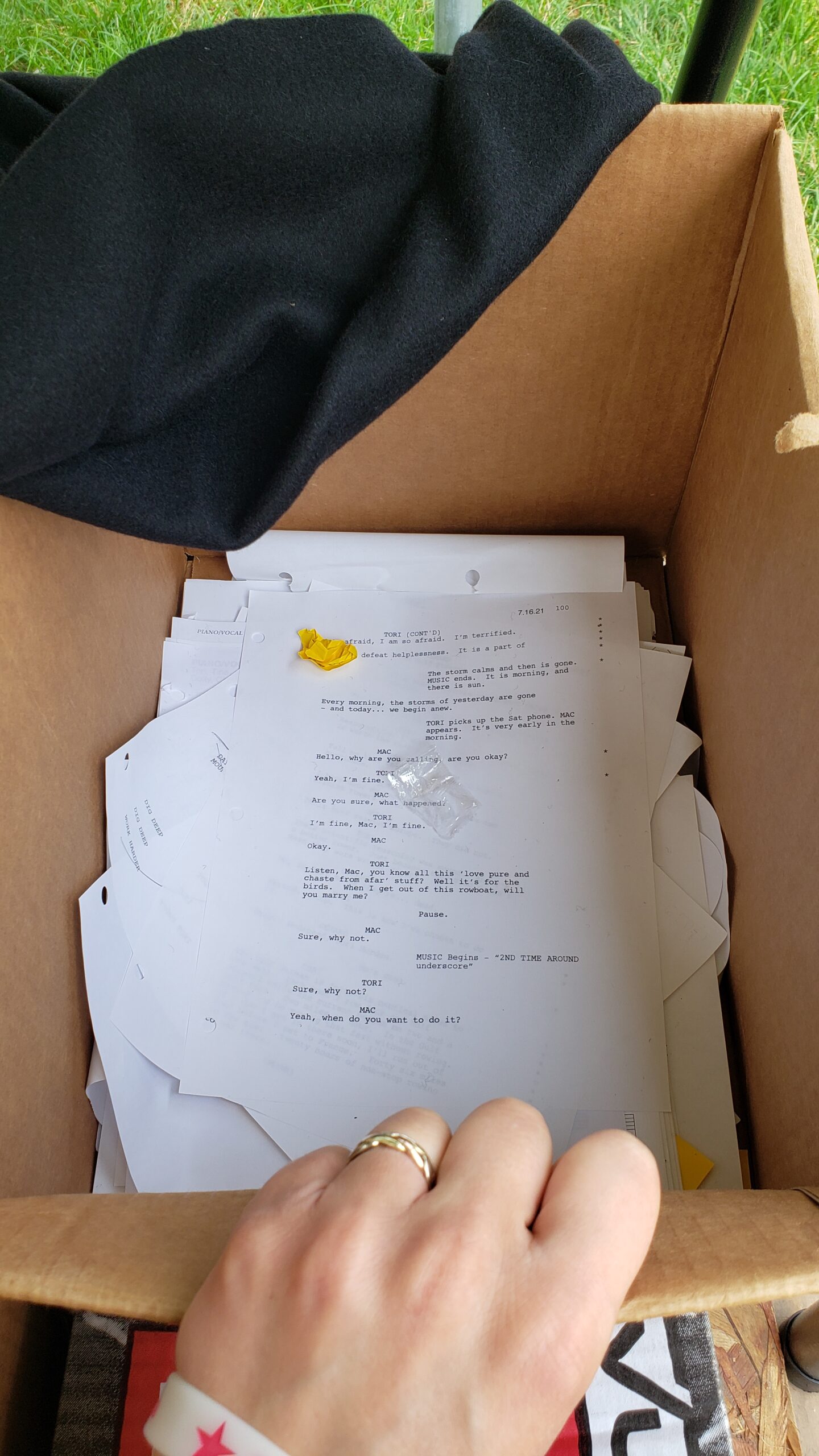
My current stack of old pages for Row.


Practice but don’t memorize yet

As you mix a show more and more times, you will naturally begin to develop muscle memory for making your pickups and fader moves. However, on new work, it’s important to not let habits set in too soon in case things keep changing. I have on occasion caught myself making errors because my hands got too used to doing a scene a certain way and then the scene was re-written. Pay extra attention to any lines that you use as cues for yourself in case they change!

Consult all your sources

Since we’re talking specifically about musicals, it is likely that songs will change in addition to book scenes as the show develops. Make sure that you are getting updates from the music department in addition to the ones you get from writing/stage management. Sometimes the piano/vocal will have more current information than the libretto! Also, even if you don’t read music, it can be super helpful to have access to the piano/vocal score to consult as you figure out the timings of band moves and console scenes.

Try to program flexibly

As a general rule, it’s good to leave yourself “buffer” console scenes/snapshots as you program in case you decide you need to add things or adjust DCA assignments. This is even more true on a new musical. For example, the console on Row is a Yamaha CL5, which can accommodate up to 300 console scenes. When I laid out my DCA tracking prior to programming the show, it looked like I would need about 60 scenes to do the whole show. So rather than start at Scene #1 and go sequentially, the first song is scene #10, the second song is scene #15, etc. That way I have room to add more scenes internally without having to renumber every subsequent scene. To save time and hassle, also try to program in a more minimalist way than you might on an existing show so that you can adapt to changes more easily. Inevitably you will find yourself having to go through 10 separate console scenes to make a single change to all of them because of a script/song change, but the fewer times you have to do this the better. ☺

My console scene tracking sheet for Row. Notice the skips between numbers!


The thing to remember most of all on a new musical is that while rolling with the punches as things change can be stressful, it’s all in service of the art. I once worked with a choreographer who when he needed to adjust something would say on his god mic “I’m making a change” and the whole company would reply “Change is GOOD!” I’ve made that quote my new musical motto. The reward of knowing that all of the work that the creatives are putting in (and you alongside them) is truly helping to tell the story better will make it worth it when the show finally gets “frozen” (this means no more changes are allowed) and makes its world premiere in front of its first-ever audience!

The “Gibbs Rules” of Being a Stagehand

When I was in high school, my family’s go-to TV show was NCIS. We’d put it on in the background over dinner, or watch reruns on the USA channel when nothing else good was on TV. By the time I left to go to college, I must have subconsciously taken in hundreds of episodes!

For those who aren’t familiar, the show is about a team with the Naval Criminal Investigative Service who work to solve murders of Navy or Navy-affiliated persons. The team is lead by Special Agent Gibbs, a former marine with a big heart and a sometimes short temper. He’s far from a perfect person, but he has a strong moral compass that he uses to inspire his team to do their best work to solve these mysteries. One of the ways we learn about Gibbs’ particular brand of moral code is through a philosophy known as Gibbs’ Rules. The NCIS Fan Wiki defines them thus:

“Gibbs’s Rules are an extensive series of guidelines that NCIS Special Agent Leroy Jethro Gibbs lives by and teaches to the people he works closely with.” (Source: https://ncis.fandom.com/wiki/Gibbs%27s_Rules). Some of the rules are things you might expect to hear on a crime TV show, such as “Never let suspects stay together” or “Always wear gloves at a crime scene.” Others, however, are more universal and can be taken as good lessons for life in general. Some of my favorites of these include “When the job is done, walk away” and “Don’t believe what you’re told. Double-check.”

As I started getting more involved in theatre throughout high school and college, I started trying to figure out how to compile everything I was learning into a sort of guide for myself. Classmates, teachers, and mentors were giving me all sorts of great tidbits of advice, and I was scribbling them all down in an unorganized jumble to be able to refer back to later. I began thinking about how I could organize it into some sort of guide that I could add to and share as my career continued, and naturally, Gibbs’ Rules came to mind!

I called the document I wound up creating “Gibbs’ Rules of Stage Management,” because initially, I was training to be a stage manager. But as I got into mixing and sound design, it seemed like a lot of the rules didn’t have to just be for stage managers. And the more people I shared them within different fields of entertainment, the more I realized that a lot of them can be applied pretty universally across our industry. So here, for your perusal and enjoyment, are some annotated selections from the 2021 Gibbs’ Rules of Being a Stagehand. If you would like to see the entire collection, it will be posted on my website, beccastollsound.com, in the next few days!

2021 Gibbs’ Rules of Being a Stagehand

Rule #1: ALL HUMANS ARE STUPID (AND EVERYONE’S HUMAN).

This is one of my favorites. It speaks to the fact that people make mistakes, and it’s important to cut people slack and not hold it against them.

Rule #6: GIVE LOTS OF THANKS, EXPECT NONE IN RETURN.

Unfortunately, those of us who work behind the scenes are often not adequately recognized for our contributions, especially compared to the onstage talent. Try your best not to let it get you down or give you a bad attitude.

Rule #7: EVERYTHING IS SUBJECT TO CHANGE.

In stage management and production management, it is common to put “subject to change” in the footer of most paperwork. We’re making organic art after all, and we’re making it in the moment, so there’s no way to predict everything that will happen!

Rule #11: EVERYTHING IS SUBJECT TO UN-CHANGE

A corollary to Rule #7. Especially applicable on new musicals, where a scene or song that got cut yesterday could go back into the show today. Keep good archives, and don’t throw anything out until closing!

Rule #13: IT’S PROBABLY GOOD IF AT LEAST ONE PERSON KNOWS WHERE YOU ARE.

This one was inspired by the actual Gibbs’ Rule #3, which is “never be unreachable.” But in this age of smartphones, push notifications,  and constantly feeling the need to be “on-call” for work, I think it’s important to reclaim the ability to take time for yourself and not have to immediately answer to everyone. On the other hand, if you simply stop picking up your phone, people might worry that something has happened to you because that’s the kind of world we live in now. So strike a healthy balance between the two.

Rule #19: IT’S A SMALL WORLD AFTER ALL.

In NYC theatre this is commonly known as the “5 block rule.” Meaning that if you are talking smack about someone or something within 5 blocks of the theatre, it’s going to become back to bite you. Everyone knows everyone, and no one will ever forget you. People’s friends/assistants/partners will refer or recommend you and it counts. Read the room and don’t burn bridges.

Rule #24: IF YOU CAN’T SAY YES, DON’T SAY NO.

People are going to ask you for impossible things. People are going to ask you for hints that aren’t your job to do. Saying “no” just shuts the conversation down rather than fostering collaboration. Even if something is 100% impossible, the best answer to start with is “I’ll look into it” or “let me get back to you.”

Rule #25: THE SHOW MUST GO ON (EXCEPT WHEN IT CAN’T).

This rule is credited to my stage management professor, Tina Shackleford. And wow, does it read differently post-pandemic!

Rule #26: WHEN IN DOUBT, DRESS TO IMPRESS.

My mom came up with this one ☺ If appearance or apparel is something that helps you to feel motivated or prepared, by all means, use that to your advantage! Dress in a way that makes you feel awesome on the inside but also shows you are prepared for the occasion, whether it’s a corporate interview or an arena load-in. And always wear close-toed shoes.

Rule #33: NOTHING CAN BE TESTED TOO MANY TIMES.

This rule is from Shannon Slaton, author of the excellent book Mixing a Musical.

Rule #34: KNOWING WHAT YOU’RE DOING IS ONLY 1/3 OF THE JOB.

Credit for this one goes to NYC-based sound designer Dan Miele. As I’ve outlined in many a blog post, so much of this job is people skills, improvising, and just making things work in a very short amount of time! Yes, the hard skills matter, but the soft skills (plus a good attitude and a willingness to collaborate) matter almost as much if not more!

Rule #35: ALWAYS READ YOUR CONTRACT.

Always Always Always! Read the whole thing. Top to bottom. Read all the fine print. Ask questions about anything in it that is unclear. Run it by mentors and friends.The last thing you want is to be blindsided by something you signed before you fully understood what you were signing. Just read it!

Rule #40: DO YOURSELF A FAVOR AND STAY IN YOUR LANE.

It’s noble to want to help people. In theatre we all pitch in to make it work, right? The problem is that it can be easy to over-exert yourself trying to help others, and suddenly your own job begins to suffer as a result. We’ve all been there. Over the years I have come to see having my one specific job to do as an absolute blessing in disguise. It allows me to focus on the things that are mine to control, and not worry about the things that aren’t. So if it’s not your job, don’t do it. If it’s not your problem, don’t make it your problem. Not trying to be everything to everyone is not only an act of self-preservation, but it is better for the overall show if everyone is able to take on their own workload and not burn out doing the jobs of other people as well. So as often as possible, make best efforts to stay in your box.  Do your own job well and trust that others will do theirs.

As always, comments and questions welcome! What are some of your personal “Gibbs’ Rules?”

Ready for the Road?


I’ve been on the road for the better part of a decade, so I’ll easily admit that I’m biased in favor of tour life, but it’s fascinating to hear what other people think my work is like. Mostly they see the glamour of a life that some only dream of being paid to travel across the country or even the world. They’re less enamored when they hear what my work schedule actually entails and that I’m not some carefree nomad having adventures and playing pretend every night. Still, I bet most would give it a go if they ever got the chance.

So what does the reality of touring look like? Well, let’s start with the least appealing side of it and get that out of the way

Time and Stress

Since tours only make money when they’re actively on the road, the ideal is to be booked constantly. Most shows have a few weeks scattered throughout the schedule that aren’t booked and the actors, musicians, and crew are laid off. To a 9-5 worker, “layoff” is a horrible word, but on tour, it’s synonymous with a scheduled, short, unpaid vacation, and you’re still working 45-50 weeks out of the year. However, that means there’s limited time off to see friends and family back home or just to recharge, and it can be difficult to get time off for events like weddings, graduations, or even family emergencies.

Then you have your day-to-day work schedule. On a whim, I calculated how many days I’ve had off in an average year on tour. That qualifies as a day not in the theatre, not traveling to the next venue, nothing work-related. My average was 70-75 days off per year over seven years on the road. To put it in 9-5 terms, if you just count weekends that’s two days off a week, multiplied by 52 weeks, most people get 104 days off in a year, not even looking at holidays or vacation time.

(Touring data based on my 2019 year on tour with Miss Saigon, then Mean Girls.)

Plus, 40-hour work is the norm, but on the road, you’re looking at anywhere from a 60 – 80 hour workweek depending on how often you have to load in and out.

Moving on to stress

Somedays tour feels like holding 10 pounds of crazy and staring at a 5-pound bag, trying to formulate a plan that gets everything in. Each show and every venue have quirks and your job is to figure out how to work with or around them. Sometimes it’s easy: in Cleveland, there’s only space for the actual show deck onstage, so the local crew knows that amp racks typically go in an alcove in the house. Other times it takes some finagling: in DC, the Les Mis speaker towers weighed about 3000 lbs all together, but the structure the motor was attached to could only support 2000 lbs, so I calculated a way to build most of the tower, then slide the rest into place so we didn’t exceed the weight limit and still kept most of the build on the motor instead of overtaxing our manpower.

But, if you think that sounds stressful, those are the times when things went pretty well and we were able to come up with a solution that still accomplished the design. There are times you simply can’t do what you’ve planned: in Hartford, we had to get a mid-load in delivery of truss when the measurements we’d had for the rigging points were wrong. We found out partway into the day that the points were simply too far apart to safely fly the smaller truss we carried. Or something malfunctions right before the show is ready to start and you have a stage manager watching you, giving play-by-play commentary to the SM at the call desk as you attempt to suss out the problem, knowing the curtain is waiting on your troubleshooting skills.

These stressors can take a toll on your mental and emotional well-being, which affects your physical health. Fast and unhealthy food is much easier to access on the road, and the post-show default is to head to the nearest bar with your crew to unwind from the day and socialize. As an introvert, I had to learn to pay better attention to what I needed socially: some days it was respecting my need to relax, other times it was noticing that I’d lacked social interaction and, despite the habitual ease of just heading back to the hotel, I’d actually prefer to be out with the crew.

Mostly what it comes down to is fatigue. It takes a concerted effort to take care of yourself on the road: finding or choosing healthy foods, making time to exercise, checking in with yourself. Sometimes you don’t have the energy to deal with that after a long day of work, and your well-being falls to the wayside.

All that being said, touring sounds really appealing right? Well, let’s take a look at what’s kept me on the road for so long.

Experience

One huge benefit is experience. That same stress that fell into the Con column has equal footing in the Pro side by virtue of the adage “what doesn’t kill you makes you stronger.” Every load in and out, you’re handed new challenges to solve and, by the sheer repetition of it, you learn how to analyze situations faster and build a log of potential fixes you’ve tried before.

Plus, it’s all hands-on practice. You can talk about the theory as much as you want, but it will never be as beneficial as putting a contingency plan into action.

Along with problem-solving, you also (hopefully) gain people skills: just like analyzing situations, you also learn how to read people. Part of your job is learning if you can hand a project off to the house head and let them direct the crew, or if you’ll have to check in constantly to make sure it gets done. It’s noticing someone who’s willing to work, but is new and needs detailed directions, yet is too nervous to say they don’t understand. There are times you have to light a (figurative) fire to get a languorous crew moving, but others where you can joke and enjoy chatting and they’ll still get the job done.

The Pay

A large appeal of touring is the money. On the road, the company will provide you with accommodations or per diem for food and housing, so the majority of your survival expenses are taken care of. With that covered, it frees up the majority of your salary to pay down credit card debt, mortgages, or student loans, while simultaneously having some money to save or use for a guilt-free splurge. Personally, having the opportunity to up my savings percentage paved the way for me to discover the financial independence community, which is worth exploring no matter where you are in your financial journey. (Check out this list of FI blogs, or two of my favorites: JL Collins or Afford Anything)

The People

Last, but absolutely not least, are the people. Your crew and coworkers become family. Often boisterous and sometimes dysfunctional, you’ll find some of your best life-long friends on the road. When you’re together day in and day out, you help each other solve problems, pull off incredible under-the-wire show saves, or make it through a crappy day that you can laugh about afterward. Stagehands are the best kind of people I know to take lemons and turn it into an epic comedy of errors, and there are always new stories whenever you end up in the same city again to catch up.

Touring is life where the amp is always turned to 11

The lows are confidence-shattering and lonely, but the highs are soul-affirming and leave you with the feeling that there’s nowhere else you’d rather be.

I’m the first to tell anyone that they should absolutely tour if they have any desire to do it, but I’m also the first to say that it isn’t for everyone. I’ve learned that I’m built to tour. Even when I wasn’t sure if I was any good at sound, I still knew I loved touring: stressful situations are puzzles to solve and most days I thrive on the challenge, plus my family has always been understanding that I have very tight constraints on my schedule. The pros of touring outweigh the cons by a mile for me, however, even I (and my knees) know that the day I look towards getting off the road isn’t all that far down the line. For others, life on the road just isn’t appealing from the get-go: I know people who are amazing at their job but hate the lifestyle, the stress, and the mental and physical toll it takes.

It’s always important to take stock of how you honestly feel and refrain from talking yourself into signing up for another tour if the cons outweigh the pros. It’s not worth making yourself (and everyone you work with) miserable if you hate your life day in and day out.

But if you do like it, pack those suitcases and get ready for an adventure. I know I wouldn’t trade the experience for anything!


Starting A Show

In any normal year, early spring is when the staffing process begins for tours going out in the fall. You probably won’t have a contract in hand yet, but your resume has gone off to designers and production companies, or (if you’re currently on tour) you’ve had a conversation with your design team or production manager about the shows going into production, and what they might have in mind for you.

However, there are still months before you’ll hit the shop to build a new show, and longer until you’re in the venue to tech it. So spring and summer become the perfect time to start learning a new show so you can give yourself a running start. Right now, conversations center around maybes: someone has your resume on their desk; they’d like to inquire about your availability for a possible project; we’d like to see if you might be a good fit. That sort of language. At this point, nothing is for certain, but I’ll start in on some cursory research for the show I’m under consideration for. This mostly involves cyber stalking the show: searching YouTube for Tony Award or press event performances, Googling pictures of the production, and listening to the most recent cast album or recording of the show.

On Official Offer

Conversations use more concrete terms: yes, we’d like you to do the show; we’re sending your resume to the production manager; you should hear from this person soon, etc. At this point, the show’s soundtrack becomes the new underscore of my life. I cannot stress enough how important it is to listen to the show. Replicating the sound of it is your job, so the more familiar you are with it, the better. Plus, knowing what’s happening gives you a solid foundation to start tech and make intelligent mixing choices.

Finally, once I have an official offer I can start my formal prep. At this point I ask for a packet of information from the designers or production consisting of: a script (preferably a mixing script if it isn’t a brand new show), any audio recording that might be available, and a console file (again, this is if there’s a version of the show currently running).

The Script

The script is the basis for most of my paperwork. The audio recording hopefully gives me the full show to listen to, including dialogue. The console file lets me dive into the structure of the physical show as well as providing details about programming that might not be clear in the script.

From the script, I’ll build an initial set of paperwork starting with my own mixing script. Even if I get a complete, annotated mix script, I will always make my own for two reasons:

#1. I like my formatting. I have a system with color-coded notes that is easy for me to read, and I can put page breaks in convenient places. Plus, re-entering cues and notes means that I know exactly where each one goes.

#2. It’s another opportunity to get the show in my head. I always re-type the script which forces me to go over every single word of the show. Usually multiple times with annotations and proofreading.

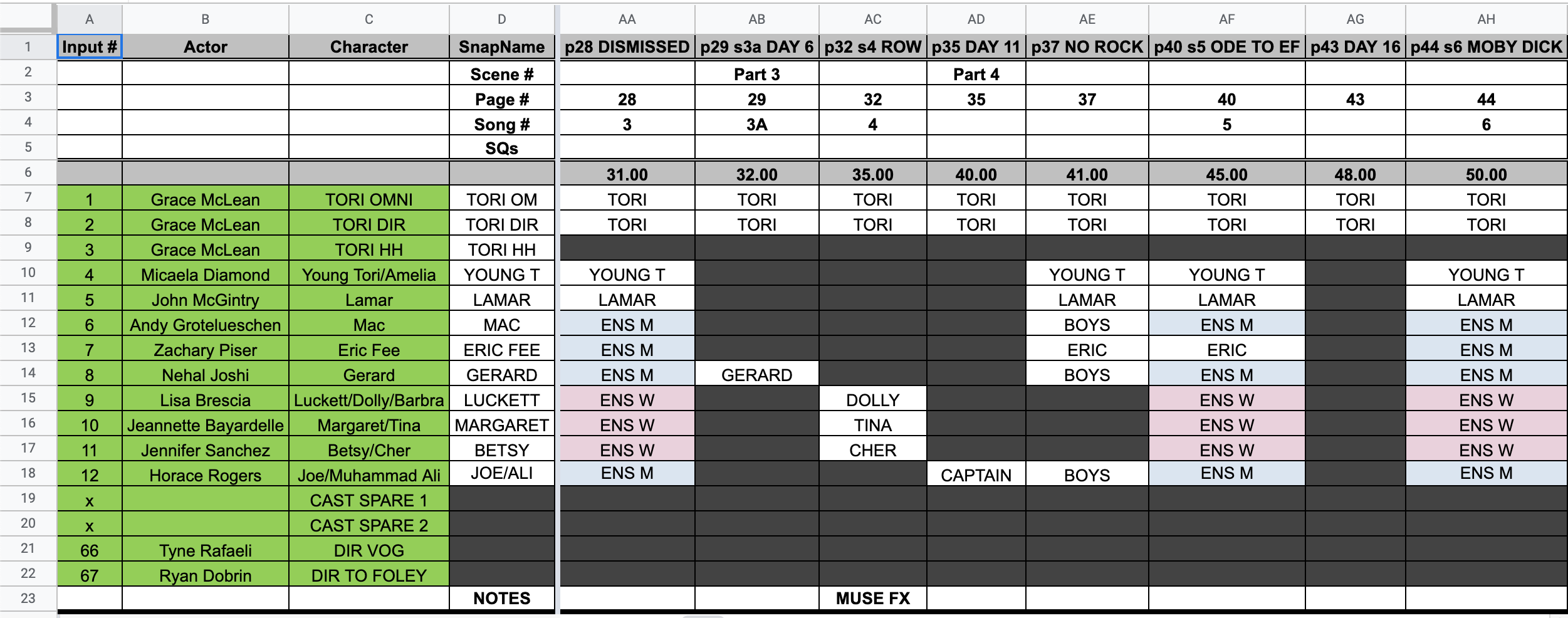
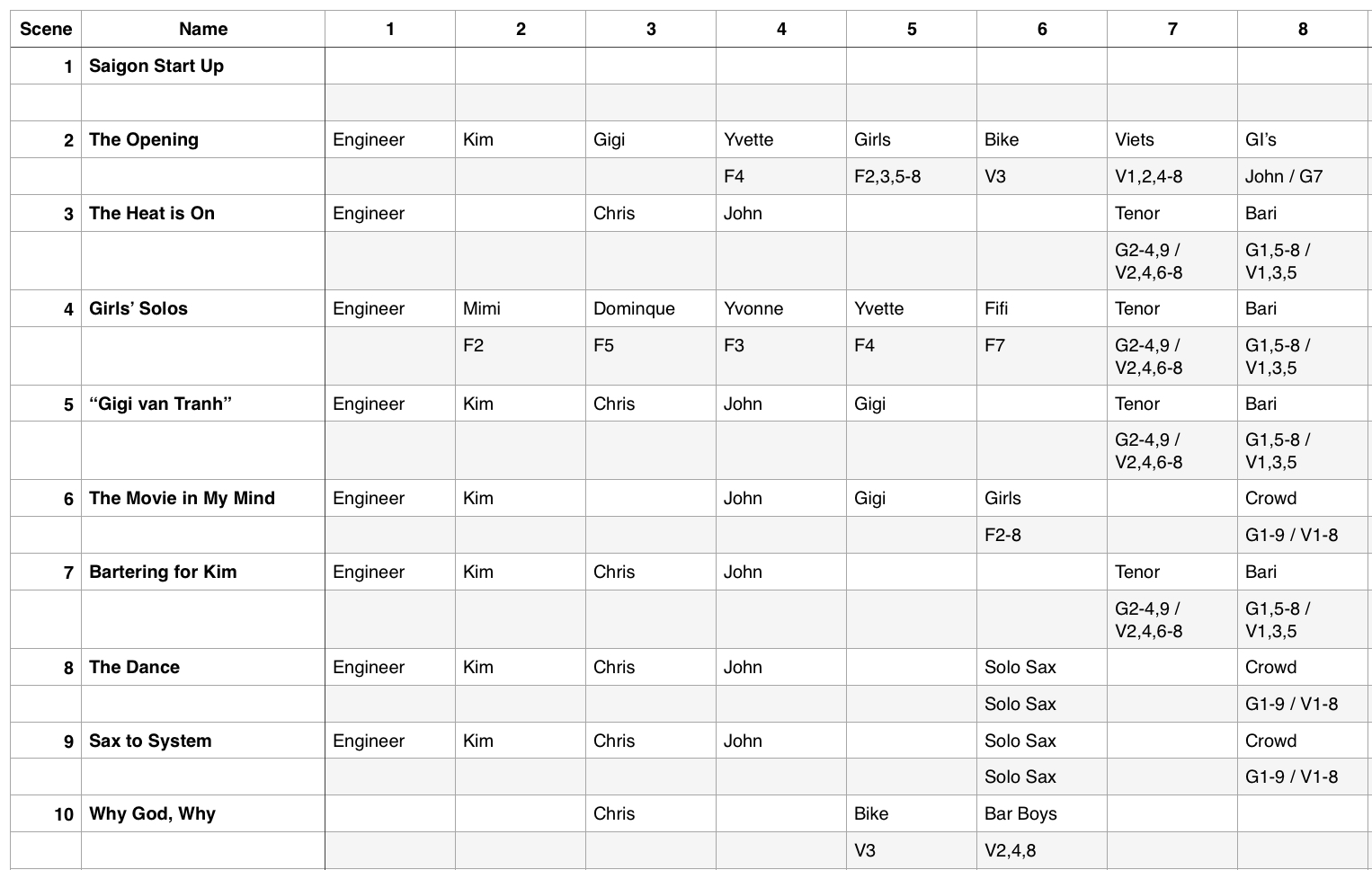
In conjunction with the script, I’ll do some additional paperwork and make a spreadsheet to document (or for a new show, create) DCA assignments. This has the basic information of how many console scenes are in the show, what the name of each DCA fader is in each scene, and which specific mics are assigned on a given fader (if it’s not obvious, such as faders labeled chorus, altos, or one-off solo lines). This helps while annotating my script if I have a question where a cue needs to go or who’s in what scene, and becomes a quick reference for programming the console when I get to tech.

This is where the console file can come in handy. Most consoles have an offline editor that you can use to open it on your computer and look around to see how the show is laid out. When I’m building paperwork, I’ll double-check the file if I have questions about who exactly is singing which part in a scene.

Practice

Once I have an annotated script, my basic paperwork, and the audio recording, I’ll start to put the mix into practice. I use two methods, one that requires my practice board and another I can do pretty much anywhere.

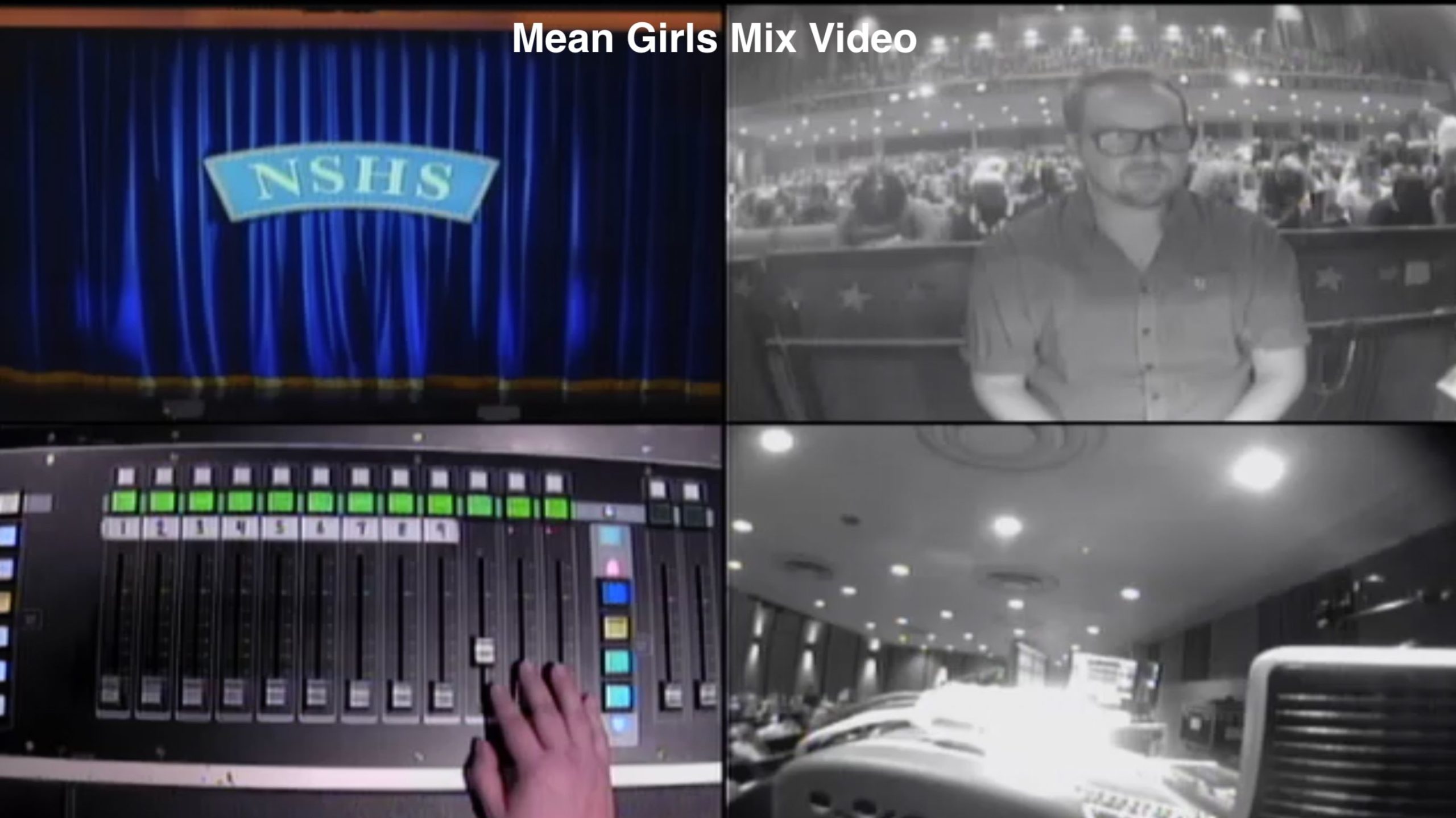
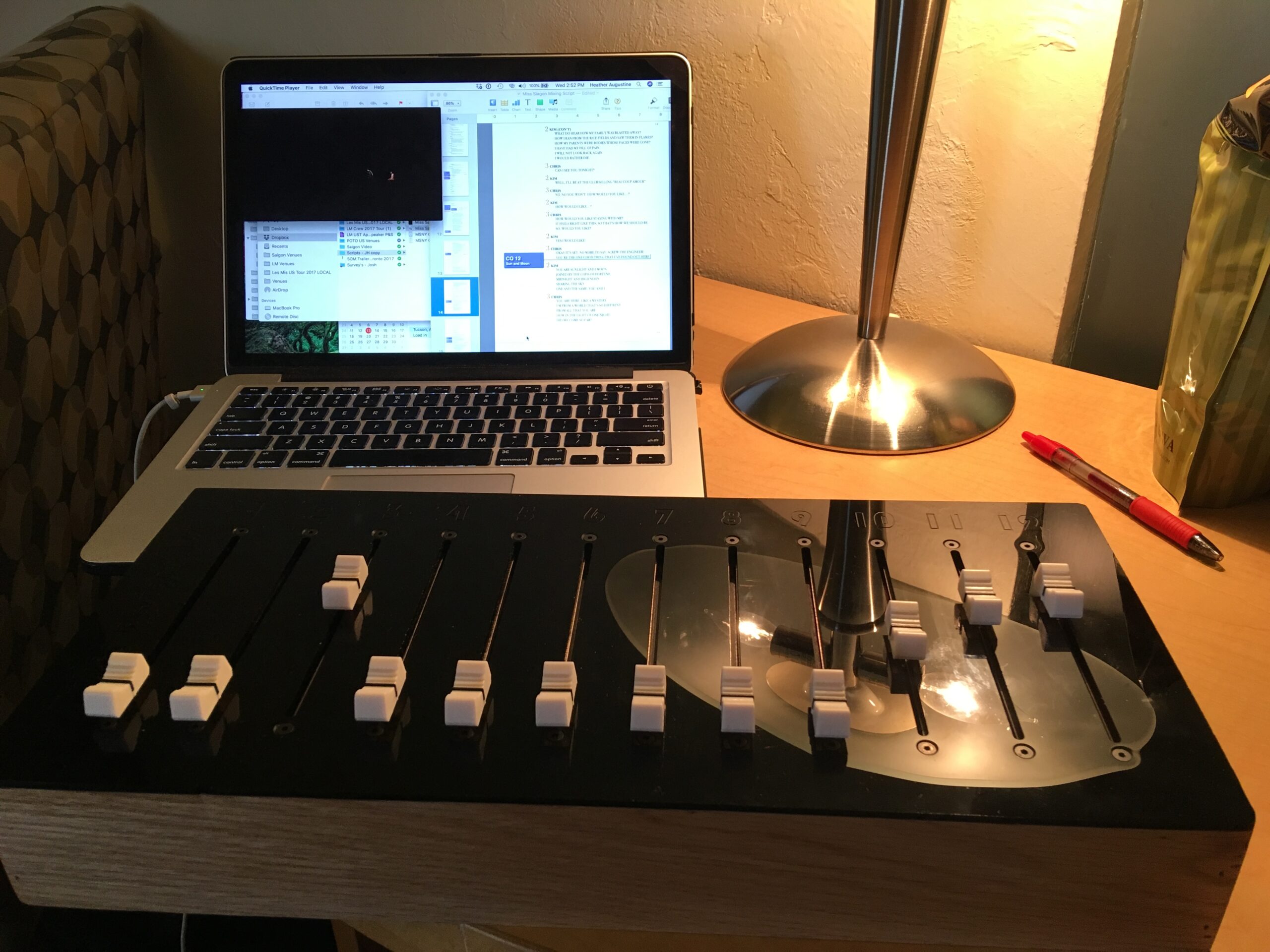
Using my practice board (a set of faders that don’t control anything which you can find versions on casecraft.com, er3designs.com, or I, personally, have a custom board made by Scott Kuker), I’ll grab my script and the recording and move through the mix of the show. I’ll go over difficult transitions or fast sections multiple times to start developing some muscle memory, and if I’m having trouble, I’ll play around and see if there’s a more efficient way to mix the scene. That might be adjusting the DCA programming or changing which hand covers which faders. On Les Mis and Saigon, those shows are almost entirely sung-through, and there’s always music. So I used my right hand on the orchestra faders for the majority of the show and did the vocal choreography with my left hand. Practicing for those two shows involved figuring out where I needed both hands for vocals and should switch my right hand from covering the orchestra faders to assisting with dialogue. Mean Girls on the other hand has dialogue scenes with no underscoring, so I spent more time using both hands-on vocal faders and then shifting back over to the band for songs.

The second method I use is something I call pointing through the show. I can practice with this technique anywhere with just a piece of paper (the aforementioned DCA breakdown paperwork), and the audio recording of the show. For this, I’ll listen to the show, pointing along on the paper to who’s mic should be up at the moment. This tests how well I’ve memorized the show because there’s no way to hide if I can’t point to who’s talking. Then I’ll go over any problem scenes with my script. Most often these are dialogue scenes where it’s constantly switching between several different people or scenes with a lot of one-liners. Pretty much anything that might cause you to skip around on the faders if there’s no good way to do typewriter programming.

I started practicing this way because I got into the habit early in my career of working to get off the book as soon as possible. Pointing through the show gives me a head start on memorizing the show and I can usually put my script away a couple of weeks after tech. I find I pay better attention to how the show is sounding when I don’t have my head in my script. Other people prefer the security of having the script in front of them to reference, even if they don’t necessarily need it. It’s purely a personal preference, but you should always make sure you are comfortable and confident that you truly have the show memorized before you completely put your script away.

*    *    *

But what happens when you don’t have all this time to learn a show? The prep process I’ve outlined can take weeks or even months. What happens if you get thrown into a show at the last minute or won’t even get a script until a couple of days before tech? Or what if it’s a short run where you just can’t justify months of preparation?

In this case, I do some basic preparation but focus on making the notes in my script are clear since I’ll likely be sight-reading it in tech. I won’t retype my entire script, but instead use the limited prep time to make sure annotations and notes are easy to follow and my fader or DCA layout is as logical and simple as possible. If I have time to physically practice, I’ll focus on the complicated parts to make sure they’re efficient. I’ll always make and print out a DCA breakdown so I have a quick reference for programming the console.

Every bit of preparation helps, no matter how much or little time I have, and I’ve never met a designer that wasn’t happy to give me whatever they could to help me learn the show. So don’t be afraid to ask for materials, your designer will appreciate your initiative and everyone (yourself included!) will love it when you’re self-sufficient in tech.

Practicing Proactivity


Have you ever had a little voice in your head whispering that you don’t know what you’re doing? Ever looked around the room with a sinking feeling that you’re the least qualified person there? In small doses, these impulses can push us to improve, to get help and learn from those who’ve come before us. However, when that mentality seeps into our lives and latches on for months, years, or even decades, we find ourselves faced with the far more problematic Imposter Syndrome.

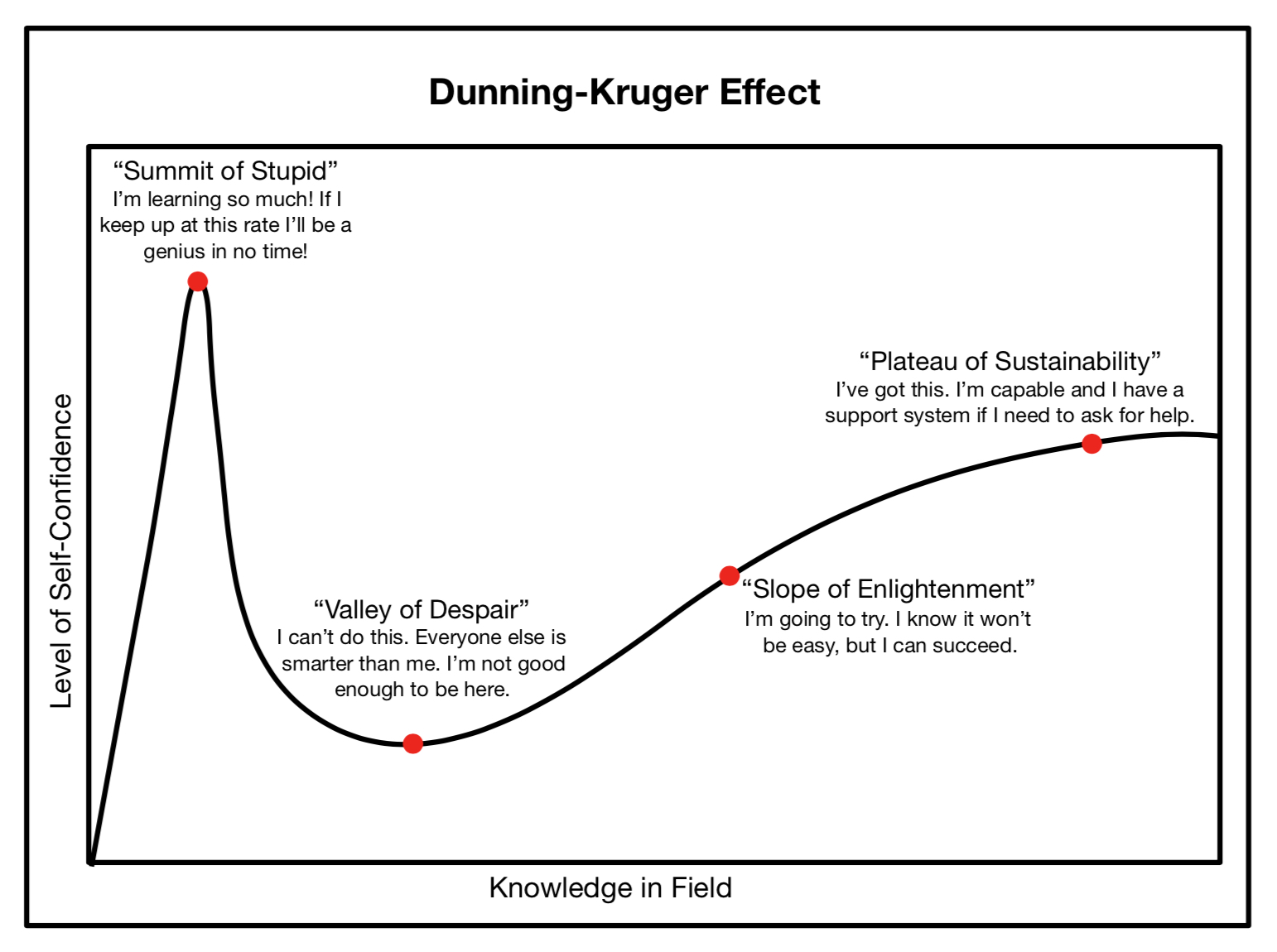
The Dunning-Kruger Effect is the best representation I’ve found to conceptualize the progression that most people follow during their careers. As you can see, it’s not a linear road to travel, even in its most simplified form. As 2021 continues, and we hopefully start to make our way back to work, many of us are facing the discouraging outlook of a year or more of lost time in our careers. Most of us will have to take a few steps backward before we can go forward in rebuilding our professional confidence.

When I started my career I was excited: I’d wanted to tour since I learned that was an actual job and I was ready to hit the ground running. Instead, the ground hit me. I loved my crew and running shows and seeing the country, but there was a learning curve (like with any new job), and I was suddenly very much aware of just how much I didn’t know. Imposter Syndrome hit hard at that stage in my life and turned my learning curve into a confidence free-fall from my Summit of Stupid.

For such a sharp plunge on that graph it starts out deceptively small: a little voice in the back of your head harping on every mistake. That voice monopolizes your attention when you realize you’re making someone wait while you finish a project. It whispers, “they’re right” when you’re told, “It’s not something I can teach you if you don’t understand it.” These little things build on each other and grow until you wonder how you were even hired in the first place.

I spent most of my time as an A2 caught in a loop: I felt horrible at my job so I figured I should quit, but I’d be just as horrible at anything else, so I should just stay where I was, but I felt so horrible at my job…. That cycle went on for years before I found a way out. There were days I was depressed and didn’t know why, but also days I went out with the crew after a tough load in and laughed so hard that I squeaked. Once I was told that my brand of book-smart intelligence was good for nothing more than being a “party trick.” Other times I had shows I mixed where everything clicked and I fell in love with my job all over again.

Imposter Syndrome is a toxic relationship with yourself. It keeps you guessing at every turn: constantly off balance and convinced that the world is waiting for the right moment to pounce. The thing is, everyone other person around you is dealing with those exact same feelings. So, the good news is you’re not alone.

The even better news is this isn’t permanent. Imposter Syndrome is effective because it puts you on defense and instills a reactive state of mind. You no longer trust yourself to give an accurate assessment of your own skills. Instead, you take your cues from the words and reactions of those around you, and always give extra weight to the negative because it agrees with that little voice in your head. After all, why should you even try to improve when people who know so much more than you have told you you’re hopeless?

The best way to quiet that voice is proactivity. In a proactive mindset, you dictate your own self-image first and all other information is evaluated, but not treated as fact purely by default.

One of the best proactive moves I made was transitioning from an A2 to A1. Unknowingly, that was my final major step out of my Valley. Three years up the Slope, I was in tech for Saigon when a colleague told me he was worried that I didn’t realize how hard the show was to mix.

Reactively, my self-esteem would have curled up in the fetal position and that voice would have whispered what an idiot I was to think that I was even halfway decent at my job.

Proactively, I raised an eyebrow at a comment made out of stress-induced worry. After all, I’d spent as much time as I could working on my script, learning the show, and practicing the mix. While there would inevitably be a few mistakes, I had come prepared and I knew I could handle them.

Practicing proactivity gives you a solid foundation to approach a project or learn a new skill. And just like Imposter Syndrome, it starts small. It’s taking the time to relabel a cable instead of having to wrack your brain for its name every single load in. It’s refining the way you explain a project to the local crew so they don’t have to ask you to clarify the directions seven times. It’s signing up for a class or a workshop that the little voice says you don’t know nearly enough to attend.

These seemingly insignificant steps give you the building blocks for the rest of your career. Now, I’m particularly efficient at loading in and out shows because back then, in any proactive moment I had, I made one tiny tweak after another. Sometimes it was looming the end of a cable bundle a different way or even making a whole new loom for a special project. Other times it was pre-marking a tape measure to make instructions less complicated or taking pictures of an efficient case pack so it was easier to duplicate. Bit by bit the small fixes accumulated to make me more efficient, clearer, and more consistent.

Even after two years on my way out of my Valley, it wasn’t until the tech for Saigon where it actually hit home that I didn’t feel like an Imposter anymore. That month was challenging to say the least, partly because I was faced with many of my former triggers: not having all the answers, people getting frustrated, negative comments, and more.

That voice started whispering again, but when it did, I realized that I hadn’t heard more than a momentary peep from that insidious little thing in all of my previous two years as an A1. Without those triggers, that voice couldn’t sustain itself.

I was not the common denominator.

At that moment, I had the choice to drudge up my old, reactive habits or stick to my new, hard-won, proactive ones. Tech was still tiring and stressful, but I was better able to identify and mitigate my triggers. I did my best to address problems and solve what was in my control or ask for help with what wasn’t. If someone got frustrated I did my best to talk with them to see if there was an underlying issue. There was no way to avoid every frustration, but I could make sure I didn’t add to them unnecessarily.

If you find yourself with your own negative little voice, practice being proactive whenever you can. Even if it seems like it’s pointless, do it. One baby step at a time. Also, make a point to keep mementos. Did you have a great day, mix an amazing show, solve a tough problem? Write it down. When someone sends you a note or text or email telling you how amazing you are, save it, screenshot it, flag it. If you have a bad day, pull those out to remind you that this is temporary.

Lastly, find your kindred spirits: people who aren’t afraid to be honest when you need a swift kick, but will always have your back. (It helps if they work in the same industry and understand your world.)  Mine are my former A2’s, current dear friends, and the very people I ask to proofread everything I send to this blog.

Rachel, Mark, and Dan were with each with me for a year of my first three tours while I navigated a new chapter in my career as an A1. Touring with someone creates a unique bond in itself, but each of these three have gone well above the call of duty time and time again to offer support, help, and motivation anytime I’ve needed it.

It’s not an easy road out of Imposter Syndrome, but the only way out is through. Keep in mind that you are not alone, grab a friend, and do your best to get a little better, one baby step at a time.


X