Empowering the Next Generation of Women in Audio

Join Us

The Road Less Travelled

Tips for Touring in Less Developed Countries

Touring with full production in first world countries is, let’s face it, not easy street. Like a family of hi-tech snails, you carry your home and everything you need; and beyond power and rigging points, you don’t need a whole lot from the local production/promoter. Even when you’re not carrying all your gear, picking up what you need locally in the western world is usually straightforward as long as you’ve advanced it all properly, especially in countries where we all speak the same first language.

But what happens when you start to travel further afield, to countries where the language, culture and wealth-status is very different? Touring in far-flung places is fabulous – you get to see parts of the world you might never have even considered visiting. You get to experience different cultures, meet people of all nationalities (and realise we’re all the same), taste wonderful and unusual foods, explore cities where you can’t read the roadsigns, see natural beauty and temples and monuments that you didn’t even know existed, and step far, far outside your comfort zone and grow as a person more than you knew was possible.

You’ll probably also get frustrated, feel out of your depth, and feel like you’re being stared at a lot, especially if you’re a woman working on a gig.

You know what? It’s all really good for you, both as a human and as an engineer.

My first world tour was 13 years ago, and I’ve wound up somewhere unusual every year since then. Some tours have been big enough that we’ve carried everything except racks and stacks (PA, wedges and amps), and others I’ve carried little more than a multimeter and sense of humour – both of which are VITAL! I’ve picked up plenty of tricks and tips along the way to make life easier, which I hope you’ll find useful the next time you find yourself on a long-haul flight to somewhere you never dreamed you’d find yourself!

– Speak very plainly. When you start to write your spec, remember that English is not these people’s first language – keep it simple. Lose any slang, colloquialisms and unnecessary words in specs, emails and conversation. It avoids confusion and means you’re more likely to get what you need with a minimum of fuss.

– Make plain in your specs, things that would be taken for granted back home. For example, I offer a couple of alternatives for acceptable IEM systems, then add ‘all EITHER x or y please, no mixtures’. Likewise amps and crossovers – I once walked on stage to find the wedges I had asked for, but all sounding completely different from each other. I asked my babysitter to show me the amps, which were buried under the stage, and sure enough, amongst a horrible snakepit of cable, there were several different sorts of amps and crossovers. I certainly improved my chops that day! To things like mic stands, I add the words ‘clean and in good working order. This extends to the production world too – things like toilet roll are not a given in some countries. Assume nothing and put it all on the rider!

– When advancing, don’t take a reply of ‘yes, everything is fine as confirmation that everything is indeed fine. Many cultures around the world are very concerned with ‘losing face’, and want to be seen as stepping up to the mark in their dealings with you. Unfortunately, this often means that they will agree to everything on paper, and wait till you’re on-site to tell you that this bit of kit was broken or that piece of gear is not available in their country. Ask them to list exactly what they have. You might be lucky and you might not, but better to know and have the conversation about substitutes and contingencies now, than when it’s 10 hours till showtime.

On a side note to this, always communicate respectfully, both because you’re a nice human, and because the ‘face’ thing can’t be overstated – if you make certain cultures feel disrespected, you’ll make life very hard for yourself indeed.

– Invest in a good quality multi-meter if you don’t have one already, and take it everywhere. It’s good practice to meter the power before you plug in wherever you are, but it can quite literally be life or death in less developed countries. I’ve come across readings that could have killed someone had I blithely carried on without noticing. Local gear will often already be rigged and powered up – find an outlet and meter it anyway. If it’s not what it should be, don’t go any further till you get it sorted.

– Make friends with the interpreter! If you’re very lucky you might have a member of the audio crew who speaks good English or a technical translator, but the likelihood is you’ll have a dedicated interpreter who doesn’t have any technical knowledge. Nonetheless, they are going to be a big help, so learn their name and keep technical questions that need translating as simple as possible.

– Have a stash of wipes and a paintbrush for cleaning your gear and the desk. In a lot of places, you’ll be faced with gear that hasn’t been well-maintained and sometimes is downright filthy – and there are few things grosser than a stinky vocal mic!

– The food in some countries is fantastic, but that doesn’t mean all crew catering will be great. Some days it will rock your world, others days it really won’t. Having a supply of nuts or muesli bars is a good idea for those days. Likewise, it’s smart to carry a kit of basic medicines for common ailments – something I’ve done ever since trying to explain a UTI via sign language to a pharmacist in Russia!

– Be sensitive to where you are. In very poor countries, the local crew might not be earning 1/100th of what you are each day – I’m not kidding. Understand that they don’t have the same experience or opportunities as you; be kind, patient and if they seem interested in what you’re doing, take the opportunity to share some of what you know. There are often keen members of the local audio company who are eager to learn from you, and if you can teach them something that helps them, however simple, they’ll never forget you.

– There aren’t many women doing what we do in a lot of the world, and staring is not considered rude in many cultures. This adds up to the fact that, as a lady roadie, people are going to be curious about you and you’re going to get looked at. 99% of the time it’s completely innocent and they’ve just never seen a woman do what you’re doing, so try to ignore it. (It goes without saying that if it gets creepy, you don’t stand for it – trust your instincts.) There’s also less concept of personal space in some countries, and having people close behind me when I’m trying to mix the show is a personal pet hate of mine. I deal with it by either creating a physical barrier, such as a cable trunk behind me as a ‘table’; or if that doesn’t get the message through, I’ll smile and say, ‘I’m sorry, could you give me some more space please?’ Again, the culprits are usually just trying to learn what you’re doing – I’ve known people take photos of channel EQs!

– Pack your sense of humour. On one memorable stadium show, the stage was deemed unsafe by our production manager and we all had to walk away whilst it was put right. An hour later we returned to find a large dead chicken, several garlands of flowers, and a lot of incense centre stage – and for once the incense wasn’t mine. When we asked the locals what was going on, they cheerfully explained that they had made an offering to the gods responsible, and the stage would now be fine. Needless to say, we went back to the dressing rooms for a little while longer!

Touring further afield is exciting, daunting, and a wonderful experience. It’s a privilege that most people can only dream of – to travel the world with a bunch of buddies and get paid for it. Some days amazing things will happen, some days things will go horribly wrong. But you’ll truly live life to the full – and if you ask me, that’s what this whole rock and roll business is all about!


When Does It Stop?

Since the beginning of my career I have committed to myself entirely to tirelessly working to build my reputation, build my resume, and build my networking. It’s been about five years or so now since the beginning. In some ways it’s flown by, and in others it’s been a lifetime. I have taken moments of my time the last few months to really contemplate my next career steps. And now it is Thanksgiving season, where I try to write out everything I’ve done this year and what I’ve accomplished to keep my perspective. So during my meditation and reflection I came up with the following question: When does it stop? When do I stop taking every single job that comes into my lap? When do I stop taking the kicks when I’m down? When do I stop working 70+ hours a week at assorted jobs? Does it ever stop?

As I’ve mentioned in one of my recent posts, I’m tired. Really tired. I’ve been on the grind for five years and it has gotten me so far. I’m proud of where I’m at most days. I make decent money having a lot of fun and doing what I love. But as each month passes, I find my tolerance level dropping a notch. A musician in one of my bands has a real micromanaging issue. I mean it’s really bad, you guys. He’s come up during the middle of a set and started mixing front of house. Literally pushed his instrument to the side and put his fingers on my board. The other week we had a sub trumpeter and instead of introducing me to him and having me work on his monitors for him, the micromanaging musician pushed me out of the way in the middle of a conversation to go to the trumpeter’s mix and put in random amounts of every single fader, regardless of what was actually going in it. I should’ve given it to him right there. I tell you this because I used to let this roll off my back. It’s just him. I don’t have it in me to be so disrespected with a smile on my face anymore. Is it worth it?

In another recent post I wrote, I speak on another job I took. The more I dig into the position, the more I understand the attitude of the guy before me. I came in thinking, “Wow this guy is cranky as heck.” And now I get it. As many sound people may know, regular folk have a lot of opinions on what you do and how it sounds. I have never gotten so many conflicting requests at any job ever. It’s impossible to make everyone happy, but I’ve been wondering if it’s possible to make anyone happy at this place. I am the agent of change, and as such, am the most disliked individual in the building. I come in to rip everything out and start fresh. Well, people like things to stay the same and that is not what I was hired to do.

So when do we decide enough is enough? When do you step down?

Every one of my jobs has incredible, amazing parts to it. Parts I’m not sure I’m ready to live without, which only makes this harder. In the aforementioned band, I love the music and most of the band members. At the new job, I love the fresh start. Is the money worth it to struggle? Is it worth the disrespect for the experience? When does it stop? Does it ever?

I’m not sure I have an answer, so I hope you haven’t read this far in search of one. I couldn’t do what I do if I didn’t love it. None of us can really do what we do if we didn’t love it. This field is brutal, and being a woman (and a young one at that) only makes it more so. There are days when I feel like quitting. There are days when I feel like taking on 5 more projects. As I’m typing this diary-style blog I begin to question if I’m just being whiny. I’d put money down that a lot of women probably have those self-doubting moments where we try to justify a reason to not feel this way.

Don’t you think you should be done, too?

P.S.:

I was originally going to end my piece what that last question. It felt done, I had gotten the feelings off my chest, I was relieved if nothing else. But, then I decided that perhaps I should add a few of my next steps so that you readers out there think I’ve abandoned the field and became a hermit here in the Midwest.

I’m still here. I’m not giving up. I’m not quitting, it’s not in my nature.

Instead, I will strive to be less of a doormat. I will expect more from my colleagues (I can’t be the only one who works this hard and cares this much.) I’m trying my hardest to shave off hours at certain jobs, especially the lower-paying ones. I’m going to try my hardest to share the band with another trusted engineer so that I don’t have to be subjected to such disrespect as much. I love the band and the music, but we all need to draw a line and swear we won’t cross it. I think that I’ve sacrificed a lot for the sake of my career, and I will continue to do so as necessary, but it’s time to appreciate the right here and right now. I’ve lived the last 5 years 2 years in the future. I’m always thinking and planning and preparing.

Don’t forget about right here and right now.

There’s a lot going on right here and right now.

Don’t ever stop striving for the best and for the future, but don’t put on blinders and accept anything and everything. Don’t wake up one day with no photos in the photo album. Wake up every day trying to add another photo on your amazing journey in this amazing field.

SoundGirls Sound System Optimization Workshop Denmark

20160921_114621In September, SoundGirls.Org hosted a workshop on Sound System Optimization that took place in Copenhagen, Denmark. The workshop was organized by SoundGirls Representatives Malle Kaas and Petra Randewijk and featured instructors Theis Romme and Rasmus Rosenberg. The workshop was held at Amager Bio and made use of their L’Acoustics Kudo System.

The two day workshop focused on the skills needed to properly tune a sound system using audio acoustical analysis software. Attendees were provided information on how to identify crossover points, optimal equalization, delay times and speaker placement.

20161122_131720Both instructors are industry veterans and brought a wealth of knowledge and experience to the workshop. Theis Romme is a project manager at Victory Tour Production and System Engineer for ‘Volbeat’. Rasmus Rosenberg is a freelance engineer and an instructor at several institutes in System Design and Optimization, he is also a Super-User of Smaart and a Beta tester for Smaart v7 and v8.

Using analyzing methods to optimize a sound system isn’t a new idea. It started out in 1978 with engineers ‘Dr Don’ Pearson and Dan Healy, that toured with the Grateful Dead. They would utilize a Bruel & Kjaer 2032 Audio analyzer to optimize the PA of the day.They were posting their results in different articles and this led to a cooperation with companies like Meyer Sound and Rational Acoustics, who would go on to develop measuring methods that would later result in software applications like SIM3 and Smaart.

Rasmus hoped that the workshop would be driven by those attending, he was not let down. Stating that “The participants were well prepared and attentive. We hoped the class would be driven by the participants, their questions, curiosity and desire for new knowledge, and we got all what we hoped for”.  Theis and Rasmus designed the workshop and drew from several sources. Meyer Sound, Rational Acoustics, industry training sessions, power point presentations, and the unique drive rack they designed, built and use for system optimization.

This gave the participants a understanding of the workflow of a system tech, and the measurement platforms, role and function in that context. Rasmus says that “ by reviewing a “typical” day workflow and focused on the four different phases we divide a day into, Design, Verification, Optimization, Show. By showing, the workflow, context and results of our methods, we encouraged the participants to dig even deeper into the specific knowledge of the different subjects and techniques, that we touched on”.

20160920_163057The first day, Rasmus explained the theoretical side of system measurement by introducing the group to basic terms of Smaart. Smaart was chosen, as it is the most commonly used acoustical audio analysis software. With software like Smaart it is possible to find information on room acoustics, output of the speaker system, phase, SPL, room coverage, delay times and frequency response, all useful information to optimize a sound system. ‘Theis did recommend using Smaart for monitors as well.

It is one thing to understand the theoretical aspects of audio analysis software programs, but an entirely different thing to translate that into practical use. So on day two, Theis took the group through the practical side of working with a measurement program, how to optimize a system, showed on- and off-axis measurement positions, phase alignment,etc. He also gave the group some options for system design and sets of workflow.

Theis also took ran through a couple of practical exercises, where attendees could change position of speakers or adjust spl levels of the subs, so they could get a sense of the impact such changes have positively or negatively. Theis also imparted an important lesson -Often you will have to make compromises and make difficult decisions that may sacrifice audio and acoustical quality, but this is part of being a team player in the overall production. Knowing how to optimize less than positive conditions is a skill all engineers need to have.

While the experience level of everyone attending varied, Rasmus and Theis adapted information to everyone’s level. Both Rasmus and They did a fantastic and left those attending with more than enough information to continuing learning.The most important thing they imparted to the group was confidence to start working with a measurement program and to keep learning.

20160920_204912This might have been the first time so many women engineers from all over Europe were gathered in one place. We hosted a total of thirteen SoundGirls from six different countries and one SoundMan. Over the two days everyone dug into learning the complexities of tuning a system and Smaart. They also made new friendships across nationality and background. Everyone shared their experiences from their work back home.

We had members attending from Norway, Finland, Lithuania, Denmark, the Netherlands and England. While all that attended came to learn and grow as engineers – they all said that finding and meeting other women engineers was a driving factor. “To find out if I am all alone or if I have some fellow female techs” said Kristina a member attending from Norway.

When attendees were asked if they would use the information in the workplace the responses were a resounding yes. Terhi from Finland said “ time aligning a delay line has never been as easy as it was yesterday on my gig at a church”. Kristina from Norway had used it solve some low end issues, and Louise also from Norway was purchasing a new soundcard and giving measuring another go. Aiste from Lithuania says “ I work in a theater so first I will use it at my venue, and also as we are travel around with the shows I can measure the systems in all different venues. Gaining experience myself and making sure that the sound I get, coming to an unknown venue is matching the settings I am working in as much as possible”.

When asked if they would travel to attend another seminar Brigit from Denmark said “ I would definitely travel a long distance to attend a Soundgirl workshop again!” and Kristina from Norway said “Yes!Now even more willing! Both for the seminar and to hang out with the other techs”.

A big thank you to Theis Romme, Rasmus Rosenberg, Kim Kahn Technical chief at Amager Bio and Mikkel Alyd House tech at Amager Bio for doing a great job! And a big thanks to all the SoundGirls that attended.

If you couldn’t make this workshop we have asked Theis and Rasmus if they will teach this workshop again in September 2017.  Always check the website for up to date news and events. 2017 events are in the planning stages and will be posted as they are confirmed.

Military Music

On 18th of November, Oman celebrates ‘National Day’. Every year Omanis celebrate with great pride the independence from the Portuguese in 1650. The 19th of November is also the day that His Majesty, Sultan Qaboos bin Said al Said’s birthday is celebrated.

Given the importance of November, the Royal Opera House celebrates accordingly. This time we move to the ‘Maidan’. This area in front of the Opera House is the perfect setting for outdoor concerts and events. The Military event involves members of all of the military forces and the police. It can be compared to the Edinburgh Tattoo in format. It is a hugely popular event and is free to attend.

The line-up for this year included performances by The Republic of Korea army and The Central Orchestra of Georgia Armed forces and National Folkdance Ensemble.

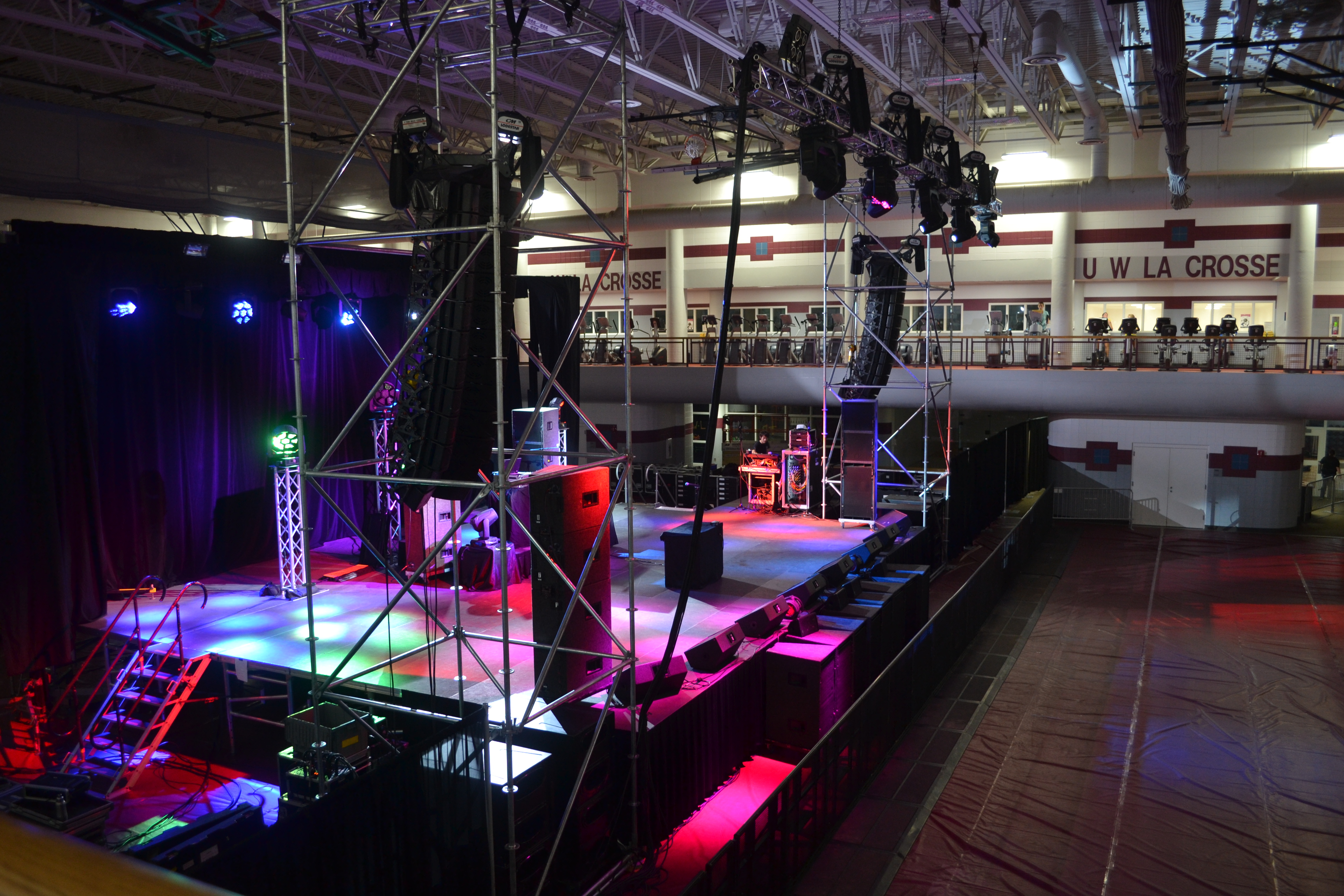
As a department we make use of our extensive in house stock. Bruno Silva our assistant head of department is in charge of designing the system and opted to hire a Digico SD7 for the FOH position and a SD10 for the monitors/ broadcast position. Our M’elodie line array from the main house is de rigged and re rigged onto truss also hired from a local company. 8 Meyer 500-HP subs, a single UPQ (used as a side fill for bleacher style seating) and 2 UPJ’s for a VIP seating area were also used.

The load in time was carefully scheduled from 4pm to midnight for 4 nights so as to keep out of the sun and searing heat of the Middle East. Despite being November, temperatures can still reach the mid thirties (degrees celsius) at midday. We often forget it is so warm outside when we are in the lovely air conditioned auditorium!


Soundcheck and dress rehearsals were scheduled over two days in order to ensure that work did not take place during the hottest period of the day. The first day comprised all ‘local’ acts. This included marching bands and displays from the Army, Navy, and Royal Air Force as well as the Royal Omani Police. On the second day, we welcomed the Korean ensemble. Each act was introduced by commentary in Arabic and English. The two commentators sat next to the front-of-house lighting and sound positions.

It is the uniqueness of creating an event like this in Oman that it is so incredibly satisfying. The excitement generated is a sure reminder of His Majesty’s vision for his Opera House.


Annie Stoic – LD and Assistant Tour Manager for Joan Jett

Annie is currently the Lighting & Assistant Tour Manager for Joan Jett & the Blackhearts who just finished up touring with Heart and Cheap Trick. In addition to her Tour Managing position, she is the guitarist for her all-female band Jackknife Stiletto. 


Can you tell me about your experience as a musician and your current position?

I’ve been a guitarist for almost 10 years, been in a bunch of bands growing up on Staten Island, NY. I was able to play CBGB’s before it closed when I was in high school! Currently, I’m in an all-female rock n’ roll band: Jackknife Stiletto. I just started singing for the band as well, which is very new and different for me. We just went on tour in October and literally had four rehearsals with me singing for the first time. Jackknife Stiletto will be booking more tours, have recordings coming out early next year, and we are very excited about it!

How did you get into lighting?

anie-and-others-all-girl-lighting-team

All Woman Lighting Team

I’ve been working with lighting for about six years. I started at my college theatre: Five Towns College: Dix Hills Performing Arts Center. I really got into programming and learning the different lighting boards. My favorite board is the Grand MA. Most of my jobs after college have involved lighting whether it was on tour, at a venue, or at corporate events. I have a lot of fun learning the new gear and figuring things out, learning from everyone I meet.

How is managing a band different from playing in a band?

Honestly, I don’t think I can tell the difference at this point? Jackknife Stiletto really does everything on our own. But for our recent tour, it was a different experience being the ‘front person for the first time. When you’re sitting at the merch booth before the show but realize you need to be on vocal rest and need to go warm up in the van, then jump into ‘artist/musician’ mode and hit the stage to give it your all, then go back on the floor, unload your gear, hit the merch booth again and start asking for new friends to sign up on your mailing list. It’s all very crazy and hectic – I wouldn’t ask for anything different!

Can you tell us how you became asst. tour manager / LD for Joan Jett tour?


I started interning for Blackheart Records when I was in college, after a semester they sent me on Warped Tour and from there, I was hooked on touring! When I was ready to graduate they didn’t have a merch, production, or lighting person so I said I can fill that spot & learn quick – so they gave me a shot the week after I graduated and I’ve been working with them ever since.

Can you tell us how bands get together to go out on the road?

You really need to plan and budget out a tour. Make sure you really research how much gas, food, hotels, showers, etc. are going to cost – you also need to make sure you have money set aside in case something wrong happens (van breaking down). As for my band, we get out our map and play ‘pin-the-post-its’ to figure out where we want to go. Usually, we start out looking where we might have friends, family, and bands we know and start there first. There is also the case where another band might have a tour already booked and we can jump on their routing, both situations are always awesome. There are really great websites like IndieOnTheMove.com & MusicThinkTank.com that have great articles for up and coming bands to read & learn about what they should be prepared for.

What is the biggest myth about going on the road for up-and-coming bands?

That you’ll come home broke with a pile of groupies in the van? Here’s the reality: Booking your own tour is A LOT of work! You don’t have to come home broke. There are plenty of ways to keep your expenses low on the road and as long as you’re working hard and hustling your merch – you should come out okay! Sometimes yes, you might loose money. We get one hotel a week (if that), sleep in the van at the truck stop & shower there (yes, they are actually nice showers!!). You can keep food expenses down by stopping at a Wal-Mart, bulking up & the usual Waffle House stop post-shows. Even if you play a show to five people in the middle of nowhere – it’s still an important show. As long as you’re killing your live performance, those people will buy your merch & tell their friends to come see you next time you are in town. Every show counts, every person in the room counts.

Do you feel that being a woman makes your job harder or easier….or has that not been an issue?

I don’t feel like it has made much of a difference to me. But there is the “oh you can’t lift that” aspect that some guys will say to you from time to time. Fortunately, I’ve had great experiences on the road and met some very cool people. There’s always some weirdo or jerk that will say or do certain things that might not like ‘chicks working in the industry, but I just ignore it and carry on with the job I need to do. Not everyone is going to like you whether you’re a male or female. Some people just aren’t cool!

What is the main reason a band tours?

I think touring is the best thing an up and coming band can do. You’re getting your music out directly to new people instead of just through a screen. There is nothing like being able to meet fans & new friends on the road and giving them sweaty hugs right after a set! And for your band itself, it’s a great way to see if your band even gets along on the road! Touring is rough: there’s little sleep, horrible food, loading and unloading gear, driving through the night. You’ll find out soon enough that some of your band members aren’t cut out for the ‘touring lifestyle.’

What are some of the biggest problems you have faced during the tour?

As an all-female band we do get the occasional ‘creepers’ on tour or as we like to call them, Stalkers! Some people always ask us ridiculous questions such as… “Isn’t that heavy?, Why do you carry your own gear? I’ve never seen a woman carry a half-stack and a bass drum down ten blocks.” And we know they aren’t trying to butter us up, you can see it in their face, the surprise that this is happening. We do everything on our own in this business, booking the tour, driving the van, loading gear, calling radio stations, websites, artwork, etc.. There are still people that come up to us and say that they’ve never seen an all-female band live.

On the upside, the van smells a lot better!

What advice do you have for women who want to work on the tech side of touring?  

Learn as much as you can and don’t stop learning! I’ve never taken a class in lighting or selling merch or how do run a meet & greet. Any part of the business you may like or even think you might like it – learn more about it! I love doing lighting but I still have so much to learn. I also love selling & managing merch, production, meet & greets, etc. I always try to work in any part of the music industry I can. The more you know about different areas, the more valuable you are. If you don’t have the experience, there are plenty of awesome people you meet at gigs that would be happy to let you pick their brains and let you shadow them. Oh and network, network, network!!

How has it been working with rock icon Joan Jett? 

It’s been very cool!! She’s inspiring as an artist & a woman. The whole Blackheart family is awesome, it’s a pleasure working and learning from everyone. I couldn’t thank them enough for taking a chance on me when I didn’t have much experience, but I’ve been learning as much as I can from them since day one. To be able to experience traveling around the world, meeting artists & people I never thought I would – it’s amazing!

Websites:
www.JackknifeStiletto.com
www.Crewicide.com


What is the Fair Labor Standards Act?

Fair Labor Standards Act – Know the changes and how they might affect you.

Effective December 1, 2016, the Fair Labor Standards Act (FLSA) will create a change in salary base pay for many people working throughout the US.  FLSA increases the weekly base pay requirement for salaried employees from $455 a week to $913 a week or $47,476 a year. You can find more specific and direct details here.  As a bit of an overview with this new act if you make less than the $913 per week as a salary for a 40-hour work week, and you end up working more than 40 hours within that week, you are entitled to either compensation time or overtime pay; both at time and a half.  Compensation time (comp time for short) means paid time off for 1.5 times the amount you worked over 40 hours during that week. Let’s use for example a situation where you work 42 hours in one payroll week.  With the changes in the FLSA, you would get that 2 hours in either comp time or overtime pay plus half equaling 3 hours of overtime for that week.  Your employer gets to decide if they will give you comp time or overtime pay when you work any extra time.

You’ve maybe run into this in the past and just altered time the next week so that it all balances out.  With the new rules, it doesn’t work like that any longer.  Overtime is based on a “per payroll week” schedule which is 40 hours within one 7-day period. That 7-day period can be determined by the employer.  Mine has set it up as the workweek is Sunday through Saturday. So if I work 42 hours one week and 38 the next I would end up with 3 hours of comp time or extra pay from the first week and 2 hours missing from work or being taken as vacation time from the second week.

This FSLA policy is another layer on top of an earlier act that does not allow you to volunteer for your employer doing the work that they already pay you to do.  As a result, volunteering for work is also not an option. You can read up on the rules regarding volunteering at your workplace for the work you are already paid to do here.

At this time, I am unable to speak about or clarify any rules regarding what FSLA looks like for anyone who freelances or works solely for themselves so I recommend that you take a look at the ruling so you know if there are any changes for you or your workplace. I do know FLSA does not affect those who are already paid hourly and already have overtime opportunities.

What does it looks like when applied to the workplace?

For many of us, this change is big as our work weeks are often very full, loaded with non-standard hours, and rarely ever 40-hours a week. I have been asking what other people are doing and many people have said they weren’t sure or are going to figure it out later. The system that I work in adopted these new rules almost immediately, so I thought I would share what has been happening for me in hopes others might be able to learn more and work out their own plan.

Personally, FLSA is causing a lot of change for me and many others in my organization. My salary is less than $47,476 a year and the organization I work for is not prepared to pay the overtime. It also happens that there is a policy within my organization that limits how much comp time I could accrue, if allowed at all, as a result they have decided to save the comp time for emergencies and high profile events. Overall, the goal in my organization is to never pay overtime or to allow anyone to accrue comp time.

My organization decided to start practicing for this change in September of this year.  That means once I reach my 40 hours each week, that’s it. Time to go home. Although I am excited for an opportunity to get paid fairly for the hours I put in, I am struggling with the idea to just walkout at the 40-hour mark. My integrity seems to be getting in the way. I struggle with the idea of walking out no matter what is happening, and potentially not being there for critical issues. The other force that I am up against is the policies of not accruing comp time, not paying for overtime, and not volunteering.   It has been interesting to find a way to navigate between these lines and feel good about it.

Now some people would say well that means they need to hire a second person, or that I’m doing too much work for one person, which could be true nevertheless in the near future with budget concerns the staffing level isn’t going to change. Just like some of you who work in smaller clubs sometimes the money just isn’t there to create the needed change so we take it one step at a time.

But I digress, to navigate this new balance there are a couple of things I have been doing.  First, I do what I can to plan my upcoming schedule accordingly to balance out the needs of events and other responsibilities of my position, while adhering to my time limit. I submit my work plan in advance of each workweek for approval to show when I will be working and when I will be away. I find myself working only 4 days a week on average, working various days and hours each week. Second, I have set specific office hours’ time where I can do the planning, administrative tasks, and ensure that I am managing my staff effectively.  I set these items into my calendar when I think the office is quiet to prevent interruptions, and when I can best connect with my staff.   Third, I find now I am even more focused on reviewing my schedule from a longer-range perspective.  Instead of working 2 weeks out, I have found I am looking 3 or 4 weeks ahead. This is so I can get the information I need for events farther in advance to plan my hours accordingly. It also helps to combat the time draw that last-minute events create on my now extremely tight timetable.  For the most part, this process seems to be working, although I have still had a couple of weeks with some extra time.  The schedule is something that those around me have struggled to deal with.  In the past, I had a more fixed schedule, and people knew when they could find me.  Now each week varies, and there is a lot of adjusting going on. It’s been a reasonable place to start, a good practice also, as it isn’t even my most busy season yet.

The process of adhering to the FLSA definitely changes things for me.  I appreciate the early planning and progress that has been made so far, to understanding the impact of adhering to the new rules.  Figuring this out is a work in progress, and is not yet perfected.  However, I wanted to share with you a reminder of the new rules, in the event, they impact you, as they do me.  I hope that sharing the basics of the rules helps you start thinking about how this may impact you and that sharing my approach may help you determine your own plans in anticipation of this change. It’s not too soon to get started thinking about what this may mean to you and how it may change your work-life balance.

Links:

https://www.dol.gov/whd/overtime/final2016/overtime-factsheet.htm

http://webapps.dol.gov/elaws/whd/flsa/docs/volunteers.asp


The Audio Girlfriend’s Guide to Pregnancy

Pregnancy and the audio industry aren’t exactly two terms you hear together. As I look back on the past 9 months of my pregnancy, I laugh at how little I knew – I thought pregnancy meant being sick in the morning, going to the doctor more often, and eventually wearing flip flops and not reaching the EQs on the console. Pregnancy has been a challenge mentally, physically, and emotionally and can completely take over your life at times. It’s also been a fun and fascinating experience – one that can be balanced with work if you’re flexible and can adapt to your new (and changing) limits.

First trimester (weeks 4-12)

There’s no anticipating how good or bad you will feel. Some women have no symptoms and others can’t keep down water. You really won’t know til you’re there.

Morning sickness can be like the worst hangover ever for weeks. You know the feeling when you’re at a greasy diner with a horrible hangover and the smell of food makes you want to vomit but you know you need to eat to feel better? That was 23.5 hours a day for me for 6 weeks.

Your nose/palate can dictate your lifestyle for a while. Normally, if you smell or taste something rotten or unappealing there’s a mild reflex saying “eww”

During pregnancy, the body reacts more like,“EMERGENCY! YOU INGESTED POISON!!” (even if it’s a whiff of a food truck a block away). I was “lucky” to only have nausea and usually could get to fresh air if something triggered me (like a coworker’s burnt popcorn). Some women can’t go anywhere without scouting out the nearest trash can, toilet, or bush because of a more visceral reaction to smells.

Eating is hard on a schedule. If you feel continually sick and there’s a small window where you feel well enough to eat, you need to eat. It’d be tough to be in a work environment where you can’t snack or only have designated meal times.

There’s a good chance you’re irritable and grouchy.

During the weeks I wasn’t eating much, my fuse was short, I didn’t have much of a filter and I had no patience for BS or attitude. I didn’t take on extracurricular gigs or stressful work during this time knowing my client etiquette and demeanor would probably be poor.

Exhaustion can be overwhelming – I had a yoga mat in my recording booth and would sometimes take a quick nap during breaks. Working swing shift was great because I could sleep in or leave work a little early if I was having a rough day.

The first trimester can be isolating. All of this is going on and you may not feel comfortable telling anyone. It can help at work to have someone in the know who can nudge the crew to eat their smelly pizza elsewhere or change the topic when someone teases you for not going out for a drink.

Second trimester (weeks 13-26)

Forgetfulness. The struggle of “pregnancy brain” is real. I was a guest on a podcast and could not remember the names of the plugins in my channel strip that I’ve used daily for at least 5 years. At work, I had to take extra notes and sometimes ask for detailed/complicated things in writing.

Need to focus on something? Good luck. Normally I have laser focus and can work for hours without being distracted. During pregnancy, I sometimes felt like a kid who was hyped on sugar and had a puppy in the room. I had to plan for extra time on mixes knowing I might get totally sidetracked or completely forget what I was doing.

Peeing all the time. There’s a reason for the old saying “bladder of a pregnant woman” (It’s hormone related.)

Even with all this going on, you might feel like Superwoman. In my second trimester I did a demanding scoring session in Canada (with long work days) and spent a week in Europe walking 5-10 miles a day. In both cases, I felt great (and ate more than the people I was traveling with).

You’ll start feeling the “thing” that’s living in your body. I’ve never been so excited to be kicked in the stomach.

Third trimester (weeks 26 -?)

Baby can hear! Babies start to hear between 23 and 27 weeks (especially low frequencies) and they can be startled by loud sounds. My little dude would often get squiggly/active when I was mixing. Studies show that babies recognize their mom’s voice after birth and will recognize patterns they heard while in utero (like if you read the same story out loud every day).

You will have some physical limitations. As your belly grows, little things become difficult (socks are my nemesis). Heavy lifting restrictions may start earlier in pregnancy, too, in part because of a hormone called relaxin which causes your joints to loosen. Belly weight isn’t necessarily the source of discomfort, either – your organs (and someone else) are moving around, too.

People may step in to help more than you want. People have good intentions but sometimes visibly pregnant women are treated as disabled or incapable. Staying active through pregnancy is great for your health (and your recovery). One thing I find funny is how often someone offers their chair or insists I sit when I’m more comfortable standing or moving around. But, there are also times where the offer for help (or the chair) is welcomed.

You never know if/when you’ll be forced off your feet. I was shocked to be admitted to the hospital and put on bedrest at 29 weeks when I felt fine and worked the night before. I was planning to work as long as I physically could but ended up on disability for over two months instead. Luckily I had a backup plan – I already had arranged a backup person for every freelance gig and my main job had a substitute list in place. Financially, I had prepared for some unpaid time off with an emergency fund (for a “worst-case” scenario).

Things to consider when you’re working and pregnant:

There are times you can’t function at full speed. This especially applies to the early and late months. Early on, I kept my schedule light and didn’t commit to anything more than a week ahead (when possible). I also turned down gigs unless I knew for sure I could handle it (I passed on a gig in China during peak morning sickness, for example).

It helps to work for companies/clients who can accommodate you in an emergency. A few years ago my husband broke both his arms falling off a bicycle. The studio I was freelancing with at the time didn’t have anyone prepared (even in case of emergency) so I had to leave him at the hospital and go in for the session. After that, I refused to ever be in a work situation like that again. Pregnancy has been much less stressful knowing that my employer can find a sub (same day, if needed) or that my clients know upfront I may bring in a backup person in case of emergency.

Guy awkwardness. One of the times it can be difficult to work with a team of guys is when you have something “female” going on. Once the weirdness passes (if there is any), pregnancy can be a fun topic to talk about – especially the name suggestions and bizarre questions.

Girl awkwardness. Being “one of the guys” in this field may also mean we don’t have many girlfriends let alone close ones who can pass down maternity clothes or give advice on breastfeeding. The jump from Audio Engineer to Mom can be completely foreign. Part of the challenge is finding resources and people who you feel comfortable asking for that kind of support.

You may get philosophical about your career. There’s a lot of questions about what your new life will look like. How do you want to balance work and a baby – or are you going back to work? If you are career-oriented or pride yourself on your work accomplishments, how are you going to handle being away from that? How will you balance your own identity and needs with your kid’s needs? Are you prepared to be “Mom” sometimes before “engineer”?

It’s sad, but loss happens in pregnancy more often than you’d think. It’s estimated that 1 in 4 pregnancies end in miscarriage (the majority in the first trimester). It’s not something that many people share openly until you go through it yourself. Loss can take some time to recover physically, mentally, and emotionally. It’s also a reason to be careful about when (or if) you share your pregnancy publicly (especially on social media or with colleagues you don’t know well).

Sometimes you see the doctor A LOT. Even in a healthy pregnancy, you may be seeing the doctor weekly or bi-weekly as labor approaches and they’re usually only available during the day. I’ve had more doctor visits and medications in the past year than the past 10!

If you are a contract worker (in the US), pregnancy protection laws may not apply. As an employee, your employer is legally required to hold a job for you for a period of time (even if your maternity leave is unpaid) and can’t fire you for being pregnant. Contractors don’t have the same legal protection.

In the US, there are disability insurance options for freelancers. California, for example, has a state disability plan workers can pay into (which is a great idea even if you aren’t pregnant). It’s very affordable and once in the system, you’ll qualify for the same disability benefits as an employee (currently in CA maternity leave covers 6 weeks paid disability time and 6 weeks paid family leave – even longer if there are complications or bedrest). There are also private disability insurance options that cover lost wages.

Emergencies can come up. There’s probably going to be at least one unplanned doctor or ER visit. If I was working out of town (or out of the country), I’d want to have a logistical plan in place in case I needed to get to a doctor/hospital and a gig replacement ASAP.

In theory, you can work until labor. It’s totally safe to travel until late in pregnancy (each airline has a point where you need a doctor’s note to fly). One of my doctors said she preferred her patients to stay working, saying, “You could take time off, but I don’t’ want you sitting on the couch eating and worrying.”

Or you may be forced to stop completely. One in ten women deliver prematurely (before 36 weeks) and babies over 24 weeks have a good chance of survival. At 6 months pregnant most women aren’t thinking or planning for delivery but it’s a risk that’s worth planning for. I’m looking forward to my new “gig” (and to meet my new little assistant). I hope other women will share their stories of pregnancy and parenthood so we can create a resource where one doesn’t really exist.

Musings on the Role of Femininity in the Music Industry

Historically speaking, women, and those that are female-identifying, have largely been unwelcome in the music business. Unless you were an overstated, hyper-exaggerated version of a sexual, feminine ideal in a front person role, you had no place, no business being near a stage, studio, or mixing board.

The concept of the feminine identity in relation to the music industry is one that perplexes and fascinates me. Now I don’t necessarily mean simply dressing in a “girly” way – most, if not all, of us, are unable to wear a skirt when working (it’s not practical in the slightest, not to mention a possible safety hazard in live situations. I prefer my trusty blue jeans.) – but more the attitude, the feeling of being “feminine,” whatever that means, and how it translates to our work.

I interviewed a few of my colleagues regarding their thoughts on this topic, asking the question, “have you ever felt like you’d have to reject your femininity in order to be successful in the industry?” Most that I asked this question to initially responded with a hard, “no.” Jill Meniketti, band manager for Y & T stated,

“That’s not something I’ve ever focused on.  I focus on my work, which I take seriously.  When you excel at your job, that garners respect, regardless of gender.”

Delving in a little deeper into the feminine mentality/attitude aspect garners a slightly different response. When I first got started in the studio, my college professor insisted that being a woman in the studio was a massive advantage, because they are better at keeping the peace and stepping into the role of the band’s creative therapist. My friend Eva Reistad, a studio engineer based in Los Angeles, echoes this thought. When I asked if there was a time when being feminine proved advantageous, she stated, “yes there was: band members sometimes are more open to the fact that you’re a woman, in which case they’ll sort of open up and tell you more things, which will cause the session to go better. I don’t think it’s really anything so much as femininity so much as being female.” Somehow, just being a woman allows people to feel more secure and comfortable in that situation.

Through all my discussions on this topic, the main conclusion I come to encompasses more than just femininity. It’s about being comfortable with who you are. As Eva puts it, in the end, what I think is how you present your aura, your energy, that will determine how you are treated. You cannot control how other people react. Be comfortable with yourself entirely.”

There is power in being a woman in the music industry. Being confident and secure in who you are provides a sturdy foundation for the rest of your work, whether you are a tech or an artist.

Jill’s Website:

Eva’s Website:


The sound of the Elizabethan era: Sound design for Shakespeare’s Sister

It’s always exciting to work on the first production of a new play. Don’t get me wrong; I’ve loved working on the re-envisioned versions of Shakespeare, Wilde, and others, but there’s something quite special about knowing your production will be the first time anyone has breathed life into this particular story.

So when I accepted the role as the sound designer for ALRA drama school’s production of Shakespeare’s Sister, and I found out that this would be the first full production, I was excited.

Shakespeare’s Sister is a play about the sister of William Shakespeare – nothing to do with the band, in case you were wondering! It follows the fictional character of Judith Shakespeare as a budding playwright when, following an unwanted marriage proposal, she follows in her brother’s footsteps and travels to London to seek a career as a playwright.

From the outset, it was clear to me that music would be an important part of establishing the period and the world of the Elizabethan theatre. In our first sound meeting, the director and I discussed the emotional context for each scene and what we wanted the music to achieve, and I outlined my views on the role of music in the play.

The director, Titania Krimpas, had already researched possible music choices as she wanted the music to be used in rehearsals from the start, particularly in the choreographed scene changes. The tracks she suggested opened up a discussion about how we wanted the music to sound – all period-appropriate pieces or modern tracks with a period feel? Live or recorded? Recordings of Renaissance music played on modern instruments, or on period instruments?

kirsty-gillmore-nov2016-pic5At this point, I looked at the design and lighting design, to give me an idea of their general approach and make sure I was aligning my design with theirs. The set consisted of a raised stage with stairs (quickly named the “raised platform” to avoid confusion with the stage itself) and moveable pieces of furniture and props on the ground in front of it (the “apron”), with action taking place on both levels. The raised platform acted as both the stage of the Rose Theatre in London, the setting for much of the play, and another level for scenes set in Stratford and the Tower of London. Although the design wasn’t intended to be strictly traditionally Elizabethan, it took inspiration from the world that Elizabethan actors would have inhabited: simple, almost stark, in plain neutral colours, with few embellishments except for touches of flamboyance in the costumes, as befitted key characters.kirsty-gillmore-nov2016-pic3

A conversation with the lighting designer, Ben Cowens, revealed his intentions to make the lighting design as naturalistic as possible, supporting the set design, and thus I had a clear direction for the music. I dismissed modern songs and investigated recordings of period compositions on period instruments, which I felt gave a much more raw, natural sound than recordings on modern instruments.

Live music was an element that I also considered from early on in the process. I enjoy using live music elements where possible in my sound designs, as I feel they add immediacy and intimacy that is harder to capture with recorded music. In an ideal world, I would have liked to use a live ensemble, but this wasn’t possible given our budget, so instead, we looked at ways of incorporating live music elements at key points. Taking our lead from the references to trumpets and drums in the script, I suggested the use of a bodhrán drum, played by one of the actors as a “player” (the Elizabethan word for an actor). A bodhrán isn’t entirely period-appropriate, but it was much easier to source than a tabor (a type of snare drum used in the period), and I knew the sound was similar enough to work with pre-recorded sounds of trumpets and other drums.

The music component of a sound design is an area where a collaborative relationship with the director is crucial. Music is a subjective discipline, and directors can have definite choices about the music they want for production. Sometimes this feels a bit restrictive for the sound designer as it can mean they have to build their design around the music they didn’t choose. It’s useful to remember that the sound elements of a production, and music in particular, often play a significant role in the rehearsal process. In the case of Shakespeare’s Sister, the choreography of the scene transitions required music and the actor who was playing the bodhrán needed to rehearse with the pre-recorded music which he was to accompany.

As rehearsals continued, I found I was drawn to create the sonic world of the play’s version of Elizabethan London more with music than with sound effects. While I used sound effects and soundscapes to establish location – the crackling of a fire and chickens in the yard for Stratford, wind whistling through cracks, and dripping water for a cell in the Tower of London – I used musical motifs and drums for moments of heightened emotion and physical tension. One of my favourite sound moments in the play was the use of a repetitive drum beat which slowly increased in volume as the scene built to a climax. Rather than keeping the drums at a level that comfortably underscored the actors’ speech, we chose to use the sound to energise the scene and encourage the actors to raise their voices above the drums.kirsty-gillmore-nov2016-pic2

I haven’t spoken much about the speaker positions for this production because these were straightforward. Any production with a limited budget and space restrictions will require a certain amount of compromise, and I worked around fixed speaker positions and speakers that wouldn’t have been my first choice but worked fine for the production and in the space.

Two challenges that I had to overcome were where to position two speakers behind the raised platform and where to put the two subs. I had expected to attach the two speakers on a horizontal bar between wall beams, and the subs under the seating banks, but had neglected to discuss this with the designer or the lighting designer. During the get in I discovered that the designer and lighting designer had planned to install a lighting feature behind the set and the seating banks would be too low to fit subs underneath them, which slightly marred my plans! Thankfully, I was able to re-position all speakers with minimum fuss, and it was a good lesson to maintain the relationship with the creative team right through the rehearsal and production process.

Having designed a baroque opera and an Elizabethan play, it almost feels like my next design should be medieval, but instead, I’ll be concentrating on two banned plays from the 1920s. From courantes to Charlestons, no two plays are the same and my work is more interesting for it.  


X