This year I’ve written about a number of topics ranging from Fabfilter plugins to cover letters. While I wanted one of the last articles of the year to be a roundabout to my first on New York and its restoration from Covid-19, I realized it’s October.
For some of you that might be a “Why is the obvious being stated here?” But for high school seniors or college students, it’s more like “Wait it’s October?!”
Yes, it is that time of the year that you will rush to fill out your FAFSA, you might be already applying to colleges If you’re in high school, and now if all so suddenly you are becoming an adult and are expected in some way to know what you are supposed to be doing.
If you are reading this on SoundGirls then you might have a clue that you want to have something within the music industry, and that’s awesome! Now the question on how you get to where you want to go, If you haven’t yet feel free to read my last blog on college ( and if mine isn’t enough some other amazing people have also touched on the subject ) it might help give you some idea of how to get to the place you need to be.
Now that’s that said and done, and I’m going to assume here that you are going through with whatever you settled on – the next step is reaching out.
Resume?
References?
Cover Letter?
Now you gotta send it out.
(The following steps are not in any particular order and can be read individually.)
Step One: Utilizing Social Media
LinkedIn, Discord, Instagram, Facebook. These are all great ways to connect with other creators, engineers, and such. I am currently part of a discord server for attending a seminar done by Downtown Music Publishing. It has publishers, producers, talent management, singers and songwriters, and even journalists. Remember, I’ve said it in the past and I’ll say it again- it isn’t weak to ask for help or not know everything. Sure you have people that won’t bother helping you, but I think you’ll find that most people have been in your shoes starting out and are going to give you a helping hand if you reach for it. I didn’t know much of anything about what entertainment management did or looked like until I talked to someone on the server I’m in. Now I can say that I was able to network and I learned something through doing so.
KEEP IN MIND
Some have Instagram or Facebook for personal reasons only, they may not want to have work and family mix on these platforms. Be mindful of the pages that are private, check to see if the person you want to connect with has a LinkedIn account or business email before trying to contact a personal account. These guys and gals are just as human as the rest of us! So let them have privacy if it is clear it isn’t for public access.
Step Two: Email
While I would never recommend sending a cold turkey email to someone before being invited to do so, some may have emails set up for just that reason. If a label you want to reach out to for example has a new artist email or outreach for talent hires it could be a good move for you. Make sure to attach the resume, cover letter, and reference sheet. Structure the email on Google Docs or Microsoft Word to avoid accidentally sending an unfinished email. Keep the email short but informative, mention something unique about yourself or the position.
Example Email
Dear New York City Recording,
I am interested in the available position of summer intern posted on LinkedIn. I have experience running an SSL 4048 and have a vast understanding of Universal Audio outboard equipment and in-the-box plugins. Within this email, I have included my cover letter, resume, references, and samples of work I’ve mixed during the last two years studying under John Smith at Iris Studio, located within the University of Sunderdale. If possible I would enjoy the pleasure of arranging an interview at your studio, famous for recording XX’s classic hit Cakewalk.
Sincerely,
Kimberlynn Ahlers
Step Three: Calling or Going Directly
It could be a long shot – you might definitely come across a lot of people saying no, but if you live in a city like ( but not limited to) Los Angeles, London, Berlin, Kyoto, Tokyo, New York, Miami, or Nashville you might have a shot. If people see you show up enough or call in enough on a certain position they might see it go two ways, You are either annoying or persistent. The next time someone moves jobs or gets fired – the persistent one often comes to mind as a quick fix to patch a gap. You might not get anywhere doing this, but you just might – if you really really want it.
So… congratulations! I hope that this helped you think of ways to reach out to those you are looking forward to meeting. I have nothing but a foam finger on my end – cheering you on!
Hello, summer 2021. Hopefully, most of you who are reading this are preparing for a busy summer. I know I am quickly booking myself as many safe live shows as I can, and I hope you are as well. Over the past few months, I have been collaborating with a friend and colleague to present an article that talks about freelancing in an extensive and informative way. Since summer is right around the corner and many of us will be hunting for work, now feels like the best time to release it.
Networking. Networking. Networking.
How many times have you heard the word networking thrown around? The word means roughly the same thing to everyone, but each person does it differently. For me, I like to listen to people, and if I want to start a working relationship with someone, I ask them what their opinions are. I make it my goal to learn from them or to simply talk about the work that we do. It is a great opportunity to hear from another person’s perspective, but also to prove that you know what you are talking about. People enjoy feeling like they are important and being heard. Typically, this results in a positive association of me in that person’s memory.
This also leads to one of my colleagues’ opinions on the subject. He likes to take a more online approach by keeping up to date with the ever-evolving industry. He frequently uses social media, online groups, and forums, as well as LinkedIn. Knowledge is a valuable tool in this industry, especially if you are looking into jobs centered around higher education or research. Networking like this also opens you up to the opportunity of coming across and engaging with professionals.
On the other hand, networking on the job can be a bigger challenge. Introducing yourself and making a good impression are two things you will want to prioritize. A peer of mine also likes to prioritize listening to artists’ concerns and will take on the ‘problem solver’ role. It is easy to forget that we are in a service industry and being able to listen and solve issues put your band or artist’s mind at ease. It is an excellent way to create a lasting impression of you in their mind.
One of my recent endeavors has also been to simply ask. In preparation for my summer off of grad school, I started looking for local work. I noticed a local tavern had a full schedule of live music that they were going to have outside, and I asked if they needed any sound support. Fortunately for me, they did, and the conversation went from there. I might suggest as a tip to reach out to venues to see or offer your services rather than searching for a band or a couple of groups to work with.
Multidisciplinary vs. Niche
Something that also needs to be considered is what kind of services you are going to offer. I will cover two approaches that you may want to think about.
The first being multidisciplinary, which can also be associated with flexibility. Myself and many of my peers come from a multidisciplinary background. The education I received in my undergraduate program was well-rounded. As a first and second-year student there, we took several basic stagehand classes covering lighting, sound, production, scenic, and costume work. This results in most individuals being multidisciplinary on some varying level.
Some of the pros of this approach are that it opens you up to most gigs that need help. For example, I can finish up with my sound set up and jump in and help install the lighting rig if needed because I have basic experience with lighting. On most of the IATSE gigs I have worked, the other union members were also well-rounded workers. From personal observation, that appears to be how they live industry works and thrives. It is a fast-paced environment. When you need a hand with something, you typically do not have the time to wait for the right, single person to come and help. Having basic knowledge about several things on top of your more experienced expertise in one area is what makes you more marketable and typically, more desirable.
A second approach is a niche approach. This is a more concentrated or expertise-based method. For example, we talked about union stagehands typically being well-rounded and multidisciplinary. However, a union stagehand might not be the best fit for an audio programmer for video game production. That role should be filled by someone with more concentrated expertise and experience. Services can be even more niche than that. A client may be searching for a recording engineer in a twenty-five-mile radius, but they are specifically looking for a recording engineer who specializes in abstract noise rock.
This can also be perceived as limiting your chances of work and your possible clientele. As one of my close friends likes to put it, “how many eggs versus how many baskets”. This refers to the client to services ratio for you as the business, for the area, and for many other factors. If you have multiple baskets, representing a multidisciplinary approach; you may be able to fill your baskets with more eggs compared to someone with one or maybe two baskets; a niche approach. However, this is entirely dependent on client-related factors like area, service rates, or if the industry is suffering from recent financial hits.
Developing a brand
This section applies to everyone. Most of the time we, as the individual, are the brand or the thing that we are marketing. Everyone is going to have an opinion about your website or your social media accounts. However, what is most important is that it looks good, the information is up to date and easy to navigate, and that it represents you.
A person is always developing and changing, therefore their website’s style is also going to develop and evolve over time. For example, I prefer clean lines and black and white for my website. I like the simplicity and that it allows for my work to be the center of attention. I added a cool and interesting picture of myself or my work on each page for emphasis. The black and white color scheme is nice because it doesn’t clash with any of my pictures. It looks clean and professional and allows for myself and my work to take center stage. Small things like consistent use of single text font and watermarking or other associated symbols are also important. If done well, things will look professional and pleasing but will establish an association with your viewers and audience. We want that association to be positive. Therefore, we put time and consideration into this.
A peer of mine who spends most of his time working in live sound will establish a good impression with an artist or band and then follow them on social media to form a connection between his name and his face. This is also another great way to create a path that leads people to your website and credentials. Business cards are also a great physical object that can lead clientele to your credentials. The same principle applies to these as well. Use the same text font if you can and include any associated symbols or marking to make it personal to you.
Public Image
This leads to consistency and keeping up to date with information, services you can provide, and communication. Personally, I like to keep a log of everything that I have worked on or done. That way I can tailor my credentials and information that I share with clients. For instance, the resume that I applied with for my MFA was a solid two pages, but you still want to stick with the one-page resume when applying for work like live sound gigs or audio editing for audiobooks or podcasts. Thus, because I keep a log of everything I have ever done, my one-page resume is consolidated to relevant work. This also means that I have multiple resumes and the one I use for live sound work is different compared to the one I may use for a gig doing sound design for a short indie film.
Consistency is also going to influence how professional you and your brand feel to potential clients. If I receive an email inquiring about my services, I am going to respond as soon as possible. On the other hand, I do like to follow the rule of responding within 24 hours once a working relationship has been established. Of course, there are always exceptions and if you respond within 48 hours, but have an open and clear sense of communication with that clientele, that is fine too. Communication is often one of the factors that make people move on and look for services elsewhere, so consistency in that regard is vital for any freelancer.
All of this plays an important role in your public image and how people perceive you. Are you reliable, does your resume or website reflect your capabilities, are you timely when sending emails, etc. Our industry tends to share information and recommendations through word of mouth, thus placing emphasis on a good public image. It is going to be impossible for you to not have some burned bridges, but the more poor interactions that you have, the less likely you are going to be recommended to others. Meaning you will most likely not be called back for more work.
“Don’t do it for the money, but don’t do it for free”
You should always be compensated for the work and services you provide. Unfortunately, that doesn’t always mean a paycheck. The phrase ‘don’t do it for the money, but don’t do it for free’ might sound foreign, but the mindset might allow you to see other possibilities. For example, a gig might not be able to pay you, but they are nonprofit, which allows you to write it off in your taxes. Several other professionals are also going to be there, which will allow you to network and possibly get your foot in the door for a few more jobs. Or even with potential clients. The gig might be broadcasted or have a large audience on social media which may look good on your website and help you develop your brand as a professional.
This mindset also works when a job might not be able to pay you as well as you want. When you begin freelancing, this kind of thought process is really helpful because arguably it is more important that the flow of work is steady rather than a steady paycheck. Things like networking, developing a brand, consistency, and public image influence that flow of work. It is all about what you can gain from that job. Sometimes it will be a paycheck or sometimes it will be other opportunities. Some people will only accept a paycheck, others may be looking for something more plus a smaller paycheck. What is important is that you value your time, and that will always be changing and will be unique to you.
The World is a Write Off
The gas that you need to get to a gig, the meals that you bought yourself for that day, your overnight stay at a hotel after working a show, and various equipment needs you have for your work are all examples of tax write-offs. Many freelancers will keep detailed records of all of this and submit them to their accountants or CPA. You must keep all receipts, various pay stubs and checks, and any other relevant records you may have. Having some kind of organizational system for these kinds of documents is vital. Depending on your flow of work, you may choose to organize by client or job. If that job is long-term or becomes more consistent, it may require a separate form of bookkeeping and organization.
Let’s briefly talk about equipment write-off and itemizing. This refers to the accounting of all of your receipts when purchasing equipment needed for your business or the work that you do. I will give a few examples. One, I just started out freelancing and I would like to get myself a small tool belt and crescent wrench for a gig I have coming up. When I purchase what I need, I will keep the receipt for my records, file it away in whatever organizational method I am keeping, and eventually present that to whoever files my taxes. Another example, I am working on a client’s podcast and would really like to add a denoiser plugin to the vocals. I can purchase the said plugin and keep the receipt for an eventual write-off because I needed it to do my job. This can also include much larger purchases like needing to upgrade your board if you are a freelance mixer for live music. All of this is relevant and should be written off to receive the taxes back. If large businesses can do it, so can you.
For those who do not know, a 1099 is a tax form for non-employed workers like gig workers. This is because they are not salaried and typically get paid per show. These should be submitted to an accountant or CPA when filing your taxes. Who should I expect to receive a 1099 from? Typically, any business should send you one. If I mix live music all summer for a local bar that pays me in checks, I will expect to get a 1099 form from them. If you worked for a business or client and made less than 600 dollars, they do not have to send you the 1099 form. However, it is also common to do a gig and be handed cash at the end of the night. This kind of payment is harder to keep records of.
Hopefully, this article has brought some sense of clarity or answered any unanswered questions that you may have had. Freelancing can be difficult, but also very rewarding. I have found most of my success by referring to my friends and peers who also freelance. At first, it may seem like a lone wolf type of work, but you will find so much more success and satisfaction if you spider web out and use the resources that you have.
Have you ever had a little voice in your head whispering that you don’t know what you’re doing? Ever looked around the room with a sinking feeling that you’re the least qualified person there? In small doses, these impulses can push us to improve, to get help and learn from those who’ve come before us. However, when that mentality seeps into our lives and latches on for months, years, or even decades, we find ourselves faced with the far more problematic Imposter Syndrome.
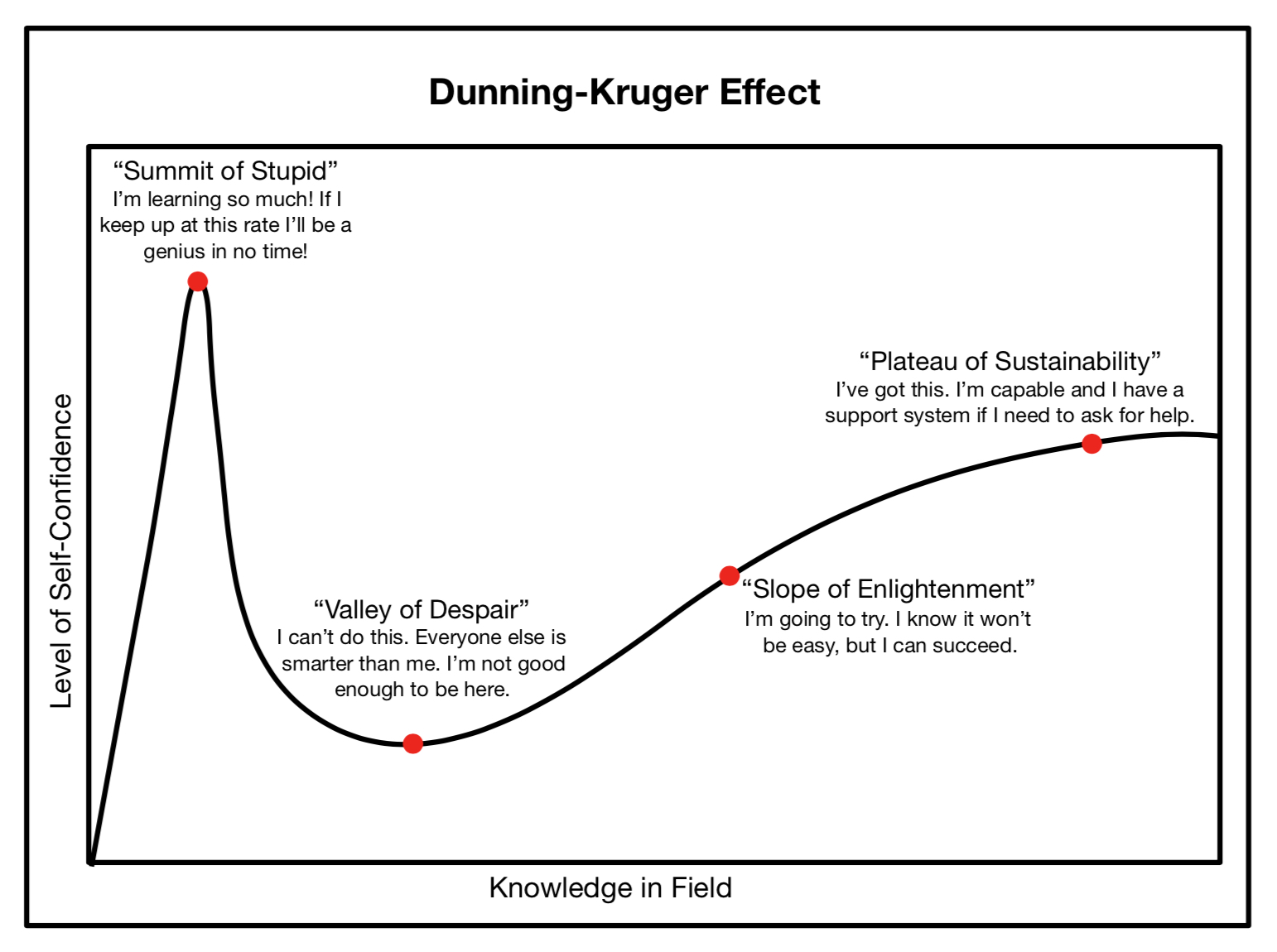
The Dunning-Kruger Effect is the best representation I’ve found to conceptualize the progression that most people follow during their careers. As you can see, it’s not a linear road to travel, even in its most simplified form. As 2021 continues, and we hopefully start to make our way back to work, many of us are facing the discouraging outlook of a year or more of lost time in our careers. Most of us will have to take a few steps backward before we can go forward in rebuilding our professional confidence.
When I started my career I was excited: I’d wanted to tour since I learned that was an actual job and I was ready to hit the ground running. Instead, the ground hit me. I loved my crew and running shows and seeing the country, but there was a learning curve (like with any new job), and I was suddenly very much aware of just how much I didn’t know. Imposter Syndrome hit hard at that stage in my life and turned my learning curve into a confidence free-fall from my Summit of Stupid.
For such a sharp plunge on that graph it starts out deceptively small: a little voice in the back of your head harping on every mistake. That voice monopolizes your attention when you realize you’re making someone wait while you finish a project. It whispers, “they’re right” when you’re told, “It’s not something I can teach you if you don’t understand it.” These little things build on each other and grow until you wonder how you were even hired in the first place.
I spent most of my time as an A2 caught in a loop: I felt horrible at my job so I figured I should quit, but I’d be just as horrible at anything else, so I should just stay where I was, but I felt so horrible at my job…. That cycle went on for years before I found a way out. There were days I was depressed and didn’t know why, but also days I went out with the crew after a tough load in and laughed so hard that I squeaked. Once I was told that my brand of book-smart intelligence was good for nothing more than being a “party trick.” Other times I had shows I mixed where everything clicked and I fell in love with my job all over again.
Imposter Syndrome is a toxic relationship with yourself. It keeps you guessing at every turn: constantly off balance and convinced that the world is waiting for the right moment to pounce. The thing is, everyone other person around you is dealing with those exact same feelings. So, the good news is you’re not alone.
The even better news is this isn’t permanent. Imposter Syndrome is effective because it puts you on defense and instills a reactive state of mind. You no longer trust yourself to give an accurate assessment of your own skills. Instead, you take your cues from the words and reactions of those around you, and always give extra weight to the negative because it agrees with that little voice in your head. After all, why should you even try to improve when people who know so much more than you have told you you’re hopeless?
The best way to quiet that voice is proactivity. In a proactive mindset, you dictate your own self-image first and all other information is evaluated, but not treated as fact purely by default.
One of the best proactive moves I made was transitioning from an A2 to A1. Unknowingly, that was my final major step out of my Valley. Three years up the Slope, I was in tech for Saigon when a colleague told me he was worried that I didn’t realize how hard the show was to mix.
Reactively, my self-esteem would have curled up in the fetal position and that voice would have whispered what an idiot I was to think that I was even halfway decent at my job.
Proactively, I raised an eyebrow at a comment made out of stress-induced worry. After all, I’d spent as much time as I could working on my script, learning the show, and practicing the mix. While there would inevitably be a few mistakes, I had come prepared and I knew I could handle them.
Practicing proactivity gives you a solid foundation to approach a project or learn a new skill. And just like Imposter Syndrome, it starts small. It’s taking the time to relabel a cable instead of having to wrack your brain for its name every single load in. It’s refining the way you explain a project to the local crew so they don’t have to ask you to clarify the directions seven times. It’s signing up for a class or a workshop that the little voice says you don’t know nearly enough to attend.
These seemingly insignificant steps give you the building blocks for the rest of your career. Now, I’m particularly efficient at loading in and out shows because back then, in any proactive moment I had, I made one tiny tweak after another. Sometimes it was looming the end of a cable bundle a different way or even making a whole new loom for a special project. Other times it was pre-marking a tape measure to make instructions less complicated or taking pictures of an efficient case pack so it was easier to duplicate. Bit by bit the small fixes accumulated to make me more efficient, clearer, and more consistent.
Even after two years on my way out of my Valley, it wasn’t until the tech for Saigon where it actually hit home that I didn’t feel like an Imposter anymore. That month was challenging to say the least, partly because I was faced with many of my former triggers: not having all the answers, people getting frustrated, negative comments, and more.
That voice started whispering again, but when it did, I realized that I hadn’t heard more than a momentary peep from that insidious little thing in all of my previous two years as an A1. Without those triggers, that voice couldn’t sustain itself.
I was not the common denominator.
At that moment, I had the choice to drudge up my old, reactive habits or stick to my new, hard-won, proactive ones. Tech was still tiring and stressful, but I was better able to identify and mitigate my triggers. I did my best to address problems and solve what was in my control or ask for help with what wasn’t. If someone got frustrated I did my best to talk with them to see if there was an underlying issue. There was no way to avoid every frustration, but I could make sure I didn’t add to them unnecessarily.
If you find yourself with your own negative little voice, practice being proactive whenever you can. Even if it seems like it’s pointless, do it. One baby step at a time. Also, make a point to keep mementos. Did you have a great day, mix an amazing show, solve a tough problem? Write it down. When someone sends you a note or text or email telling you how amazing you are, save it, screenshot it, flag it. If you have a bad day, pull those out to remind you that this is temporary.
Lastly, find your kindred spirits: people who aren’t afraid to be honest when you need a swift kick, but will always have your back. (It helps if they work in the same industry and understand your world.) Mine are my former A2’s, current dear friends, and the very people I ask to proofread everything I send to this blog.
Rachel, Mark, and Dan were with each with me for a year of my first three tours while I navigated a new chapter in my career as an A1. Touring with someone creates a unique bond in itself, but each of these three have gone well above the call of duty time and time again to offer support, help, and motivation anytime I’ve needed it.
It’s not an easy road out of Imposter Syndrome, but the only way out is through. Keep in mind that you are not alone, grab a friend, and do your best to get a little better, one baby step at a time.
Making Moves to Make Money
How making lateral career changes within the industry will keep you paying your bills.
“Stepping onto a brand-new path is difficult, but not more difficult than remaining in a situation, which is not nurturing to the whole woman.”
Maya Angelou
The last year has brought unprecedented obstacles to how and where we work. The landscape has changed drastically, and the future can feel overwhelming. We are placing a higher value on resiliency and adaptability not just to survive but to pivot and thrive while throwing new information about the pandemic. Events are booking, canceling, rescheduling, postponing, and that is stressful. We reward people and companies that can look at their options and pivot quickly.
Over the last few months, I’ve been fortunate to see first-hand how events are coming back within different areas of the live event industry. We’ve seen anything ranging from virtual zoom performances to hybrid conferences to large crews in arenas doing broadcast-based events. The name of the game to fill my schedule has been about making lateral changes to keep my schedule full with gigs in live events.
Three years ago, I worked full-time in theatre. To avoid the dead season in my market, I quickly realized I needed to adapt and make a parallel move into corporate AV. I stayed in corporate AV up until March 2020. I noticed many production companies stick to using a core group of people to do virtual events. Hiring freezes created an interesting power dynamic. With the limited number of shows, many production people were out of work with the relatively small but highly competitive need for leads, but labor for events became more crucial. Good hands were (and are) quite literally hard to find as people take jobs outside of the industry.
I made the move into labor in arenas. I had always been hesitant to consider the arena environment for its notoriously bad reputation for treating women in the workplace. While it hasn’t been all peaches and cream, the first thing I noticed was how appreciative of my skillset they were. They genuinely seemed grateful and excited that I was there and a part of their teams because of my broad range of experience. The standards in my other workplaces made me exceptional as a new hire.
Now I’m offered more opportunities to work and train than I have in years. I’ve done so much online training that I’ve gotten to refresh my resume. I haven’t done as much audio as I’d like, but being willing to switch into different departments as easily as changing my days uniform (from black clothes to different black clothes) has made the difference in keeping busy. I’m taking a Covid-cautious camera class soon. Try saying that one five times fast. I’m also even getting trained in rigging, which will only make me more assertive as a candidate for future productions.
The uncomfortable change that this pandemic has put us all through has forced some of us to make decisions we probably would’ve never considered. I’m still taking corporate gigs as they recall more people back to work. I’m still working for multiple companies to keep my schedule full to pay my bills. But as the quote says above, stepping onto a brand-new path is difficult, but we can thrive in new ways we never could’ve imagined had we not taken that step.
Alyssa Freire is a live event technician and crew lead from Miami, FL. From theatre to corporate events, she takes pride in having a varied skillset and broad interest in all facets of events. She started her career in lighting and quickly found joy with the faders of another console. While having a strong focus on technical knowledge is crucial, Alyssa also focuses on social and communication skills to create strong interpersonal relationships with her teams. As a Cuban-American, the topics that are important to her are diversity, inclusivity, and accessibility in all forms. She is a proud member of TSDCA and ESA.
You are not a unicorn: The transferable skills you already have
I have written before about the need to have a back-up plan for when times are tough What’s Your Plan B. We literally work in a gig economy and there are plenty of reasons why you might not be able to make ends meet solely through audio. Whether it’s an injury, family illness, recession or global pandemic keeping you from working, or you simply want a bit of a change for a while, knowing you have an alternative job you can fall back on (preferably one you can do in any health, from anywhere) can be invaluable.
Unfortunately, we in the live music industry like to think we’re a totally unique, ragtag bunch of misfits, who’ll never be able to stick a “normal” job. I’ve been told many times that the only way out of live audio is to move into a less physically demanding role that is still in the industry, like production management or an office job with a hire company (or death!), because our talents are so idiosyncratic and we just don’t fit in anywhere else. This exceptionalist mentality can even extend to calling people outside the industry “muggles” or even “civilians” like we’re a band of magical Navy SEALs. The bad and good news is we are not as special as we like to think. If you’re considering an alternative career or just supplementing your income, there is hope. You already have plenty of transferable skills that you can use to your advantage. Here are just a few of them:
You’re self-motivated: If you’re a freelancer, you know you need to hustle for every gig. You organise your own education and training, network like your life depends on it and keep up to date with industry news. Even if you’re a full-time employee you will still do most of these things. At work you are task-orientated, managing your time and prioritising your workflow without direct supervision so everything is ready for doors.
You’re hard-working: You work long hours in a job that is both physically and mentally demanding and you take it in your stride. Have you ever had to sympathise with a friend who complained about having to do a nine-hour shift in retail? Or someone who had to stay in their office until 8 pm to finish paperwork? All the while thinking about the forty-five hours you had put in over the previous three days? Of course, every job has its own challenges, but long hours are not something you shy away from. Neither is lugging heavy flight cases across a field or literally getting your hands dirty pulling cables.
You’re a team-player: While you can be trusted to get on with working by yourself, you also have plenty of experience as part of a team. You’ve probably worked with difficult colleagues, in tough circumstances, and still made the show a success. If you’ve led an audio crew or worked with stagehands, you have evidence of leadership and delegation.
You’re flexible: When was the last time you did a gig where everything was exactly as you expected it to be? Channel list updates, technical faults, late arrivals, and spontaneous changes to the schedule are part of our everyday lives. Similarly, you might be patching a festival stage one day, doing FOH for a conference the next, and fitting mics for a musical the day after that. We are used to change and know how to adapt to each situation.
You’re smart!: Even if, like me, you don’t have a formal qualification in audio, you have a massive working knowledge of acoustics, electronics, and software management. If you can read a console manual and stay awake through the whole thing, let alone understand it, you’re doing better than a big chunk of the general population. It’s easy to forget that we deal with some pretty complicated topics, but we do, and often in very challenging and time-constrained circumstances.
You’re an experienced troubleshooter: This is where all that frustration over technical issues was worth it. If you can look at a setup, imagine the signal flow in your head and work through each potential point of failure, you can look at the big picture in any situation and think about potential solutions to problems. Attempting fixes in a calm, logical, and methodical way, and keeping track of what does and doesn’t work, can be a highly useful but surprisingly rare skill in many work environments.
You’re multilingual: You are so fluent in tech-speak you don’t even notice it anymore. However, perhaps, more importantly, you can also talk like a normal human and can speak client. Good communication skills are paramount in any job, and they don’t solely involve talking. Effectively listening and truly understanding what’s being said is just as important, if not more, as making yourself understood. Being able to interpret and respond to nerd-speak or a musician’s complaint that their monitors sound a bit too.. you know… green… or floooshy…, or effectively and diplomatically translating what the issue is to the non-technical end client, is an incredibly valuable talent that can be applied to countless work scenarios.
You’re calm under pressure: Gigs are some of the most stressful work environments in the world: extremely tight time constraints, expensive and complicated equipment that could ruin the whole gig if any failure occurs, and rooms full of intoxicated and excitable crowds. It’s like if someone had an hour to prepare their big presentation for corporate while being jostled by drunk people who keep spilling their beers on the keyboard. We deal with that level of acute stress on a daily basis, and we’ve learned to remain calm and think clearly throughout.
According to this Forbes article, The 7 Transferable Skills To Help You Change Careers, the seven most sought-after traits in job postings are technical skills, communication, critical thinking, multi-tasking, teamwork, creativity, and leadership. If you can solve a technical issue, work with your department to fix it, and keep your client updated on your progress while keeping soundcheck rolling, you’ve just demonstrated all seven of those traits without even thinking about it.
Whether you’re looking to change career or just diversify a little, you already have a solid skillset to help you. Listing your strengths accompanied by real-life examples can show potential employers how you’re a better fit for the position than they might think from simply seeing your job history. This article from the UK job site Indeed has good guidelines for how to adapt your resume (CV) for a change of direction. Our industry might be very unusual, but that doesn’t mean we’re doomed to become institutionalised. Of course, we’re all special and as unique as snowflakes, just like everybody else, but we can be rehabilitated to adapt to “normal” jobs. Find something that interests you and give it a go. You can always re-enlist in the magical Navy SEALs if it doesn’t work out.
Side Hustles for the No Work Drought
As freelancers, we’ve all experienced dry weeks or months and are often struggling to find work to fill in the gaps. The wave of the dreaded Coronavirus has only pushed this drought into high gear. Many of us rely on events that include large gatherings of people, or feature people that have traveled from other countries that may have a larger amount of confirmed Coronavirus cases, so when those events are canceled, so are our paychecks.
Over the years I have tested out different side hustles, so I thought I would share the list of things I’ve tried. There are really millions of weird little side jobs out there, so, no, I did not just Google that for you, I’m giving you a list of only things that I’ve personally tried and liked.
Too Good To Be True
First and foremost, do not bite on any “quick cash” listings. Remember what your mom always said: If it’s too good to be true, it probably is. Remember how I said I’m only sharing personal experiences? Yeah. This is one of them. And by “one” I mean an embarrassing number. I’m not going to list the specific listings, because I’m not here to put anyone on blast, but just remember that any job worth doing will take some work to get to the good part. If it’s easy, it’s sleazy. You have my permission to use that.
Teaching
The longer you have been working on your craft, the more you can start to call yourself “an expert in your field.” I don’t say that out of vanity, it’s what I was told when I started teaching without having an education degree. I landed a band director job straight out of college, and when I reminded those that hired me that I did not have an education degree, they said that was ok because I was considered “an expert in my field” and as long as I could pass a test for an emergency teaching credential, I would be good to go. That test, by the way, is definitely the easiest academic-style test I have ever taken. I easily passed. For me, that teaching job was a full-time job, not so much a side hustle. It did, however, help me land my next teaching job, which only required 20 hours p/w of my time. I got to extend my emergency credential, and this time, I was also serving as the Resident Sound Engineer of a theatre in the same city. Teaching classes those 20 hours per week gave me some financial stability, and really helped keep my own knowledge and education sharp. That same year, I also taught piano lessons, flute lessons, and voice lessons out of my home. Currently, I am an adjunct professor at a CSU. I teach one class two days per week, and it is just a really great source of steady income.
Teching
I live near a casino, and for the past three years, I have been working as an audio technician in the showroom that brings a new live act 1-2 times per week. I love it. I love it because I can come and go as needed, so when I’m designing a show for theatre, I don’t stress. I also love working at the casino, because every week I set up a different console, or watch a different FOH engineer, and I always learn so much. The kind of side hustle that keeps you learning is definitely the best kind.
Online
There are many online job opportunities, but the one that I tried and really liked was rev.com. This is a transcription service, so being able to type quickly and accurately is key. Bonus for having great ears, because some of the files you are transcribing are really poor audio quality. You choose how often you work, but once you’ve chosen a project, you have a time limit in which it needs to be completed. There are resources that help you out, so if you get stuck on an impossible sentence, you basically just send up a flare, and help is on the way. As I said, good things don’t come easy, so there is a bit of a ramp-up to this job. You have to pass a typing test, and then you have to take several jobs that will only make you a few dollars each but will also only take 10-15 minutes to type. Once you’ve earned your keep, you can start choosing jobs that will bring you more like $50-75 and (if you’re pretty decent) should only take 1-2 hours to type. Best of all, no face mask or Clorox wipes needed!
Whatever your side hustle, remember that it should stay on the side, so don’t pick up something that makes you buy a bunch of new equipment or requires a ridiculous amount of time. Do try to find something that’s fun, keeps you learning, and most importantly, brings the $$$! Cheers and Happy Hustling!
I run a small freelance business called BackBeat365 Productions. During my time in school for audio, I built a list of clientele that I recorded and continued working with throughout my time there, as well as after I had graduated. Recently, I have taken a time-out from working with clients, as well as interning, because I was feeling very burnt out. To be clear, I was still recording, but only recording MY band’s music.
I feel most creatives are extremely hard on themselves, so taking this time out was a big decision for me, but I’m glad I did it. Why you ask? Because now I’m enjoying engineering again. It’s fulfilling that creative, yet technical side of my brain that was fried from doing it every day for four years. Since I let myself take a break, now I can come back at it- full force, but remember to take a step back (probably not as long as a few months ever again), but for a week or so. This way, I let myself, my ears recover, and remember why I love this craft.
Today, I’ll be talking about how to dive back in, stay relevant to your clientele, and meet new clients. The key to getting back into running a creative business is staying practiced in your craft. I may not have been working with clients or actively seeking new clients, but what I was doing (and still am doing), is recording my bands’ music, staying up to date (because in this industry, things are always changing), and continue learning.
So, that was a very general how-to for diving back into your creative business. Now, let’s talk about staying relevant to your clientele. For all of the bands and artists, I record and have recorded I like to create a comfortable, safe, and friendly space for them to be creative. I want to create that space because it gives the artist the opportunity to trust you. They are giving their art over to you in a sense, so it would make sense to provide them with a comfortable place to express themselves.
This has created a bond between many of my clients and me. I stay in touch through social media, and texting/calling to see how they are and vice versa. Also, a way to remain relevant in the engineering community even if you are taking a slight break is posting on your social media accounts what you are doing to stay practiced in your craft. It lets your clients, and future clients know that you are still in the game!
Last but not least is how to meet new clients. The way I’ll explain how to do that is short and sweet. You just have to practice approaching people, holding a conversation, and then following up with them after you’ve spoken to them through email or social media. Keep yourself on their radar. If it’s a band that you are seeking out, and you REALLY want to work with- maybe offer to one free song for them with one mix and one master revision (that way you are not drowning yourself in too much free work- trust me I know from experience). And do such a good job that they HAVE to come back and work with you for their next single, EP, album, or whatever it may be. They will tell their friends in bands, and then you’ll start building your client list once again! If your in a band this may be even easier for you! You’re already playing with bands, and you’re on the same level- all you have to do is let them know you’re an engineer, give them your card, and follow up with them. Even send them your most recent work that’s been released.
I hope this helped you remember that it’s okay to take a break if you’re feeling mentally fried, or more stressed out than normal. Just know there are certain things you have to keep up while you’re taking a slight step back if you want diving back into your business with ease. Thank you for reading. You can always email me any questions you have at virginia@backbeat365.com, or follow me on my socials and talk to me/see what I’m up to musically there.
Instagram: virginial97
Instagram: happyhollowband
Money, Money, Money…
Money & budgeting are two things people tend to avoid thinking about too much. Sure we all like to get paid, but actually sitting down and working with the numbers, that’s the least fun part of money. It is crucial to stay on top of your finances, whether it’s your personal finances or the company you work for.
So let’s break it down together, let’s get us off on to a good start. Let’s start with our personal/freelance finances.
Income vs. Outgoing
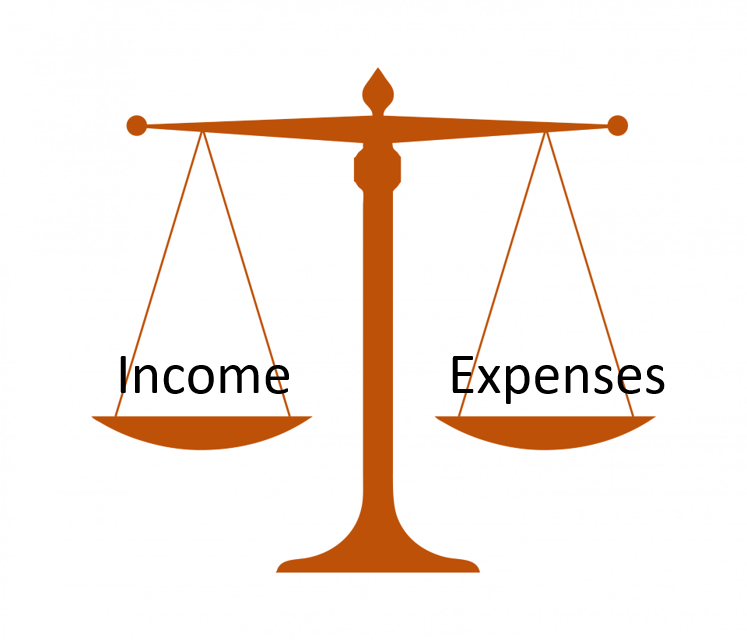
The two most crucial bits to financing is Income vs. Outgoing, so the money that you earn and the money that you spend.
Outgoing
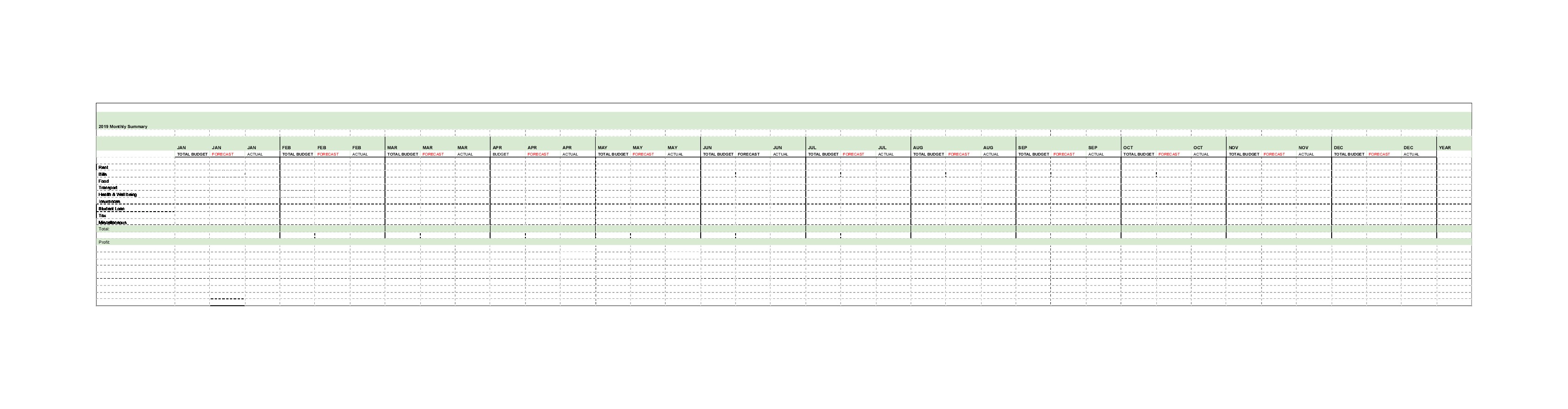
So let’s look at our expenses which are crucial and that we all will have in common: To give you an example of what life in London can cost, here are some numbers.
Rent: £670
Bills: £100
Food:£150-£200
Transport:£180
Health & Wellbeing:£60
Insurances: £50
Miscellaneous: £40
Student loan: £50
= £1,350/month
Total: £16,200/year
So that is over £1k on the basics every month, not including things like going for dinner with your friends, birthday presents, etc.
So we need to earn at the very least £1,350 per month to cover our basic day-to-day living.
Income
So income is the most fun part of working and earning money, right? But it is also important that we spend our income wisely and go through our budget monthly to keep on top of things. So we know our expenses each month, so let’s look at what we can do with our profit if we haven’t been breaking even this month.
Say that we earned ourselves £2,000 this month. After having paid all of our expenses, we’re left with £650.
It would be lovely to think that we can spend that £650 on gear ( My guilty pleasure is synthesizers), but sadly we should probably not do that.
Taxes
If you are a freelancer and have your own company we need to think about taxes and putting money aside for that time of the year where you need to declare your earnings. In the UK at a basic rate, you pay 20% in taxes.
So if we earn £2k a month, that’s £24,000 a year. 20% of 24,000 is 4,800 (24,000 x 0.20). However, in the UK, the first £12,500 are tax-free, so we only need to pay tax on £11,500 (24,000 – 12,500). So 20% of £11,500 is £2,300 a year or £192 a month.
So out of those £650 in profit (after our expenses), we need to set aside £192 for tax which leaves us with £458.
I’d probably put £100 of that into a savings account, and the rest will likely cover some miscellaneous expenses.
If you feel like you cannot handle your finances on your own, it might be worth getting an accountant.
It is important to estimate what you will spend, that is why you forecast. It’s always good to be a bit generous when you forecast to make sure you have some wiggle room. The example above is all a forecast; expenses vary from month to month.
Actual Spend
At the end of the month, you compare your forecasting to your actual spending. Did the numbers add up? Where you spot on or way off? What can you do differently next month? Here we can analyse our forecasting, spendings, and savings.
Yearly Summary
Whether you are a freelancer or working for a company/client, it is always good to do an annual summary. Compare the months, recognize patterns, spot the quiet months, and the busy ones. There is a lot to learn from a year, and planning for the next one gives you a head start.
Miscellaneous
Always account for the miscellaneous bits, there is still something we spend money on that we do not account for. A cab ride here, servicing there, something broke, and you needed to replace it. There are always unforeseen costs that are impossible to avoid, so it is better to give yourself some slack and account for a little bit extra for those times you need it.
Invoices
Stay on top of your invoicing game. Make sure you chase your invoices and keep track of which ones have been paid and which ones are overdue. There is plenty of accounting software on the market that makes invoicing easier, keeps track of which invoices have been paid, and also makes declaring your tax easier.
Editors note: Wave Accounting is similar to Quick Books and free.
The Budget Given by a Client or Company
If you have been given a budget to work with by a company or client, it is crucial that you stick to the budget. No one likes an over-spender, and it can get you into real trouble if you do overspend.
The same way you budget for your personal or freelance finances, you can apply the same method when working with a budget that was given to you.
It is important to meet client expectations, but also to be honest and realistic with what you’ve got. If a client is asking for more than they are willing to pay for you, have to be open and honest about it. Look at different options or see if they are willing to increase their budget. Communication is key.
Money and budgeting can cause a lot of anxiety; it affects us all. But if you set yourself up and tackle it heads on, I can assure you it will be a lot easier to deal with. Set aside a day at the beginning of the month and at the end of the month where you sit down with a cup of coffee or a tea to go over your budget and finances.
If you find yourself in some financial difficulties, please seek advice from accountants and contact your bank. The sooner the better.
We use cookies on our website to give you the most relevant experience by remembering your preferences and repeat visits. By clicking “Accept All”, you consent to the use of ALL the cookies. However, you may visit "Cookie Settings" to provide a controlled consent.
This website uses cookies to improve your experience while you navigate through the website. Out of these, the cookies that are categorized as necessary are stored on your browser as they are essential for the working of basic functionalities of the website. We also use third-party cookies that help us analyze and understand how you use this website. These cookies will be stored in your browser only with your consent. You also have the option to opt-out of these cookies. But opting out of some of these cookies may affect your browsing experience.
Necessary cookies are absolutely essential for the website to function properly. These cookies ensure basic functionalities and security features of the website, anonymously.
Cookie
Duration
Description
cookielawinfo-checkbox-analytics
11 months
This cookie is set by GDPR Cookie Consent plugin. The cookie is used to store the user consent for the cookies in the category "Analytics".
cookielawinfo-checkbox-functional
11 months
The cookie is set by GDPR cookie consent to record the user consent for the cookies in the category "Functional".
cookielawinfo-checkbox-functional
11 months
The cookie is set by GDPR cookie consent to record the user consent for the cookies in the category "Functional".
cookielawinfo-checkbox-necessary
11 months
This cookie is set by GDPR Cookie Consent plugin. The cookies is used to store the user consent for the cookies in the category "Necessary".
cookielawinfo-checkbox-others
11 months
This cookie is set by GDPR Cookie Consent plugin. The cookie is used to store the user consent for the cookies in the category "Other.
cookielawinfo-checkbox-performance
11 months
This cookie is set by GDPR Cookie Consent plugin. The cookie is used to store the user consent for the cookies in the category "Performance".
viewed_cookie_policy
11 months
The cookie is set by the GDPR Cookie Consent plugin and is used to store whether or not user has consented to the use of cookies. It does not store any personal data.
Functional cookies help to perform certain functionalities like sharing the content of the website on social media platforms, collect feedbacks, and other third-party features.
Performance cookies are used to understand and analyze the key performance indexes of the website which helps in delivering a better user experience for the visitors.
Analytical cookies are used to understand how visitors interact with the website. These cookies help provide information on metrics the number of visitors, bounce rate, traffic source, etc.
Advertisement cookies are used to provide visitors with relevant ads and marketing campaigns. These cookies track visitors across websites and collect information to provide customized ads.