Empowering the Next Generation of Women in Audio

Join Us

A Yes Is A No

I just worked an intense month. Financially and professionally, it was the best month I’ve ever had. I worked with an engineer that had won a Grammy for Best Engineered Album, I recorded students on a field trip. I worked in a famous church in San Francisco, I cleaned up after engineers and clients, over and over, and I mentored students in an audio class. Then I worked with a friend and a team of volunteers for two theatrical productions where we unflinchingly shot down a gallery of problems. It was exhilarating, exhausting, eye-opening, and also left me feeling oddly jaded and annoyed.

Today, I listened to some audio art by my friend. In fact, it was the winner of the Judges Award for the Columbia School of Journalism’s 2026 Radio Race. I met my friend through an event that they originated called Audio Potluck, where people just showed up and played an audio piece and everyone listened to it.

That was it. What did you make? I want to hear it. 

Let that echo in your heart. I want to hear you.

Getting started in studio recording has been a wild ride. It’s highly individualistic right now, because the days of big studios with staff engineers are largely over. It’s all about hustling for your own clients and building a reputation, and it’s a kind of life that doesn’t preclude building community, but does hamper it a bit. I tend to thrive as an ensemble player in most scenarios, and although the studio experience has, one day at a time, made me stronger in myself, it has also eroded my focus down to surviving, shields up and striding forward with glowing red laser eyes on the prize.

Listening to audio art felt like dropping into warm water and opening up like a tea flower. Like there was a part of me that had withered until I had forgotten what shape it was, and suddenly my gaze became soft and expansive, and I put out swimming, translucent petals of gratitude for the whole world.

For the first time I wondered: Is what I’m doing worth it?

I said yes to everything when I was first starting out. As a student, I volunteered, interned, and shadowed. Kind people referred jobs to me and I took them, no matter what they were. I worked for an outdoor theater company that performed in a different location almost every time. I worked with an engineer who had a hair-raising temper. I loaded gear, ran up and down streets from stage to stage at community events, wrangled with accounting and budgets, emailed endlessly with bands and organizers. I worked 12-14 hour days for minimum wage, or for nothing, and sometimes paid for the privilege.

All that experience made me grow, as a person and as an engineer. Any thought of quitting ran straight into the brick wall of I can’t imagine doing anything else. I love my life.

Now, I hear my friend’s art and the loveliness of the world stings, like a sleeping limb coming back to life. It comes at a time when I’m already considering my next steps. I’m remembering that I got into this because I want to hear people and I want to hear what people make.

One of the many things that I’ve learned over the past few years is that, every time you say yes to something, you’re saying no to something else. If I say yes to a live sound job, I’m saying no to the possibility of working in the studio that day. If I say yes to a well-paid job that makes me feel bad about myself, I’m saying no to feeling good about myself. If I say yes to that sixth and seventh workday of the week, I’m saying no to walking to the store in the sunshine with a boba, listening to the same birdsong that I used to hear in my mother’s backyard as a child.

It’s been worth it, at times, to say no to those things, because I was also saying yes to challenging my limits. In hindsight, some of those things may not have been worth what I gave up. In all cases, I gained strength and judgement, anyway, and that was the point.

Maybe the right question is: Is how I’m doing this worth it? I am realizing that I always want to say yes to meeting life with an open heart, and I never want to give up the roots, stems, and blossoms of community. I want to say yes to challenges, hard work, and of course, survival, and also to the space in between, where life just breathes.

I’m not sure I’ll be able to have all those things, but hopefully, I should be able to know them when I see them, and with luck, to say yes. I wish the same for you, whatever matters to you.

Honoring The Shape of Your Journey

Last year, at a studio event, I was tasked with monitoring sound in the control room for the overflow audience. The event was being video-recorded by a team of community college students from the media department where I took audio classes, so I knew some of the video team members.

One of them, a young woman who was taking the audio recording class, was talking to me afterwards, looking at the patch bay and telling me how intimidating she found it.

I told her, “The first time I went in to work with the patch bay at school, I almost cried.”

She gasped. “I did cry!” she said.

I’m assisting with a live sound class this semester, and my job is to identify students who need support to succeed. One young woman had taken audio classes at another community college, but those classes didn’t include any hands-on training, and she was feeling out of her depth with signal flow and using a mixer.

I spent some time with her in a separate room with an old analog Allen & Heath mixer, talking about how the different controls corresponded with the outputs, and getting her to turn the pots and move the faders. Even with the mixer completely powered off and disconnected, she still hesitated to touch the controls.

That’s real fear. I completely identified with her, because I have that, too. It’s a feeling that a mistake will lead to annihilation. Combined with whatever upbringing or experiences one might have had, it can take the shape of anxiety or techphobia that shunts a person’s whole system into survival mode and blunts understanding.

Everyone has a story. Trigger alert: this paragraph describes an act of domestic violence. Part of my story is that I grew up in a strict household ruled by adults with war trauma, where I studied to get the grade necessary to avoid punishment, but not to understand the material. I was discouraged from trying new things or taking risks. As a teen, I dated an abuser my age who brainwashed me in classic style, in one instance telling me to do a math problem he knew I didn’t know how to do, and then slapping my face and screaming about how stupid I was. Decades later, I know he was lying, but my nerves still remember.

It took me most of my life so far to navigate the fallout from that experience. Now that I’m moving forward with an audio career and have the lens of my past to look through, I’ve identified, viscerally, times that the culture of audio engineering has pushed me back. Often, everyone in the room is well-meaning (though perhaps a bit oblivious). For instance, an overzealous engineer once attempted to frame me as a rising star and gave me my first ever session at that studio (and my second session ever) but didn’t give me the information I needed to prepare. It wasn’t a paying client, but a young band that one of the studio owners knew. At one point, the studio owner, his wife, his daughter, the band, and a team of high school videographers were all in the control room watching me set up the session. The engineer came in and asked if I’d measured the position of the overheads (which I knew to do, but had gotten overwhelmed and had forgotten), and if I’d patched in any hardware processing (I hadn’t). He gave me a look and pushed me aside, undoing what I’d done and setting up the session the way he’d do it.

When I thought about this session afterwards, I could see all the ways it could have been a great opportunity for someone else, but was ill-suited for me. It helped me identify the things I needed in order to gain productive experience: time to prepare, less pressure, and fewer observers. I needed the freedom to make mistakes, and I needed to replace, not relive, lessons learned from belittling experiences.

I realized that, if I was ever going to become a recording engineer, I would need to take control of the circumstances under which I worked. I needed to be honest with myself about how I reacted to certain situations, to analyze those reactions without judgement, and to choose the most effective path forward. Most importantly, I had to let go of the opinions and expectations of others. I can’t go around explaining my whole self to everyone, so they are just going to have to learn to deal with me without knowing.

Sometimes the people in the room are other gender minorities caught in their own form of survival mode. This is possibly the trickiest situation to navigate. I’ve been in “women in audio” groups that stress beating men at their game. This involves maintaining a flawless mask of competency and holding oneself to an impossible standard of professional and emotional perfection in order to force a powerful majority (men) to acknowledge the abilities of gender minorities. But playing the game under these terms is playing a power-imbalanced game, and those in power still declare the winners and losers, even if they themselves are flawed. It also leaves behind questions of race and marginalized identity. It’s ultimately an outdated game with skewed and arbitrary rules that a person could die trying to win.

What happened to me wasn’t my fault, but that’s not the point. There’s no reason to be ashamed of a weakness. We are entitled to our imperfections. We are human beings, and it takes human beings to make art. We can turn to computers for flawlessness, and they will always do “perfect” better than we can. Every deeply flawed moment of our lives is our art. What a pity, to be ashamed of being alive.

In the classroom, packing up the old Allen & Heath mixer, I told the student how I bonded with someone about crying in front of the patch bay. “I’ve had people teaching me, where I’m so anxious that I can’t understand, and then they look at me like, ‘What, are you stupid?’” I’m not sure if I was speaking to her or to myself at this point; it was a little of both. “I know I’m not stupid. This is just hard. And if you learn slow, so what? Take the time, make yourself comfortable. Honor the shape of your journey, I’m serious. Because I think you can do it.”

The Coffee Chat

Last summer, a student asked my former audio instructor for references for “coffee chats with audio engineers to discuss how they achieved their success and the advice they have for up-and-coming audio engineers and producers.” My instructor referred her to me. When I got the email, I laughed out loud. I’m lucky enough to be an intern at two world-class studios, but that’s all I am – an intern. At the time, I felt I could use a coffee chat myself for advice to get into the recording part of the studio experience.

“I’m not sure how much help I can be to you, as I’ve been feeling a bit at a crossroads, myself,” I  wrote back. “I know it looks like I have some cool jobs, and I kind of do, but it would be cooler if they paid a living wage!  But I am totally down to tell you what I’ve seen so far in my journey.”

We met up at Hyde Street Studios in San Francisco and the conversation really helped clarify things for me and gifted me the acquaintance of a smart, funny, motivated, Black woman who works with me to this day. I don’t remember her exact questions, but I thought I’d put down some of the things we talked about.

I had met her before at an event called Bay Area Audio Nerds, which is an informal meetup of audio engineers that sometimes takes place at local studios. 2200 Studios, formerly known as The Record Plant Sausalito, was hosting, and I was there as one of the studio interns. “When I saw you walk into the control room,” she said at our meeting, “I thought, ‘oh, thank goodness.’”

Now, I’m Chinese-American; both my parents immigrated from China in the 1950s. But how bad does racial disparity in an industry have to be to be that a Black woman sees me and says, “Oh, thank goodness?” There are essays that can be written about the differences in racism against different demographics, and this is not one of them. I’ll just say that I felt uncomfortable in the unspoken proximity to any comparison between Black and Asian experiences in the US, but glad if I could be of any help.

“I’m not an engineer yet,” I told her. “All I can tell you is what I’ve seen.”

“Well, from what you’ve seen,” she said, “What is the path to becoming a recording engineer?”

As far as I’ve seen, there is no path. You make your own path. And that’s both freeing and confusing for people who come right out of the structure of educational institutions or hierarchical jobs. There’s no showing up for work every day and doing a good job and getting promoted. Nobody makes you an engineer, you have to make yourself an engineer.

The important thing is access, and that’s what an internship gives you. You can’t learn to use gear if you have no gear. You can’t learn to run a recording session by imagining it; you have to do it. There are so many moving parts, the musicians, the instruments, the microphone choice and placement, the routing. Troubleshooting noise, line of sight, isolation, software glitches, pivoting with sudden changes of plan. It’s lunchtime, is everyone going to take a break, or will they get really hangry? In the middle of the orchestrated chaos, you’re also responsible for the vibe. You have to be everywhere but not in the way.  It’s amazing any music ever comes out the other end, but it does, and it’s glorious, a miracle.

I’m filled with gratitude every day that I get to swim in that soup. And that’s important, too, because you have to love it to do it. Even for engineers that have been recording for decades, there are months when clients don’t call, when they start thinking that they need to find another job. A lot of recording engineers do have other jobs: stagehand, live sound, corporate A/V tech. The pay is not great, the hours are long and inconsistent, schedules change at a moment’s notice. “I can only be friends with other people in audio,” another friend once joked. “Nobody else understands why I have to cancel plans all the time.”

Most internships will have some kind of arrangement that allows the interns to access the studios. It’s usually some kind of work trade agreement, or maybe a discounted house rate. This is where you make yourself an engineer. Book a session, just with some friends jamming, and try recording them. Fail. Kick yourself. Tear your hair and curse. I told an engineer about my first attempt at recording, saying, “It didn’t go perfectly, but lessons were learned.”

He laughed. “You just gotta throw yourself on the fire, “ he said.

After a few sessions with friends, I approached a local band I liked and asked if they’d want to have a free session with a novice engineer, and they said yes. I hadn’t seen the full band, because they played with various configurations of bandmates and even as a duo sometimes, and it turned out to be a six-piece band, including fiddle and pedal steel guitar. They invited a seventh, a professional Americana guitarist and vocalist who had been signed to a label. To say that I was nervous doesn’t even come close. I was sick with apprehension.

Did it go perfectly? No. Did they have a good time and leave happy? Yes. It was a 15-hour day for me, no breaks. There were things I realized afterwards that I didn’t do or that I should have done differently. But two engineers listened to the rough mix and both commented, “This was well recorded.”

Totally worth it.

Squeakie, with guest musician Mya Byrne.


I hate making mistakes. It feels really dark, like I’ve broken some kind of moral rule. But I can honestly say that every mistake has turned into a skill, because there comes a time when I don’t make that mistake anymore. So don’t let the fear of mistakes keep you from trying things. Spoiler alert: you will make mistakes. They are the seeds of who you will become.

As we were wrapping up our coffee chat, the student said to me, “What advice do you have for a woman of color trying to get into this industry?”

Maybe here it turned out to be a good thing that I had been having a bit of an existential career crisis, because I’d been feeling like I should give up, and had given my situation a lot of thought. There’s both camaraderie and competition among recording engineers, and being an intern can feel a little bit Lord of the Flies at times.

“Two things,” I said. “Remember why you got into this. If you love recording, do it for the love. I got into this because I wanted to help people be heard that don’t always have access to or feel comfortable in a recording studio. I want to record those people so they can get their voices out there. I don’t need to be the best, or the top, or win any awards, so I can’t waste my energy thinking about that.

“The second thing is something that someone in an online group told me, when I had to go in and have a difficult meeting with HR at my old job. They said, ‘Go in clear on who you are.’ People are always going to try and tell you who you are, and act like they know who you are better than you do. You’re the one that knows. You’re you. You’re the only one who knows.

“Remember why you’re doing it, and go in clear on who you are. Take those two things and hold them in front of you and then just move forward.” I laughed, holding my hands in front of me in a wedge shape. “Like a ship parting the waves.”

As I walked to the station afterwards, I felt lighter and clearer, myself, on who I am and why I’m doing what I do; I felt those two things in front of me, ready to part the waves. So one more piece of advice: don’t be afraid to talk to people and ask them questions. Who knows, you might be helping them figure things out.

We Need To Talk About Tech

Let’s talk about one of the most important weeks in a theatre worker’s schedule

Tech Week

This period of time has also been nicknamed Hell Week, which is one of the first things I discovered on my arrival into the drama school world. Doesn’t sound promising, does it? In fact, a quick look at the Wikipedia entry for ‘Technical week’ reveals this information, and there’s also a ‘Controversy’ section which tells you the following:

“…the common daily schedule during this week is the ‘10 out of 12’ schedule, in which the members of the production will be actively working for ten hours out of the twelve hour shifts.”

The sources cited here are referring to theatre in the United States, but it’s also a problem in the UK. As has been pointed out elsewhere, these are long enough days for actors, but designers and technicians are almost always expected to stay even later into the night. And, as I have learnt over the past year, this isn’t just the case in professional theatre. Students are also putting in extremely long shifts.

There have been times where I’ve arrived home 18 hours after leaving, had just enough time for a quick shower before going straight to bed, then up again after five or six hours of sleep to do it all over again. I’ve seen people wolf down snacks while operating a desk rather than take an hour-long lunch break because things were deemed to be running behind. I’ve been in situations where stomachs are rumbling and energy levels are low, only for “let’s power through” to be the message. I’ve also found that, during tech, it becomes almost impossible to cook proper meals due to lack of time and resources. If it can’t be reheated in a microwave, it’s not an option, and you might even find yourself living on takeaways for a week or two (which isn’t ideal health-wise).

This kind of relentless schedule obviously isn’t good for anyone. I’ve recently seen some articles pop up in theatre publications about the impact on parents and carers, which is clearly a really important issue, but these discussions seem to be centred on performers, directors and producers rather than including technicians. And I’ve seen almost nothing about disabled or neurodivergent backstage workers. There seems to be a general reluctance to acknowledge the presence of techs with disabilities, while at the same time talking about the importance of a diverse workforce. But if we really want to make sure everyone feels welcome in theatre, we have to start practicing what we preach, and taking care of the issues surrounding tech would be an excellent place to start.

I will be completely honest. As an autistic sound technician, I have felt isolated, frustrated and let down on quite a few occasions. I have felt like my needs are not accommodated, and worse, that they don’t matter. People might say, “That’s just what tech is like: deal with it.” And people have said that. They might think changing their minds at the last minute about what time we can all leave the building isn’t a big deal. But to someone like me, who has carefully structured their entire daily routine and meal choices around the information they’ve been given, it is a very big deal and can lead to dysregulation. When such things are happening over a sustained period of time, they can even lead to burnout (and did for me, after one particular show).

Boundaries are a big issue for a lot of us, and it can be incredibly challenging to speak up and say you don’t feel comfortable with something, especially when you’re new in the industry or feel like there’s no one who will back you up. In an industry where freelancing is the norm, it’s unfortunately all too common for people to be afraid of “rocking the boat” because they may lose out on work. The attitude is: “Well, if you won’t do it, then we’ll find someone who will.” But we will only be able to move away from such attitudes if more and more people speak out against them.

If there’s one phrase I’ve become tired of hearing, it’s: “That’s just the way things are done.” And more often than not, it’s been said about tech (often accompanied with a smile when bandying around terms like ‘Hell Week’). But it really doesn’t have to be that way. Hard work and productivity doesn’t — and shouldn’t — have to come at a cost to our physical and mental health.

Save Early, Save Often

If you’ve been reading my blogs for a while, you’ve probably noticed that a lot of them don’t directly relate to sound. That’s because sound is actually such a small part of what we do on a day to day basis. Being an incredible mixer is all well and good, but if you crumble under pressure or can’t show up on time, you won’t work for long. If you’re an A2 or monitor engineer and you can’t communicate with people, you won’t even know what people need so you can effectively do your job.

Today I’m going to wander well off the sound waves into what I consider one of the most all encompassing topics for dealing with life: Money.

Now, I’ve been writing blogs for five years at this point. I can’t tell you how many drafts of this very topic I’ve written and hated. Money is such a taboo topic that we probably know more about our best friend’s sex life than we do about their bank account, so it hasn’t been easy trying to find the best way to talk about it. However, I’ve never been known for my subtlety, so we’re just going to dive in head first.

Money is important. We can go through all the overused sayings that money can’t buy happiness and that it isn’t everything, but the fact remains that money is a major factor in our lives. Having a savings account with a few months of expenses tucked away can make all the difference when emergencies or life changes come your way.

We all have different relationships with money. Part of it is nurture: the environment we grew up in and how we saw our parents handle money, but just as important is nature: who we are and what we value in our lives. My parents taught my sister and me similar things about money, but we have different priorities and habits that have developed because we’re different people with different life experiences in different careers.

This blog won’t have all the answers for every situation, but what I really want it to do is put financial literacy on your radar and maybe show what it can do for you, given time. That way you can start to figure out how you personally relate to money and what your priorities are.

Because time is your greatest asset. Even if you start small it can make a huge difference.

So, money is important, we get that. Where do we start?

First, start to pay attention to your money. Do you know roughly how much you make in a year? Do you know how much you spend? That’s the basis of all personal finance. You don’t have to go full forensic accountant on your life, but check your bank and credit card statements and start to see what your big picture is.

Personally, I don’t have a strict budget of “I can spend $X on groceries, $Y on clothing, and $Z on social activities,” but I do track my expenses, so I know roughly what I spend in a month or over a year. I use Quicken (any similar personal finance software will do a similar thing) which imports my transaction, lets me put them into categories, and I can generate a report if I want to check on things. You can also just use a spreadsheet: it can be a basic accounting tool, or you can go nuts with formulas and formatting if you really want to go in-depth and customize.

Once you’ve taken a look at that, you’ve found your baseline and rough expectations. Do you have extra money some months that you might be able to start saving? Does your income vary wildly each month so you need to put some into savings for your slow season? (Welcome to being a freelancer. By nature of our schedules, we have to be more financially aware than our 9 to 5 counterparts.)

Did you learn that you’ve been spending more than you make and your credit cards have made up the difference? Or that you’re making just enough and working paycheck to paycheck, but if anything out of the ordinary happens you’re operating on a razor thin margin?

If you’ve hit this point and you’re looking at things thinking, “oh shit!” take a moment and breathe. It’s okay. That feeling just means you have a goal to work towards.

Now that you know where you are, it’s time to look at where you want to be. Ideally you want to have minimal debt and be making more than you spend so you’re able to save. This process looks different for everyone, and Paula Pant, who runs the site Afford Anything, covers it more completely than I can in her post about “Growing the Gap.”

TLDR: you can try to grow your income (asking for a raise, monetizing a side hustle, investing, etc) while keeping your spending the same, or decreasing your spending while you income stays consistent. Doing either of those create a “gap” between what you make and what you spend, so you’re able to put that into paying off debt, savings, or eventually investing.

Once you can start saving, your money will start to work for you. Which is a concept that’s difficult to really understand until you’ve seen it in action. You may have heard the term “compounding interest” bandied about like some magic phrase, but what does that actually look like?

It means a savings account will pay you interest, and that interest will keep adding up.

It means a business can make a profit, which you can put back into it to make it bigger and more productive.

It means a stock might pay you a dividend which can be reinvested, adding more shares to your portfolio.

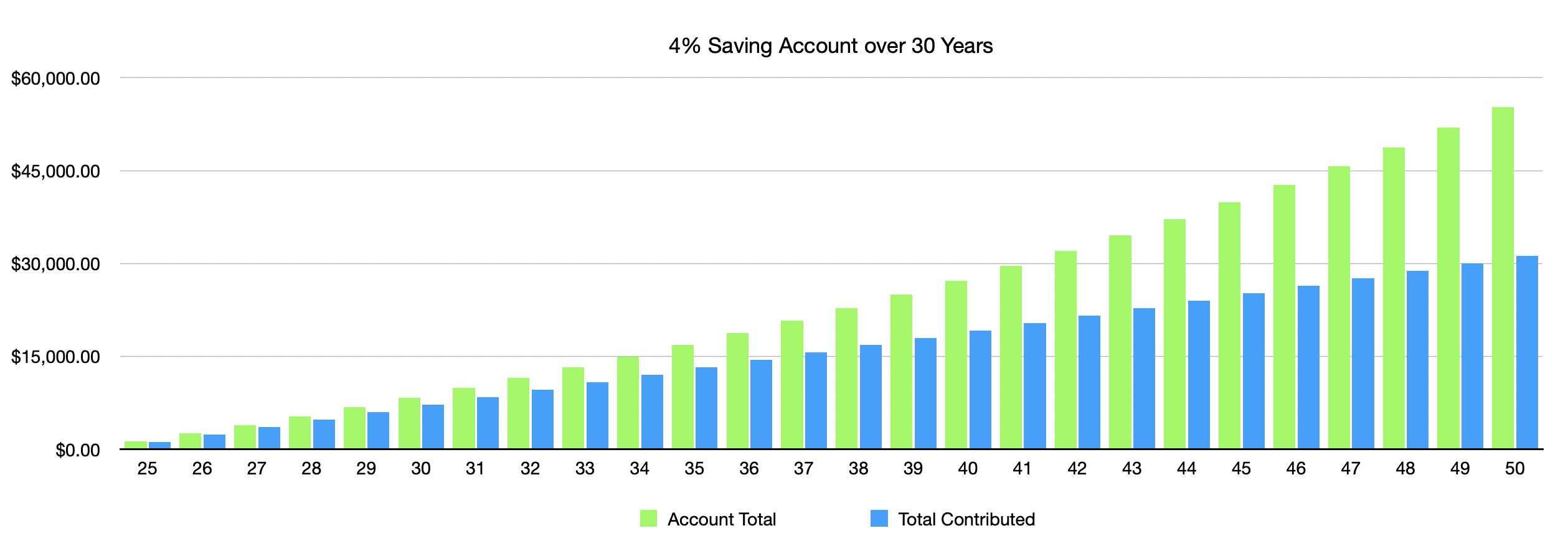
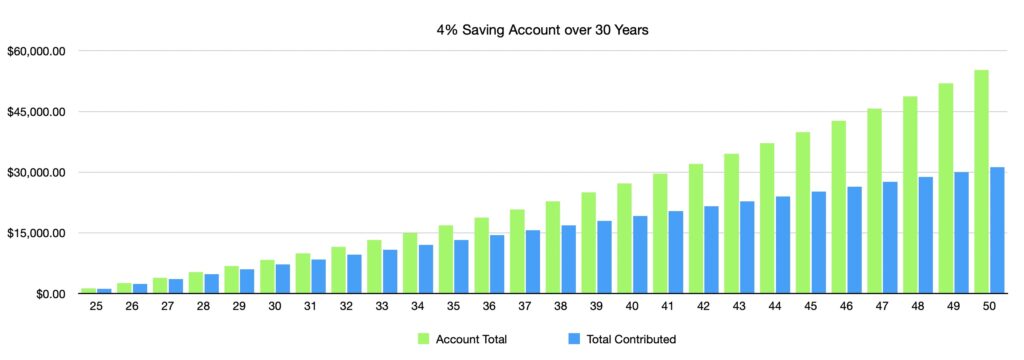
Let’s look at an example savings account. A high-yield one might pay 4% interest per year:

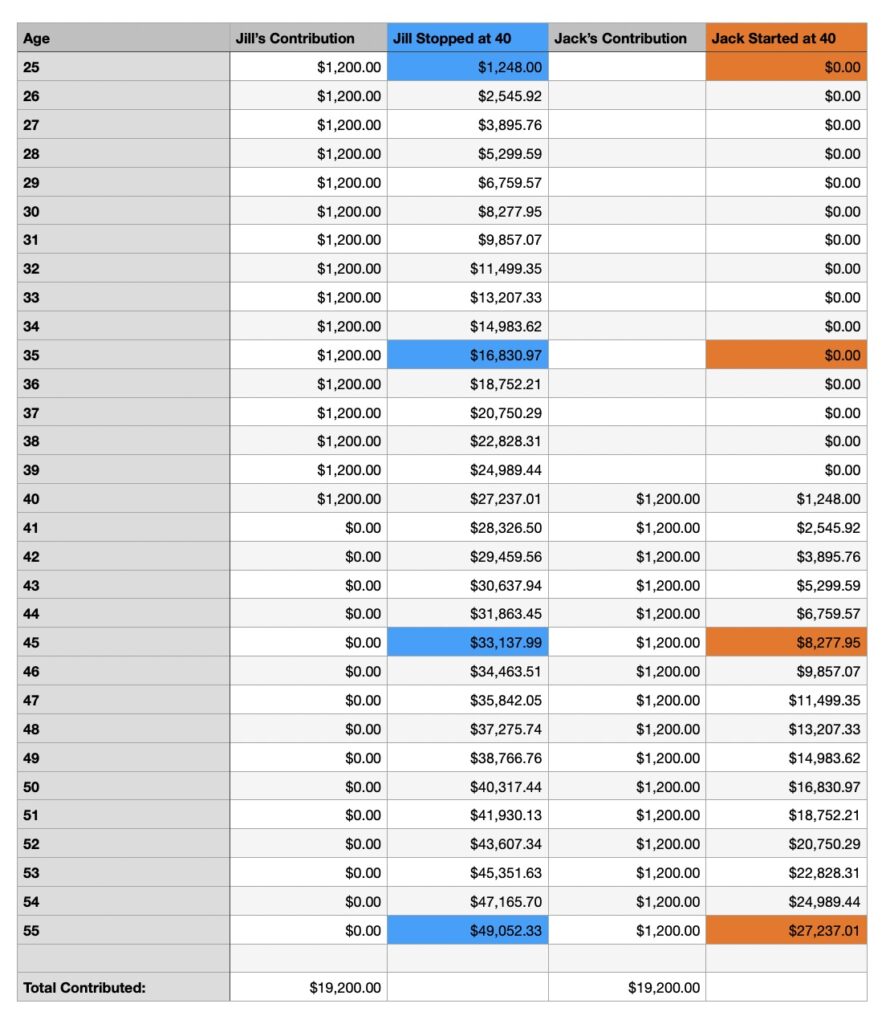
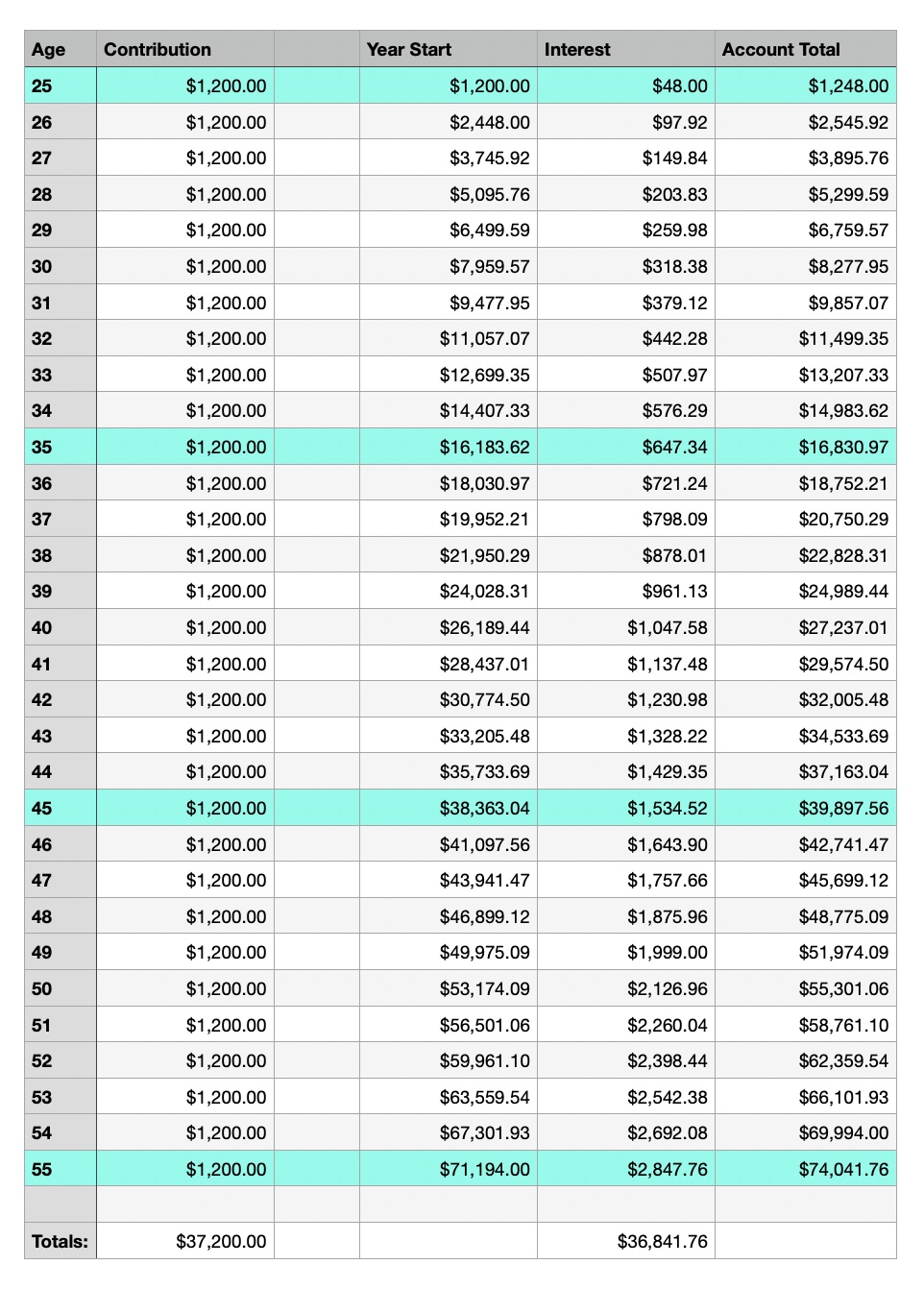
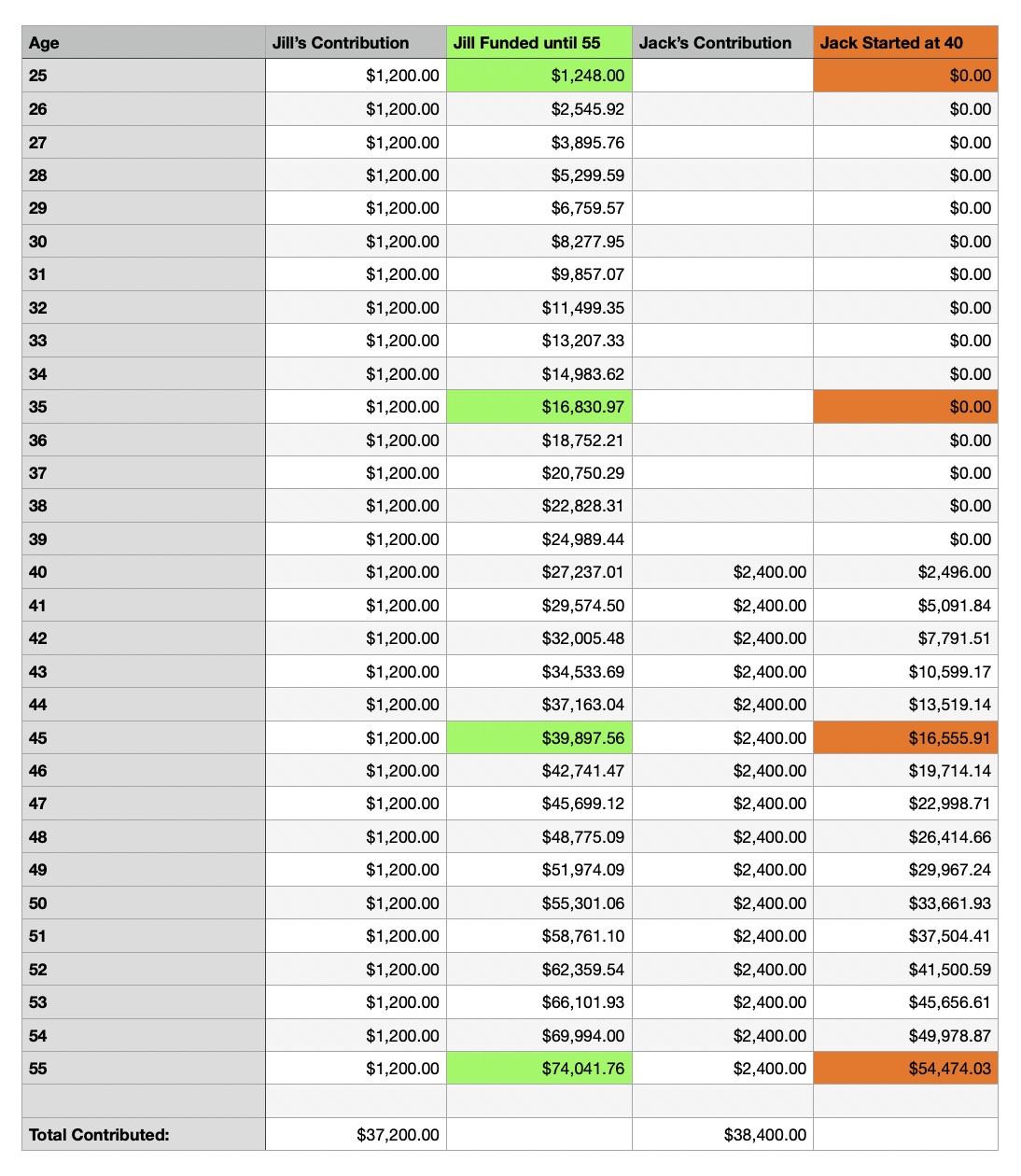
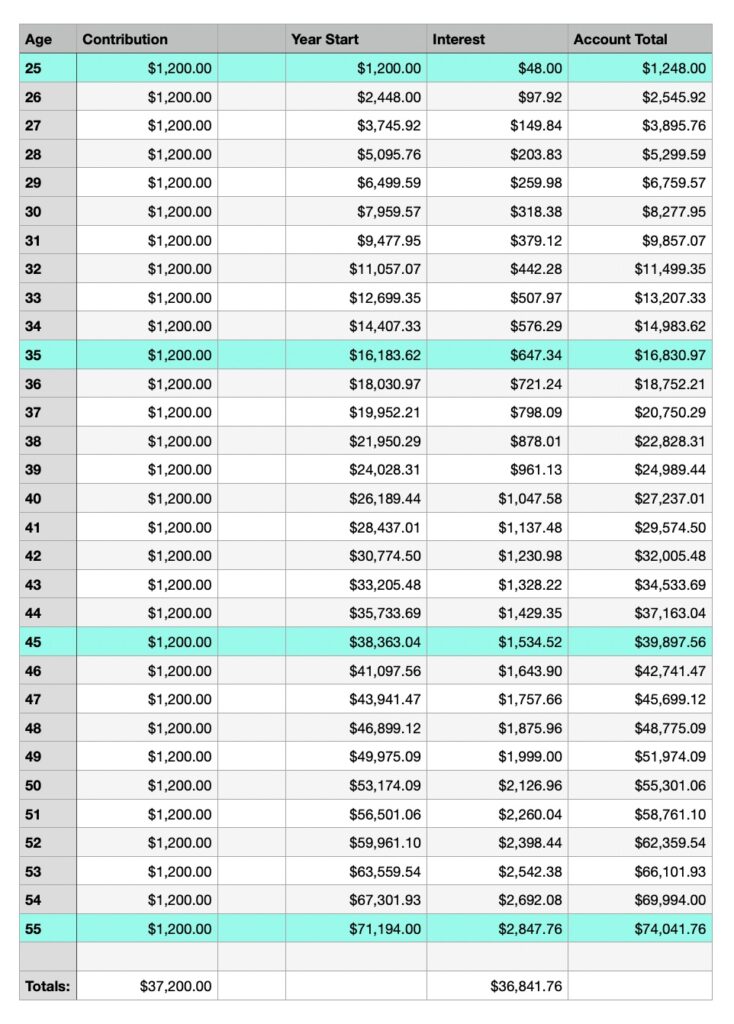
At 25 years old, you put in $100 a month. At 55 years old, you would have put in $37,000 ($1,200 per year for 30 years), but the account balance would actually be $74,000. It’s double what you put in it, but where did the other $37,000 come from?

The interest.

So the first year you put in $1,200. The interest on that was $48.

Total of $1,248.

The next year you add $1,200, now the balance is $2,448, and interest on that is $97.

Total: $2,545.

Next year is another $1,200, the balance is $3,745, and interest on that is $149.

Total: $3,895.
Screenshot


And so it continues with the interest getting just a little bit bigger year after year.

At 35 you’ve put in $13,000 and the account would be $16,000.

At 45 you’ve put in $25,000 and the account would be almost $40,000.
Time is the magic ingredient in a lot of financial success. If you give it some training (invest it, put it in savings, start a business, etc), soon it’ll start working all on its own.

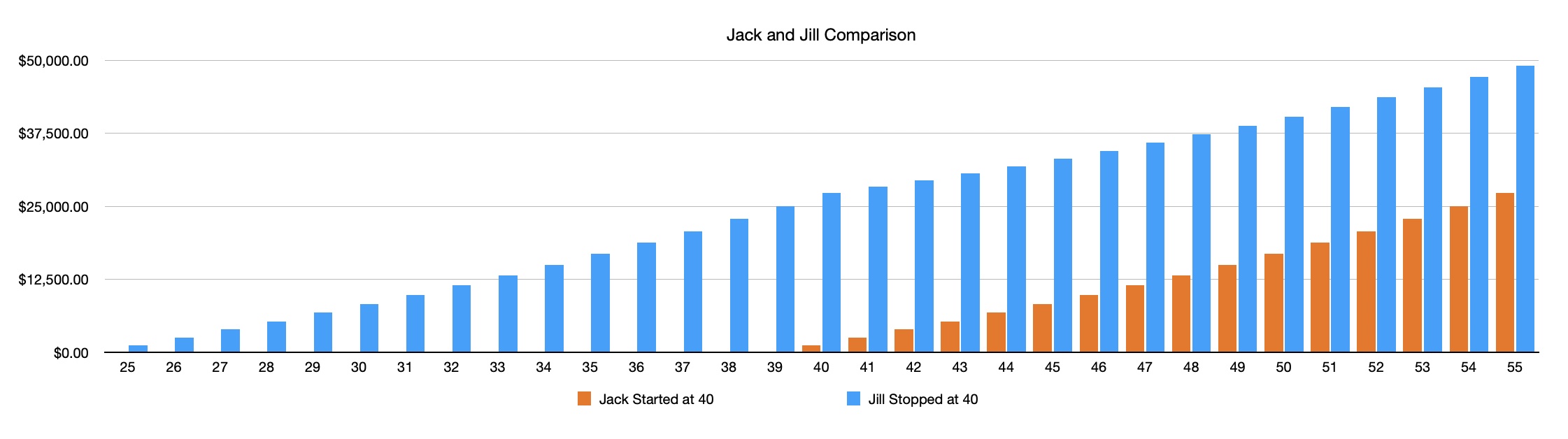
One of the favorite financial tools to illustrate the benefit of compounding interest is called the “Jack and Jill” comparison. It looks at Jill, someone who started saving/investing at the beginning of her career, and Jack, who decided to wait a few years.

Let’s look at this in a couple different scenarios:

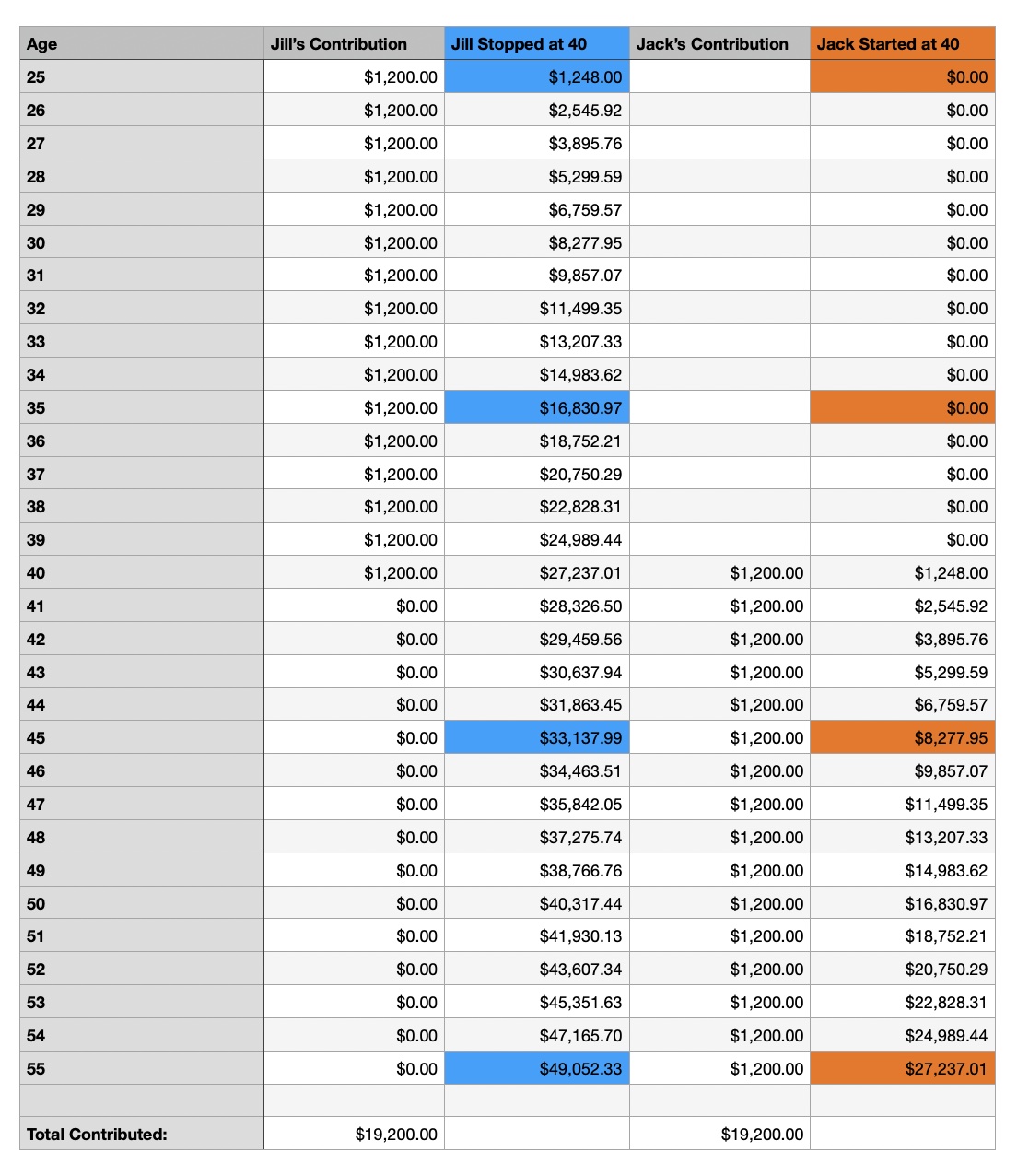
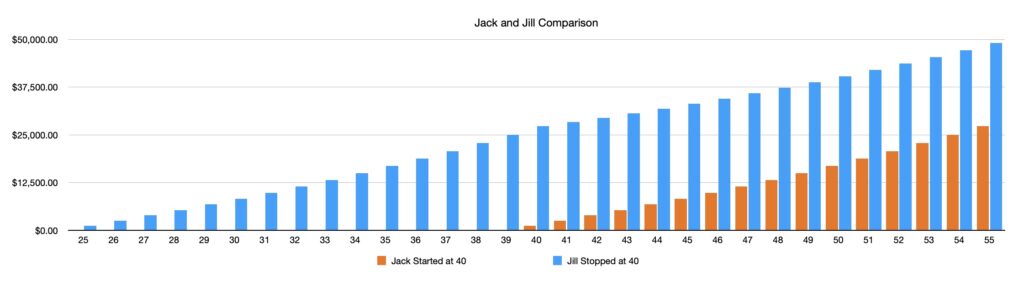
First: Jill starts investing $1,200 per year when she’s 25, stops when she’s 40, and just lets the account grow on its own from there.

Jack starts investing $1,200 per year at 40, until he’s 55.
Screenshot

Both contributed the same amount: $19,200. But when they’re both 55 Jill’s account is almost $50,000, while Jack’s is only $27,000. Those extra 15 years of interest make a $23,000 difference for Jill.

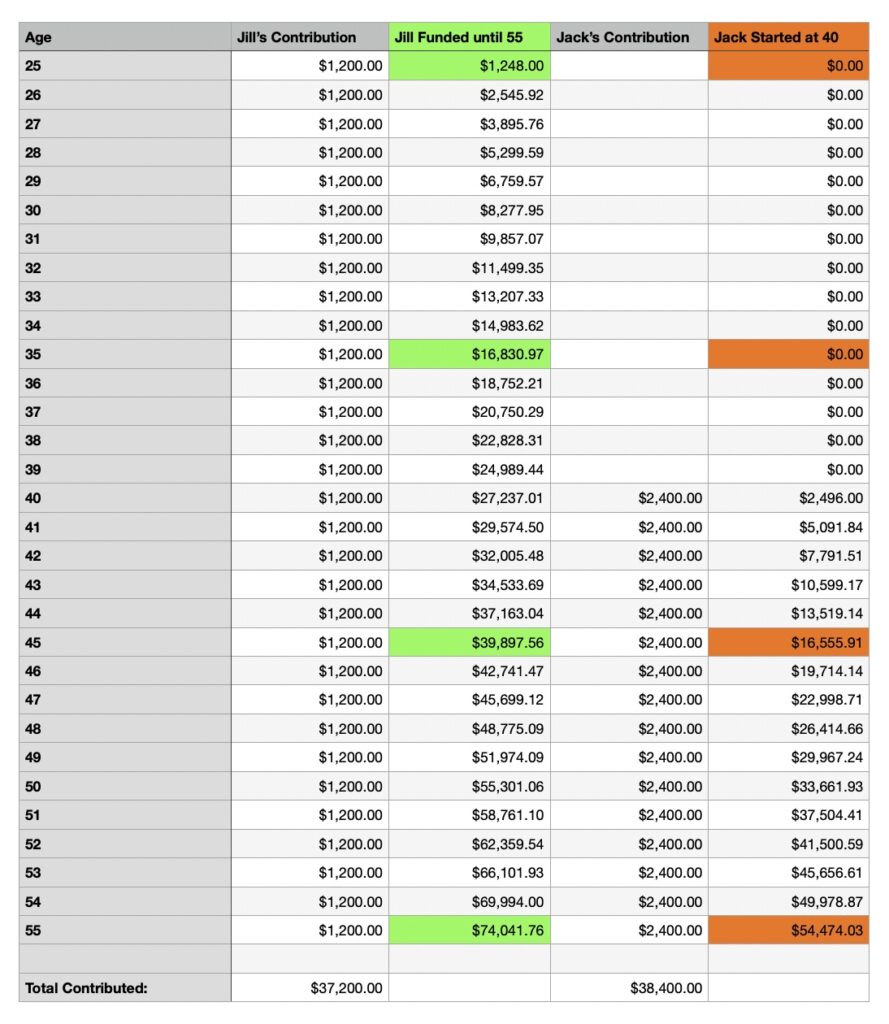
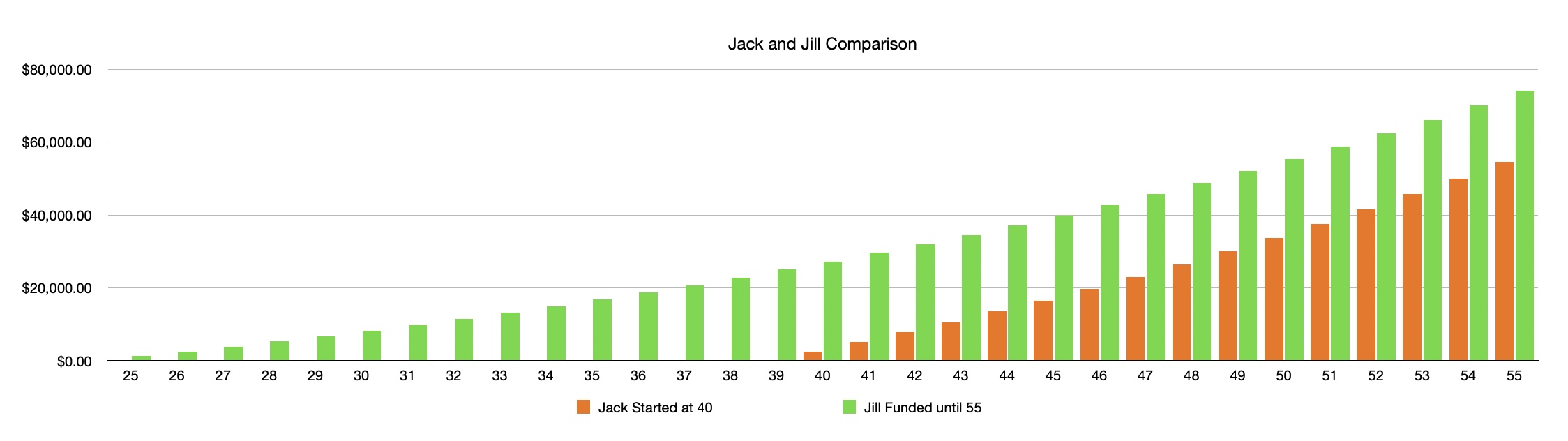
In another situation, Jill starts investing $1,200 per year when she’s 25 and keeps going until she’s 55.

Jack starts investing at 40, but he puts in $2,400 per year so he can catch up.

Jack actually ends up contributing at little bit more than Jill: his $38,400 to her $37,200.

Her account is still ends up being $20,000 more than his: hers is $74,000 to his $54,000.
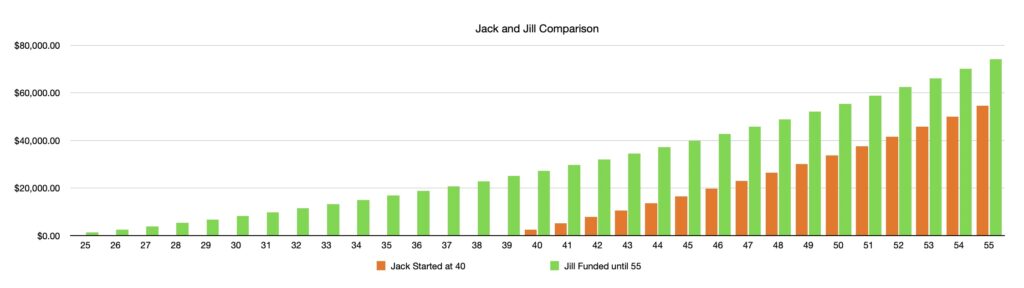
The moral of the story? Start early. Time is your friend, not only in compounding interest, but the sooner you start paying attention to your money, the more you learn and the better you get at managing it.

There’s a proverb that says “The best time to plant a tree was 20 years ago. The second best time is now.” Since most of the readers of this blog are fairly early in your careers, my hope is that in 20 years you can look back at this “tree” and be happy you planted it when you did.

Hypothetical scenarios are all well and good, but how do you start digging?

If you’re just starting out and all this feels completely overwhelming, take a look at Dave Ramsey’s Baby Steps. He’s built an empire around financial literacy, but I recommend you treat it as a good place to get your bearings, but not the gospel truth. Steps 1-3 are a good place to start and once those make sense, look around at other philosophies (like the ones below). I don’t agree with everything he recommends (doing away with credit cards and investing in mutual funds being the main points of contention), but his method can be a helpful resource to get yourself started.

For anyone who feels financially stable but doesn’t know the first thing about investing, take a look at JL Collin’s blog. He does a good job of talking about the stock market in accessible terms and is a proponent of simple, set-it-and-forget-it investing. (He also has a book that I highly recommend.) Paula Pant, who I mentioned early, is at Afford Anything, and offers another take on managing your money as well as talking about investing in property and other business instead of stocks.

If you want to do a really deep dive, Google the “FIRE movement” or “Financial Independence” and jump down that rabbit hole. (If you get easily overwhelmed, maybe save this for later. There’s a whole world of information out there, so it can be easy to feel like you just started drinking out of a firehose, but that also means there are plenty of resources to help you.)

I’m not a financial expert, but here’s my own two cents:

First, figure out where you stand. What do you have? What do you owe? Just knowing that can put you miles ahead of the crowd.

Second, open a savings account somewhere familiar (If you don’t have a checking account yet, open that first.) A “high-yield” savings account should give you 3-4% interest, so look for that. You might use the bank where you have your checking account or even the same company as your credit card. Starting somewhere you already know will make it easier to take that step, and if you want to switch banks later, you absolutely can.

Next, open an IRA. These are retirement accounts that you put your own money into and get tax benefits when you fund them. My general rule of thumb is: if you make less than $150,000 in a year, open a ROTH IRA. If you make more, open a Traditional IRA. If you’d like to learn more about those, there’s a good explanation here at DowJanes.com.

After that, use some of the links I’ve included to start looking at ways to increase your net worth. Whether that’s paying off debt, putting money into your savings account, or opening a brokerage account for investments, you’re working towards that goal.

As you’re setting financial goals, take a moment to think about what’s important to you. Imagine what your life looks like if you’ve got $100 in savings, or $1,000, or even $10,000.

Does that mean you won’t have to panic when your show closes with two weeks notice (or less) because you know you have enough to pay your bills for a few months while you look for another job?

It might look like taking on a passion project that you want to develop and love working on, even if it doesn’t pay much right now, and might grow into something later.

It could be realizing you’re in a toxic work environment and knowing you don’t have to stay in an unhealthy cycle while you look for another job.

It’s having a retirement account that’s accumulating quietly off to the side as political pundits debate if Social Security will still exist in 40 years.

Personally, having savings means I have freedom and my priorities are about making time for my family and my friends.

When I moved to the city, I made the decision to pay for an apartment that was bigger than I’d need just for myself, because it meant I had room for people to stay with me when they came to visit.

I could afford a vacation to meet my parents in London as they make the most of their retirement.

I can take time off to go visit old tour buddies in DC, Vegas, and Chicago or help my friend with her Christmas show in Pittsburgh.

The goal is to get to play as hard as I work. Sure, last year I didn’t have any vacation time from January to June because we were getting Outsiders up and running and then immediately went into Tony voting season. I didn’t mind it because I knew the expectations of the schedule and I like my job. (And that’s why I have the apartment. When I can’t get away, my friends are welcome to come to me.)

But that meant when we had subs trained, I made a point to follow through with plans and take time off to see people.

Recently, having that savings cushion (the FIRE community calls it “F-You Money,” which I do quite enjoy) meant that I made the decision to leave Outsiders this summer without a lot of extra worry. For some people, a hit show that’s going to run for at least a few years brings security and they’ll stick around for a while.

Honestly, I’m ready for the next challenge, and I planned ahead and talked to Cody (my designer) and made a plan. Part of that is getting the Outsiders tour set up. I’ve missed touring, so even just getting to go through tech and then handing it off to the crew will be a fun way to dip my toes back into that life.

Past that, there isn’t much of a plan. I’ll switch to being the sub on Outsiders and return as a sub for SIX (ah, that freelancing life!), and I’m looking forward to the change. I know I have the resources set aside so a couple months of light work isn’t a death sentence or anxiety inducing.

None of this would have been possible if I hadn’t started saving and investing while I was on the road.

And that’s what money gives you: freedom. It may not buy happiness, but it certainly does buy options. Everyone’s goals will look different, but do you and your future self a favor: get started on saving because there’s no better time than now.
New Beginnings – Changing Audio Disciplines

Audio is a beautiful medium. There are so many things you can do within it, so many different paths your career can take. Sometimes, even if your passion for audio is as strong as it always has been, you can become disillusioned with your chosen discipline. This is what happened to me over the last couple of years.

If you’ve read any of my previous blogs for SoundGirls, you’ll have noticed that my discipline has been radio and podcast production. To recap, I spent several years working in broadcasting after obtaining my Master’s degree in Radio Production, and after going freelance during the pandemic, I started producing and editing podcasts. I also made a couple of radio documentaries which were both shortlisted in their respective categories at the New York Festivals Radio Awards (in 2021 and 2024).

“Sounds glamorous!” I can’t tell you how often people have said that to me on learning what it is I do (or have done). Everything I’ve made and every project I’ve worked on has been the result of hard work and dedication. But there’s a whole other side that most people haven’t seen, like the financial struggles and uncertainty that come with freelancing, the constant competing for jobs and fighting for acceptable rates of pay, and the long list of rejected funding applications and project proposals. Nobody ever said this industry would be easy, and plenty of people manage to stick it out despite wondering: “Why did I ever want to do this?” But others can’t, and I was one of them.

Don’t get me wrong, I loved a lot of it. I’ve always seen myself as a storyteller and I don’t for a moment regret any of the ideas I had that came to fruition. But the time came when I started to think there had to be more out there for me to do. For example, I really missed that live sound environment. Even though it still took place in a studio, one of my favourite things to do had always been to get my hands on the faders of a mixing console. That’s where I originally saw my career in radio going, but it didn’t quite end up that way (though not for lack of trying).

At some point I started to think more about branching out into theatre and live events. It’s ironic that this happened during a time when the entire industry was shut down due to a global pandemic, with little idea of when (or if) things would be the same again. But I made a promise to myself to explore the idea further when the picture was clearer.

Sure enough, Guildhall School of Music & Drama in London advertised an intensive three-day short course in theatre sound engineering in summer 2023, intended as an introduction to the different roles within a theatre sound department and a chance to learn some of the basics. I went, and loved it. I learned about mic fitting and a little bit of Dante networking and got to practise using a Yamaha console. I was also so excited by the drama school environment and decided to look into it some more.

That’s when I realised how expensive most drama schools can be, especially if you’ve already gained higher education qualifications as I had. It was also tough to find courses that focused completely on sound (rather than technical theatre generally) and wouldn’t mean investing another three years of my life in education. I put the idea on the back-burner for a while. In January 2024, I was lucky to get the chance to shadow the sound department on The Rocky Horror Show when it came to Dublin on tour. I had an amazing few days, and afterwards I asked several members of the team for advice on getting a foot in the door. They all recommended trying to find depping work. I contacted every theatre and venue I could think of, with no luck at all. Unfortunately the industry in Ireland is incredibly small so I knew I’d have to find a way to move back to the UK if I wanted to stand a real chance.

That’s when I stumbled upon a brand new, year-long professional diploma starting in September at the Bristol Institute of Performing Arts. While not a sound course per se, it was one of three pathways available along with lighting design and stage management. All you had to do was select your preferred pathway during the application process. It was also much more affordable than the other educational options I’d come across, and could give me the hands-on experience I needed in one year rather than three. I applied, interviewed and was accepted.

And now here I am, living in the beautiful historic city of Bath in south-west England, commuting the short distance to Bristol by train and immersing myself in an area of sound that is new to me, yet allows me to draw on the fundamentals I’m already well acquainted with (signal flow, for example, or — when it comes to sound design — working with DAWs). I’ve already designed and mixed one show and am about to start on another; all of which I’ll be blogging about my experiences of as the year goes on.

Some people have questioned why I felt the need to undertake a course like this when I “already know everything about sound”. First things first, nobody knows everything about sound. There are just too many different disciplines within it and no one can master all of them (even one is enough for most). And it’s not just about sound; I’m learning about how theatre works as a whole, how different departments work together, how technicians and performers communicate with each other and what it takes to bring a show to life. Beyond that, I’m making contacts I would not have had the chance to otherwise. I’m also learning more about myself in the process; discovering strengths I didn’t know I had and encountering new challenges.

Would I call it a career change? Yes and no. I’m still a SoundGirl either way, but crossing over into another discipline will hopefully expand the opportunities that are available to me.

Mastering the New Workplace: The Art of Being a Sponge 

As a 22 year old female who is growing in this industry everyday, I have been told on multiple occasions how important it is to be a “sponge” in a new workplace. What does this mean? And why does everyone say it?

Well, it means to:

  1. Soak up as much knowledge as possible.
  2. Observe keenly.
  3. Adapt to the environment quickly.

I completely understand how nerve racking this feels. Its hard to find the balance between being helpful and not being in the way. So how do we change our mindset so that it focuses on growing in this field?

BE CURIOUS! it’s so crucial to approach every interaction and task as an opportunity to learn. Show your genuine interest in your colleagues and the production. Volunteer on things that will immerse yourself in the team’s workflow. I have also found that it is really helpful to familiarize yourself with all of the gear before the gig, if possible. And if you are unsure about a piece of gear, ask someone to explain its function and application. Ask thoughtful questions in quieter moments about why certain decisions are made.

CHILL. It has taken my fair share of gigs to learn how crucial it is to stay calm under pressure. Watch how others handle sudden issues and take notes. Offer help when it is needed or simply shadow the troubleshooting process. Being able to resolve problems effectively will ensure smooth operations and prevent issues from happening in the future. This will ultimately increase your confidence in yourself and others, building the core trust that is needed for a strong production team.

MASTER THE INTANGIBLES! Besides the technical details, you must learn the intangibles! Notice the informal norms like when and where decisions are made, recognize the way the A1s, music A2s, Production A2, Monitor techs, System techs, etc collaborate with one another, observe how a crew talks to the talent. Learn the dynamics and integrate quickly. Even being proactive in a production meeting with a friendly introduction can go a long way.

SEEK FEEDBACK. Asking for feedback and embracing the outcome gracefully is an amazing skill to have and will help you improve. Reflecting has always been a key part of the load out for me. Analyze what worked and recognize what could improve. It’s important to evaluate your progress and assess what you’ve learned and identify the gaps. Everyone has room for improvement.

OWN YOUR EXPERTISE. Lastly, be confident! You deserve to be here as much as everyone else does. Focus on your own qualifications and what you bring to the table. Advocate for yourself and ensure that your contributions are recognized. I believe that authenticity fosters respect and using the inevitable challenges to strengthen your skills will make you that much more resilient.

I also want to acknowledge how easier said than done all of these things are. It’s hard to be assertive, quick, and confident in an environment where you are uncomfortable. It is hard to bypass the nerves and jump headfirst. It’s terrifying to walk into an uneasy position, but that is where transformation happens.

Leaning into discomfort will lead to incredible opportunities you may not have found by playing it safe. It’s important to remind yourself that you can only do your best, stay calm, and simply be a sponge! Every show is a chance to refine your skills and become a better technician. By maintaining a learning mindset, you can carve out your place and thrive in any workplace. Respect will grow from your knowledge, collaboration, and authenticity. So in the beginning, soak it all up, baby!

Go Bother People

Over the past few years I’ve had the opportunity to do a handful of interviews (thanks to SoundGirls) and some talkbacks (thanks to Outsiders). After a while I noticed that eventually someone always asks a version of “what’s one piece of advice you would give?” My response to that usually ended up being: Go bother people. Go find someone who’s doing something you want to do (or something even remotely connected) and ask them how they got there. Ask them what they learned and what they would share with someone just starting out.

Personally, I love when people come up to the console during intermission or after a show to ask questions and share that they might be interested in pursuing theatre as a career. I have a stack of business cards at FOH just waiting for someone to walk up and start a conversation.

However, I also know that walking up to a strange to start a conversation is not an easy thing to do. I was the quiet kid in college who was more likely to sit back and absorb what was happening than put myself out there and ask questions. I was always worried about sounding dumb or appearing pushy or annoying. But now that I’m on the other side of those interactions, I wish I’d spoken up and reached out more. The truth is that almost everyone is happy to talk and answer questions. We’re all potential mentors just waiting to have an audience for our stories.

So, when you find someone doing what you want to do, go talk to them. If it’s at a show, find a moment before the show starts or at intermission to say hi, let them know that you’re interested in what they’re doing, and ask if you can come back at intermission or after the show to chat. Bonus points if you can find their job in the playbill and know their name! If I know someone’s going to come back to say hi, I’ll actually stick around at intermission, otherwise I book it backstage as quickly as I can to avoid everyone charging to the bathrooms or standing in the bar line.

Then, when you get to talk to them, think of a specific question or two to ask. I couldn’t care less if it’s “how long have you been doing this?” or “how do you like working on this show?” Even what seems like a simple question can spark a larger conversation. (Pro tip: if you’re a little shy and your parents are with you, bring them along as a buffer. They are great at asking questions, especially when they’re talking to someone about their kids’ potential future career.)

What it comes down to is that I want to talk to you and share what I do, but I want it to be things that you’re actually interested in. Just like you, most of us aren’t great at talking to people we’ve never met, so if you can give us even a nudge in the right direction it can help immensely.

Before you leave, ask if you can email them or reach out to them on social media. Some people just don’t think about it in the moment, but will be happy to say yes if you bring it up. I know of several people who keep business cards at FOH for that very reason.

If you forget, see if you can look them up somehow. I’ve had people message me on my LinkedIn profile or email SoundGirls asking them to forward an email so I can get in touch with them.

Once you have their contact info the most important step is to actually follow up and send the email. It wasn’t a first date, you don’t have to wait the proverbial three days so you don’t seem desperate. You want to show that you’re interested. I would guess the number of people who’ve followed up with me is a slim 10% or less.

Just like the initial questions, this doesn’t have to be eloquent or complicated. A simple “Thanks for giving me your card, would you mind if I reach out in the future with any questions?” is a perfectly fine intro. I think far too many people get too into their heads about needing to make a grand gesture when all you need is the electronic version of reaching out for a handshake.

Don’t get discouraged if the response isn’t immediate. There are plenty of times I’ve read an email, marked it to respond later, then got distracted with any number of things. Or it accidentally got filtered into Spam.

Since I still vividly remember what it’s like being the kid that didn’t want to cause a fuss I’ll make a point to tell people to give me a nudge if they don’t hear from me in a week. It’s not rude or pushy to do that follow up, often times we just get sidetracked and forget that we haven’t actually responded.

In general, I would say three is the magic number for trying to establish contact initially. If you reach out that many times over the course of a couple weeks and don’t hear anything back, likely they don’t have the time to respond. If you’ve already been talking, you have some more leeway since there’s an established relationship.

Once you have reached out and they’ve responded, continue to ask specific questions, even if it feels simplistic or like you’re just making up something to reach out to them. Like I said before, specific questions are easier to answer and once you start a conversation, the responses you get will bring up other questions and make it easy to continue chatting.

This is something that applies not only to meeting new people, but for reaching out to the ones you know. When you’re starting out in your career don’t be afraid to reach out and ask people for advice or see if you can shadow on projects they’re working on or let them know you’d like to work with them if there’s ever an opportunity.

Quite honestly, these are things you should do no matter where you are in your career. You can’t expect other people to read your mind, so learning to advocate for yourself and ask for opportunities early in your career will help you down the road. If you get nervous about reaching out to someone, just remember that we’re all people.

Imagine someone a few years younger than yourself coming to ask for help. Would you be happy to lend a hand and give them advice? The answer is usually yes, and the same applies in the other direction when you’re the ones asking for help.

So this is your sign to take a moment today and think of someone you’ve wanted to learn from. Then go reach out and ask them for help. Chances are you’ll be pleasantly surprised.

New Perspectives

Several weeks into this tour, I’ve come to realize how much positivity exists within this nomadic career. While it can be hard to maintain traditional relationships with friends and family, touring also presents unique opportunities to strengthen those relationships, even if they’re brief.

There are many days when I feel disconnected from folks back home, and even today’s technological advances can’t make up for differing schedules. Not only that, but my occasional lack of energy can certainly also contribute to making it hard to send a simple “hello” to a parent or friend.

Living on the road full-time is one of the most rewarding experiences I’ve had in my life. It is so satisfying to be able to wake up with ever-changing views, be it a retail parking lot or the venue, or essentially the backyard of Banff in Alberta, Canada. The gig comes with constant adventure and being able to mix for a living brings me immense joy, as does being immersed among other creative individuals and people who mirror similar values and expectations to mine. Saying I’m lucky is an understatement; in fact, there are no words to describe how deeply I feel about this career.

In the midst of tour currently, I find myself settling into a groove. I love it. I love the challenges, I love the places we’ve seen, and the music I’ve been able to help make. However, as the tour continues, it’s increasingly obvious how much of a gap there is between myself and the individuals I love who are not on the road with me.

Don’t get me wrong. I love being a pilgrim. Personally, wandering and making music with my road family is the most satisfactory way to spend most of the year. However, it can be difficult to navigate the interpersonal relationships you have with people back home. I miss my pets and movie nights with my roommates. I miss giggling over failed trivia nights and losing track of time in my hometown with loved ones. Feeling like you’re constantly playing catch up with people post-tour can also drag you down, and FOMO can really bite you if you’re not self-aware and grounded.

A few weeks ago, while visiting with my aunts before a show at Red Rocks, I realized how a tour can present so many opportunities for connection. We bonded over old memories, told stories, and explored a cute town in Colorado, dreaming of adventure and making plans for the future. Many more of my friends and family have made efforts to visit me across the country since then, and because of these visits, each week has brought me someone new to look forward to, whether it’s briefly on a show day or trekking around old and new cities on off days. It’s been fulfilling and enlightening, and I feel like I’ve been able to lean into the discomfort of missing individuals and exchange that discomfort for more meaningful memories. It’s been beautiful and wholesome.

I offer this as a new outlook for anyone struggling on hard days. Beyond the physical distance you may initially see, this kind of gig presents so much room for true quality time and novel memories. We get to do what you love for a living, we get to travel the world, and we get to see so many people as you do both, time permitting.

X