Empowering the Next Generation of Women in Audio

Join Us

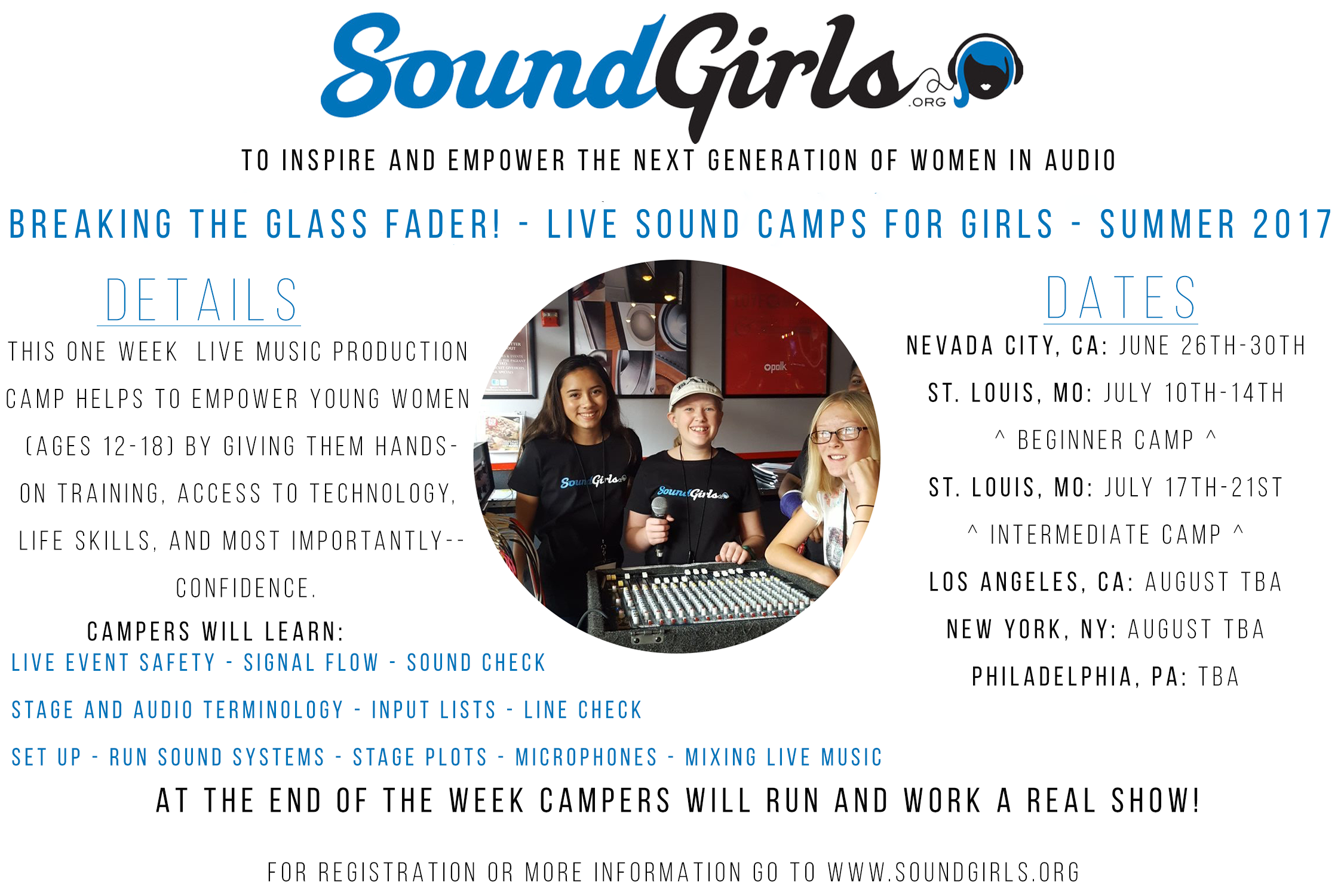
Registration for the 2017 Live Sound Camps for Girls is now open!

We are excited to announce that registration is available for the 2017 SoundGirls.Org Live Sound Camps for Girls!

Register here: 2017 Camp Registration

Registration is open for the following cities:

Camp dates and registration for Los Angeles coming soon!

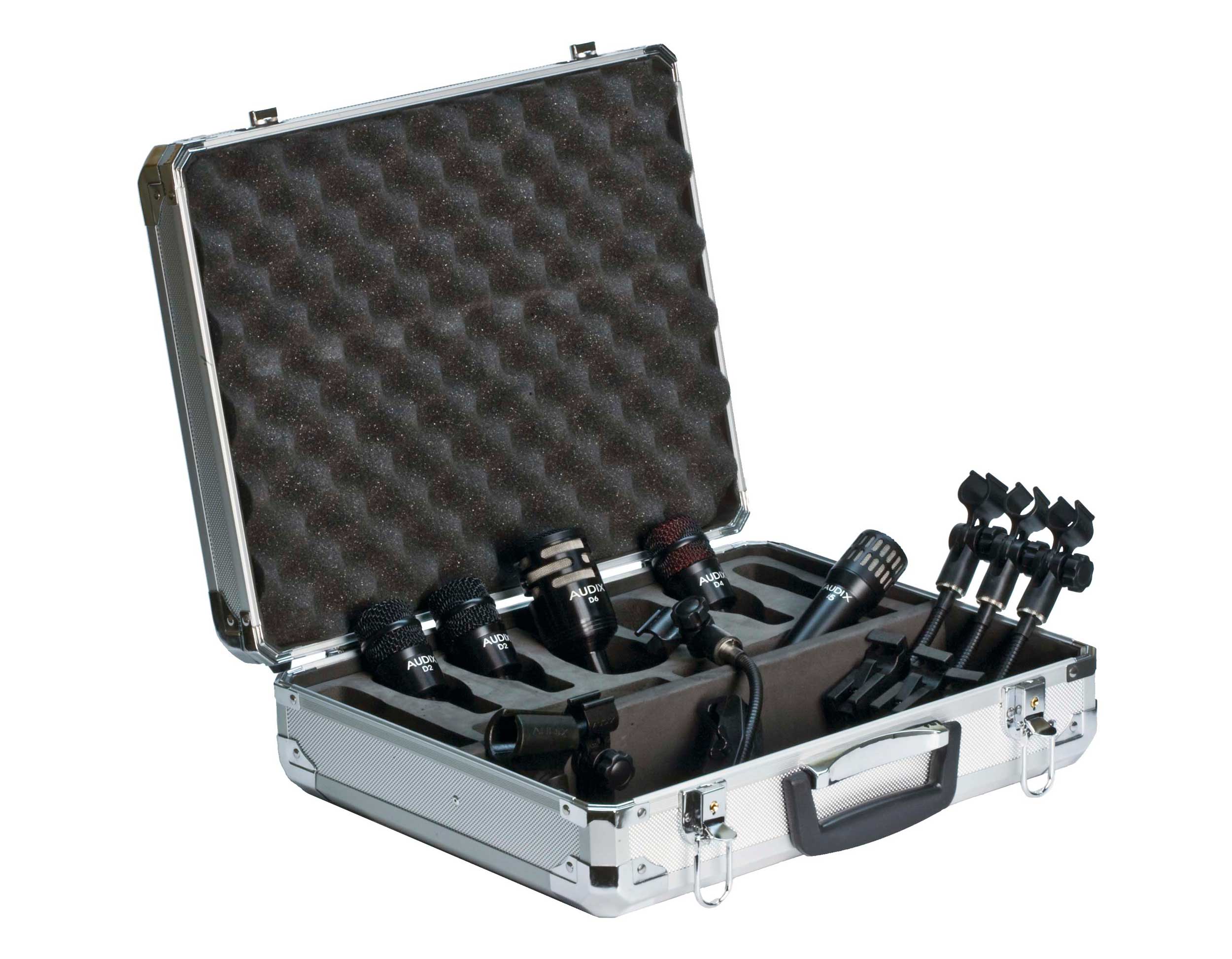
Support our camps by contributing to our Generosity Campaign! Rewards for donating are tax-deductible and include perks from companies like Pro Tools, Ableton, Slate Digital, Sennheiser, Ultimate Ears, Audix, and many, many more!

For questions, please e-mail soundgirls@soundgirls.org with the subject line “2017 Live Sound Camp”.

Post Production Audio: Broadcast Limiters and Loudness Metering

Any time you’re working on a mix that’s going to broadcast, it’s important to ask for specs. Specs are essentially a set of rules for each broadcaster, such as:

Generally there will be a “spec sheet” for each broadcaster (i.e. ABC, CBS, BBC, etc) that your client will provide when asked. Spec sheets aren’t necessarily public or available online, but some are (such as NBC Universal). Some online content providers (like Amazon), movie theater chains, and movie distributors also have specs, so it’s always good to ask.

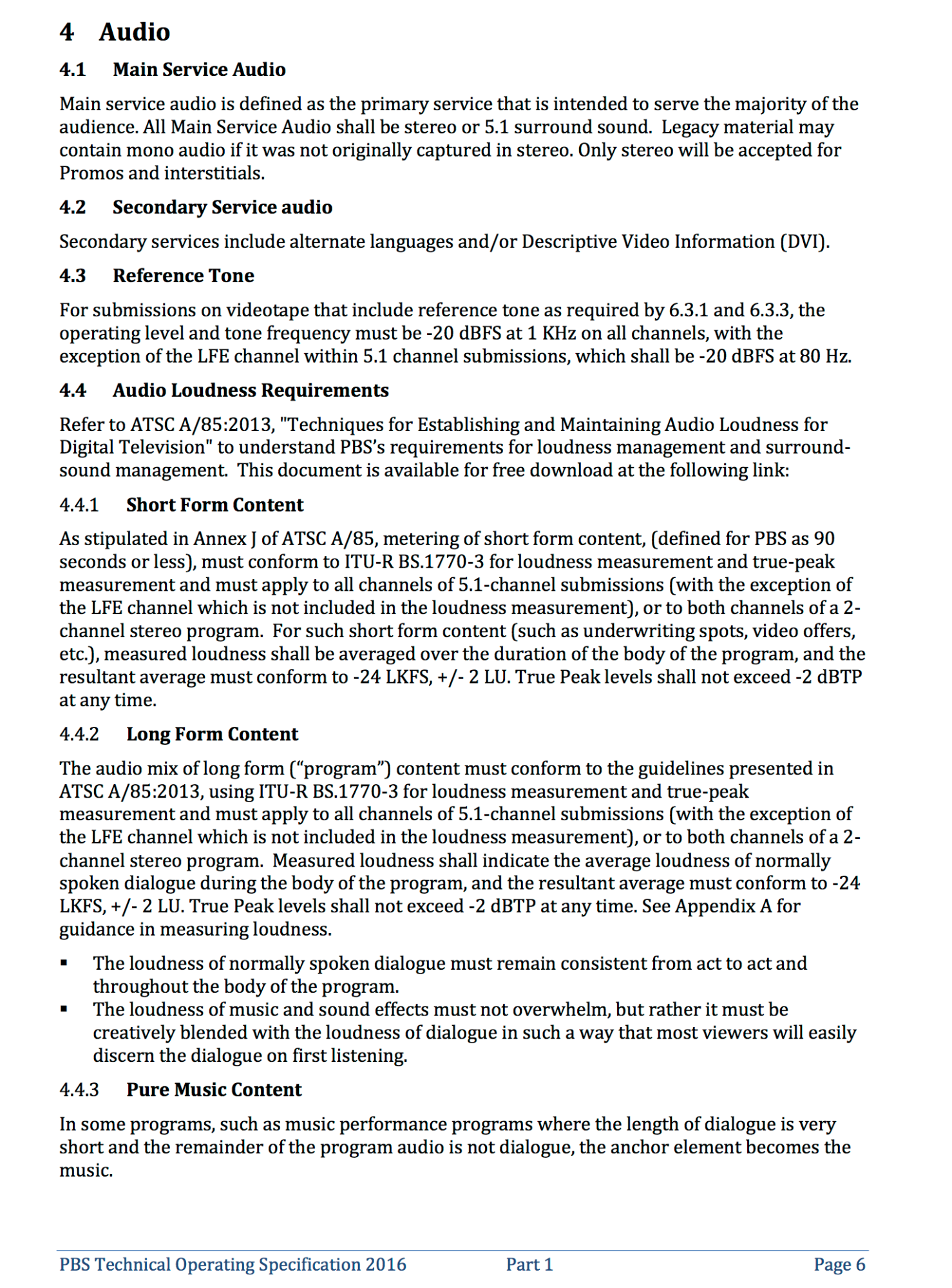
To understand some important concepts, we’ll take a look at PBS’s most recent specs (2016), found here.

For PBS, it’s a 21-page document that includes requirements for video, audio, how to deliver, file naming, closed captioning, etc. It gets pretty detailed, but it’s a good example of what a spec sheet looks like and the types of audio requirements that come up. The information in the spec sheet will dictate some details in your session, such as track layouts for 5.1, where your limiters should be set, dialog level, bars and tones, etc. We’ll break down a few of these important elements.
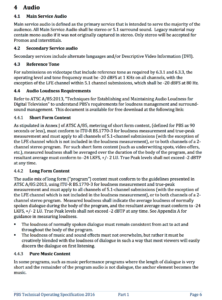
PBS Technical Operating Specification 2016 – Part 1, Page 6 Sections 4.4.1, 4.4.2 – Audio Loudness Requirements

The three most important details to look for on a spec sheet are peak loudness, average loudness, and the ITU BS 1770 algorithm. These will be explained in detail below. In this case, the PBS specs are:

Peak Loudness: -2dBTP (“true peak” or 2 dB below full scale). This is your brickwall limiter on the master buss/output of the mix. In this case, it would be set to -2dB.

Average Loudness: – 24dB LKFS +/-2 LU.

ITU BS 1770 Algorithm: ITU-R BS.1770-3. This is the algorithm used to measure average loudness.

Some background on the average loudness spec:

Before 2012, there used to only be one loudness spec: peak loudness. This was a brickwall limiter placed at the end of the chain. Back then, most television networks (in North America) had a peak level of -10dBfs. From the outside (especially coming from the music world) it seems like an odd way to mix – basically you’ve got 10 dB of empty headroom that you’re not allowed to use.

As long as your mix was limited at -10dB, it would pass QC even if it was squashed and sounded horrible. That’s what was happening, though, especially with commercials that were competing to be the loudest on the air. If you remember running for the remote every commercial break because they were uncomfortably louder, that was the issue.

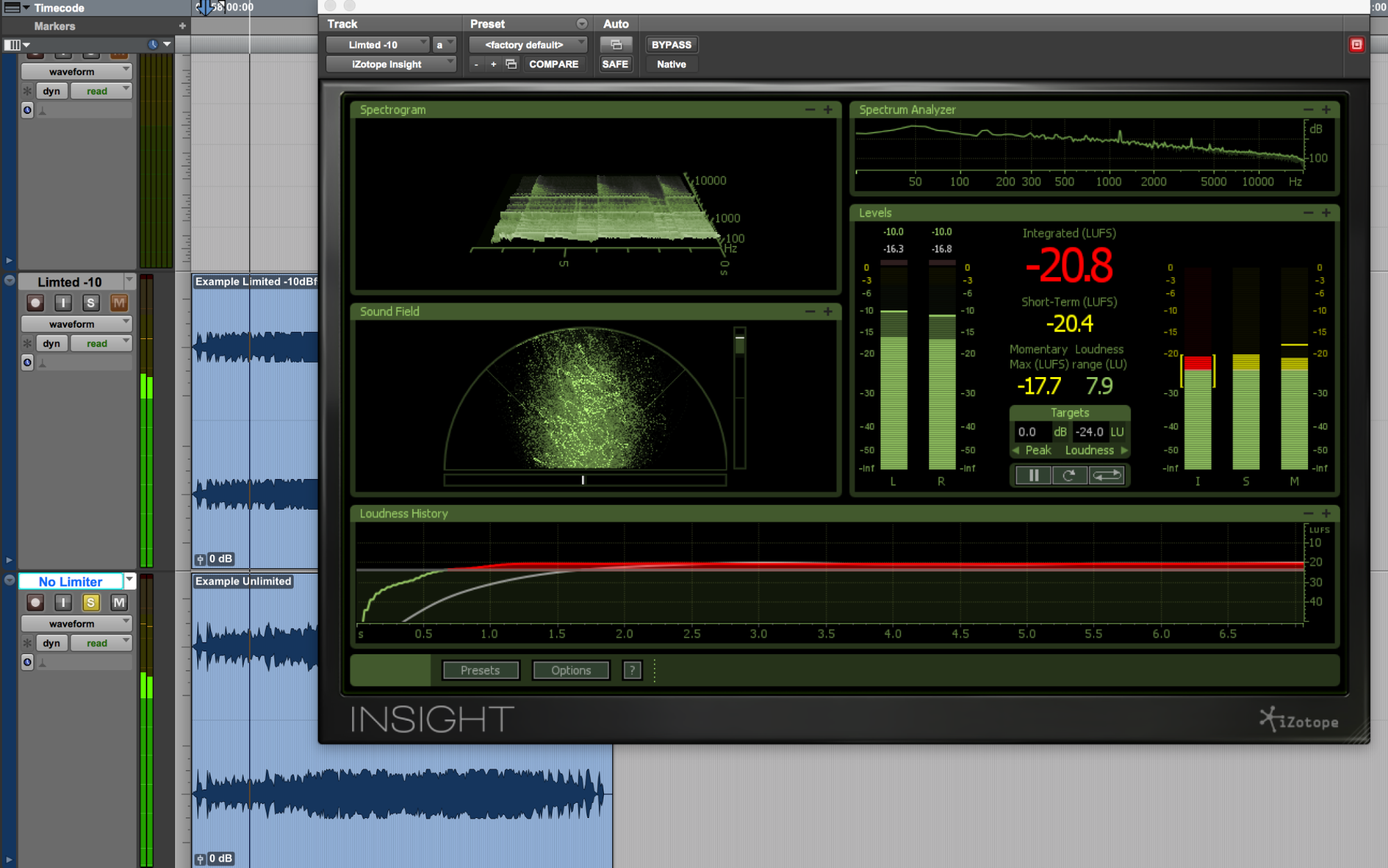
In the US, Congress enacted the CALM act which went into effect in 2012 and required broadcasters to reign in these differences in loudness between programs and commercials. The spec that evolved from this was average loudness level. A loudness measurement covers the length of the entire piece, whether it’s a 30 second spot or a 2 hour movie. Average loudness is measured through a loudness meter. Popular measurement plugins are Dolby Media Meters, Izotope Insight and Waves WLM.
Izotope Insight screenshot

The ITU developed an algorithm (ITU BS 1770) to calculate average loudness. The latest algorithm is 1770-4 (as of early 2017). To get technical, loudness is an LEQ reading using a K-weighting and full-scale; the designation for this reading is “dB LKFS”. In the PBS spec sheet, section 4.4.1 and 4.4.2 say mixes should use ITU BS 1770-3, which is an older algorithm. This is an important detail, though, because when you’re measuring your mix, the plugin has to be set to the correct algorithm or the reading may be off. The PBS specs were written in 2016 (before 1770-4 came out). Broadcasters update these every couple of years, especially as technology changes.

In this PBS spec, the optimal average loudness is -24dB LKFS, but there is an acceptable loudness range (LRA) above and below +/-2 LU (“Loudness Units”). Basically that means your average loudness measurement can fall on or between -26dB LKFS and -22dB LKFS, but ideally you want to mix to hit at -24dB LKFS. The measurement plugin will probably show a short term and a long term value. The short term reading may jump all over the place (including beyond your in-spec numbers). The overall (long) reading is the important one. If the overall reading is out of range, it’s out of spec, won’t pass QC and will likely be rejected for air. Or, it may hit air with an additional broadcast limiter than squashes the mix (and doesn’t sound good).

As HD television has become more popular, broadcasters have loosened up on the peak loudness range. PBS is pretty liberal with -2dBTP (or -2dBfs); some broadcasters are at -6dBfs and occasionally some are still at -10dBfs.

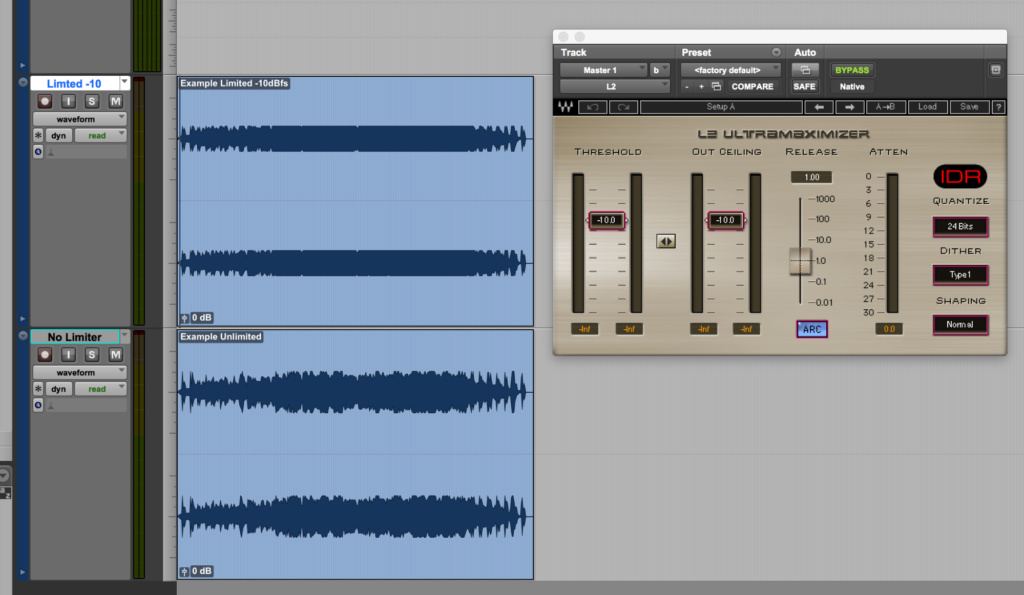
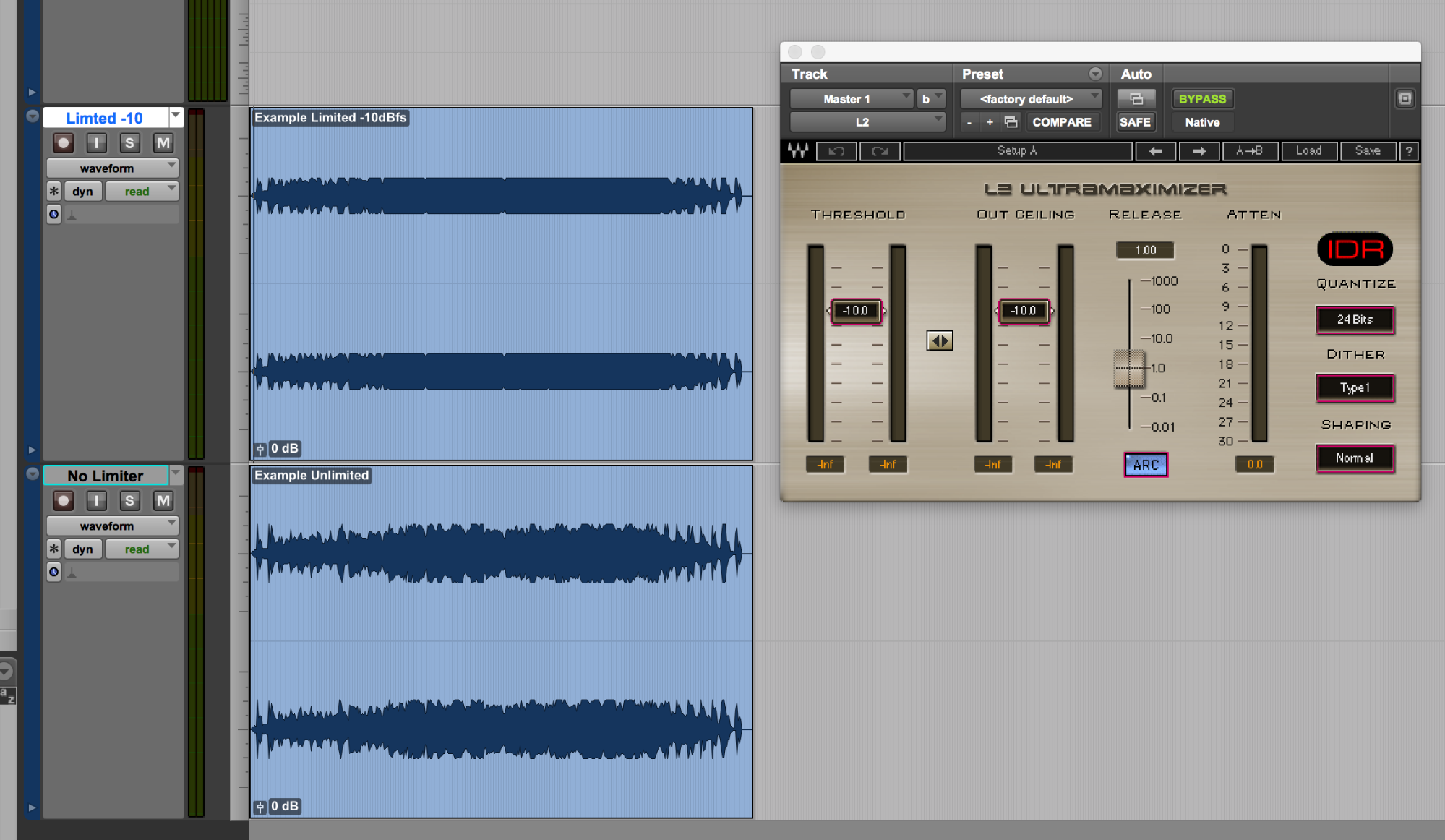
Below is a screenshot of a mix with a limiter at -10dBfs (you can see the compression – it doesn’t sound very good!) and the same mix without. If your average loudness reading is too hot and your mix looks like the upper, there’s a good chance that your mix (or dialog) is overcompressed!
Initially re-recording mixers thought loudness metering would be restrictive. Average loudness is measured across the entire program, so there’s still room for some dynamic range short term. Loudness specs can be a problem for certain content, though. For example, you’re mixing a show with a cheering audience that’s still being picked up as dialog by the loudness meter. Say your spec is -24dB LKFS (+/-2). You mix the show host at -24dB LKFS (in spec) but every time the audience cheers the short term measurement is -14dB LKFS. The overall loudness measurement might be -18dB LKFS – which is way out of spec! So sometimes you end up mixing dialog on the low side or bringing down an audience more than feels natural to fall in spec.

Another difficulty of mixing with a loudness spec is making adjustments when your overall measurement is out of spec. A dB of LU (the unit of measurement for average loudness) is not the same as 1dBFS (full scale). If you drop the mix 1dB by volume automation, it’s not necessarily a 1dB change in average loudness. If you’re mixing a 30 second promo and the loudness level is out of spec it’s easy to adjust and recheck. If you’re mixing a 90 minute film, it takes a bit more work to finesse and time to get a new measurement.

There’s software that will make these adjustments for you – basically you can tell the software what the specs are and it’ll make small adjustments so the mix will fall in spec. While this is a good tool to have in the toolbox, I encourage mixers to first learn how to adjust their mix by hand and ear to understand how loudness measurements and metering works.

I find in general if dialog is sitting between -10 and -20dBfs (instantaneous highs and lows) and not over-compressed, the average loudness reading should fall pretty close to -24dB LKFS. When I first started mixing to an average loudness spec, my mixes were often averaging hot (-20 to -22dB LKFS) when spec was -24. My ear had become accustomed to the sound of compressed dialog hitting a limiter on the master buss. What I’ve learned is that if you’re mixing with your dialog close to -24 dB LKFS (or -27 for film) you can bypass the master limiter and it should sound pretty seamless when you put it back in. If you’re noticing a big sound change with the limiter in, the overall reading will probably fall on the hot side.

When I start a mix, I usually dial in my dialog with a loudness meter visible. I’ll pick a scene or a character and set my channel strip (compressor, EQ, de-esser, noise reduction etc) so the dialog mix lands right on -24dB LKFS. I do this to “dial in” my ear to that loudness. It then acts as a reference, essentially.

One thing I like about mixing with a loudness spec is you don’t have to mix at 82 or 85 dB. While a room is optimally tuned for these levels, I personally don’t always listen this loud (especially if it’s just me/no client or I anticipate a long mixing day). Having a loudness meter helps when jumping between reference monitors or playing back through a television, too. I can set the TV to whatever level is comfortable and know that my mix is still in spec. When I’m mixing in an unfamiliar room, seeing the average loudness reading helps me acclimate, too.

I mix most projects to some sort of spec, even if the client says there are no specs. Indie films, I usually mix at -27dB LKFS and a limiter set to -2dBFS or -6dBFS (depending on the content). If an indie film gets picked up for distribution, the distributor may provide specs. Sometimes film festivals have specs that differ from the distributor, too. If you’ve already mixed with general specs in mind, it may not need adjusting down the road, or at least you will have a much better idea how much you’ll need to adjust to be in spec.
2017 Crowdfunding Rewards

Visit our crowdfunding campaign at Generosity.com to help SoundGirls.Org break the glass fader! Here’s a peek at some of the rewards available:


Maintenance Time

Unlike many touring engineers, June is the slowest time of year for me. Because I work for a graduate school/seminary, I follow the traditional American rounds of school semesters. July is the exact opposite, and is my busiest month of the year. But I digress. June: the beginning of summer. This is my maintenance time. Not everyone’s is in June, and not everyone’s is all at once. I often do maintenance throughout the year, but like I’ve stated, June is my down month.

Wipe Off That Dust

Dirty DeskThroughout the year, I keep a log of every issue that my technicians have: how long it lasted, who it affected, and what we did to solve it. In June, I go back through all the records and make graphs to know what problems are affecting us the most. While we do a Band-Aid fix as the problem is occurring, it’s important to develop a long-term plan to keep the issue from happening again.  Some great general maintenance tasks include disinfecting your vocal mics, dusting and fixing outboard gear and soundboards, cleaning and organizing cables, soldering that milk-crate full of busted cables, organizing your recordings – there are ten-thousand things I’m sure that could be done. This June, I’ll be spending a large amount of time testing internet connections and ordering new wireless microphones in an appropriate band.

Updating Software

Updating Software

Even if it’s one day a month, you should make time for routine maintenance to keep the quality of your equipment and work flow. Let’s say you’ve been having random RF problems. Sometimes a signal is dropped, sometimes there’s some interference. Yeah, you can quickly change the frequencies in the moment, but you really need to take some time and do a new RF scan and make sure that all your wireless channels are free from any new nearby interference (those of us that work in permanently installed buildings don’t necessarily scan for new frequencies every day).

Get Creative

This is also an excellent time to start trying new things. Experiment with parallel compression, create and play with a sub-kick mic, set up a recording chain, or create new base templates for different band styles. I’m working on making a mobile tech cart, creating teaching materials, and playing around with some studio work. There’s no reason you have to stick with the same-old, same-old. You can even get those creative juices flowing while you’re organizing your workspaces. Being creative is a part of what we do, and if you aren’t feeling the artistic side of this field you are sorely missing out. Find joy in creating.

Maintain Yourself

If you don’t work to maintain yourself and your career, you could crash and burn. Obviously you should look after your health (physiologically and mentally). We tend to work countless hours every week in pursuit of a fantastic production. I know that I often go weeks without having a day off, which I don’t mind at all, until I become continuously exhausted and I have to force myself to take a couple days to recover. You should eat right, exercise, and keep healthy relationships with those close to you.

Creating GraphicsI also think a very important part of personal maintenance is to continue our education. It all falls in with the above segments. Learning new techniques, taking new classes, getting new certifications, expanding your experiences, reading new books. You never know what the next page has to offer.

Never forget about maintenance. Keep your gear, your knowledge, and yourself as pristine and clean as possible. A little elbow grease now can save you money and issues in the future. I’d love to talk to you about what kind of maintenance you should be doing, technical or otherwise.

US Tours, Non-US Techs – Work Visas and You


As a Canadian working in the music industry, it often feels like my lack of American citizenship is impeding me from furthering my resume.  I frequently hear from American bands and techs how tough the Canadian border crossing can be. While I can empathise, as I am not a fan of borders, the flip side of the story is how hard it is for non-Americans to work legally in the US.

American musicians and crew with a clean criminal record can enter Canada with an immigration letter and appropriate documents, without paying a fee. Meanwhile, Canadian bands and crew looking to tour in the US must apply for work permits. Regardless of whether these artists are playing a coffee shop for three people or an arena for 20,000, they must pay for these visas.

The lowest tier and most common visa for entry-level artists and crew is a P2. Currently, this visa costs a minimum of 425$. US Immigration is reporting a backlog of P2 applications, and suggests bands send in their application 90-100 calendar days before their first show. While on tour in the US last year, the KEN mode musicians and I were waiting on renewal info for our P2 visas: although the band had submitted the forms in May of 2015, we were only told of the approval for our next visas in early October, one week before the old ones expired. That means we waited over 120 calendar days for visa approval! We were fortunate to get our visas renewed in time – fellow Canadian band Royal Canoe weren’t as lucky.

Canadians aren’t the only ones affected by this visa backlog. Polish death metal Decapitated were forced to cancel an American tour in 2015 after they didn’t receive their visas in time.  The costs of planning a tour abroad are substantial: the band most likely had to put down payments on a vehicle rental, order merchandise & backline equipment, purchase plane tickets, etc. To have a tour canceled due to immigration issues is heartbreaking, to say the least.
These are typical fees for a P2 – note that the crewmember’s visa is almost as expensive as the artists’.

For artists:

A 4-piece band can then get P2 visas for $485.

Crewmembers must submit a separate i-29 for an additional 325$ USD, and then pay a separate 100$ CND filling fee. Additional techs can be added for 20$ CND. Bringing one technician into the US then costs 425$. Adding this fee to our hypothetical four-piece band’s visa process means they are now looking at just under 1000$ to be able to perform legally in the US, with one crew member working for them.

To some, this might seem like a small cost, but to up-and-coming bands with uncertain touring incomes, this added 425$ is an expense they can’t justify. To save money, these foreign bands touring in the US might rely on local crew, or hire Americans. While this benefits my American technician friends, it’s heartbreaking to hear as a Canadian looking to do more touring.

P1 Visa

Moving up in visa categories, once a band achieves more recognition, they can apply for a P1 visa, and a P1-S visa for their crew. The P1 process requires more support documents and is typically done with the help of an immigration consultant, which further increases its costs.

P1 and P2 visas are artist-specific – this means that as a technician or musician, you are tied to the musical act under which your visa was processed. As a foreign technician, if you work with three bands with plans to tour the US, you should have three separate visas in your passport. That’s just under 1000$ sent to Homeland Security, to process the same i-29 form three times. To make matters worse for visa applicants, the US Government is proposing changing the i-29 form fee from 325$ USD to 460$ USD. That’s a staggering 42% increase, deemed necessary by officials to cover the full costs of the services provided.

Non-Americans looking to do more technician work in the US might consider applying for an O1-B visa.  This visa class requires an individual to show their extraordinary abilities in the art world, as demonstrated by either being a recipient or nominee for a significant national or international award in their field of work (ex: Emmy or Grammy), “or evidence of at least three of the following:

If the above standards do not readily apply to the beneficiary’s occupation in the arts, the petitioner may submit comparable evidence in order to establish eligibility (this exception does not apply to the motion picture or television industry).”

In short, the applicant must demonstrate that they are well established in their field and that your average American worker cannot match their skill set.  Beyond having an extensive resume, applicants will also need to pay an immigration consultant to prepare their application, which costs upwards of 5000$ USD. An O1-B is first granted for three years, and can then be renewed annually. Few up-and-coming techs can afford to pay for this, let alone qualify for the visa’s requirements.

Non-American technicians recognize that the ability to work with an American musical act is often crucial to career advancement.  The US has a population of roughly 320 million, compared to Canada’s 35 million. There are simply more touring acts and therefore more touring jobs with American acts – the US is also a much bigger musical market than Canada.

I asked a Canadian tech friend, Drew Malamud (FOH for Skrillex), why he found it necessary to apply for a 01-B. He told me that without his visa, he simply wasn’t working as much as he is now. Furthermore, buying his work permit made him level to American technicians in the eyes of future employers. As there was no added fee to hire him, he became a viable option when applying for tours with American artists.

So, what is the solution? On my end, I am just focusing on building my resume, in the hopes I can one day apply for a 01. To my American friends: do we pose enough of a threat to your job security that we can’t even apply for American tours without possessing an expensive work visa? If you have a moment, please write to your House representative and tell them you would like a more reciprocal work agreement created.

* Disclaimer: I am not an immigration consultant. If you are thinking of applying for a work visa, I recommend you reach out to an immigration consultant firm to verify your admissibility. If you are Canadian, you can also visit the Canadian Federation of Musicians’ website for more information on visa processing.

LINK: http://www.cfmusicians.org/services/work-permits#OtherWorkPermits


All-In-One-Tech


Sam2I meet a lot of engineers around my age (mid-20s or so) that strictly stick to audio and don’t dare to touch anything else, whether it be to stay focused on audio, or to not get roped into something they don’t particularly want to do. There isn’t anything wrong with this. Laser-focusing on one discipline can yield some great results. I know that my passion lies in audio, live sound especially. I study it, read about it, train myself, and I find it most thrilling. As I’ve been working in this industry, I’ve began to notice a trend: nobody wants to pay an audio engineer properly. It’s an endless undercutting massacre of our income. Something that I’ve done to make sure I get my value is to learn other aspects of event production. It’s hard to justify any less pay when I’m able to do more than someone who only does sound. Again, I want to state that there is nothing wrong with sticking with and focusing on audio. Follow your passions.

Work Beyond Audio

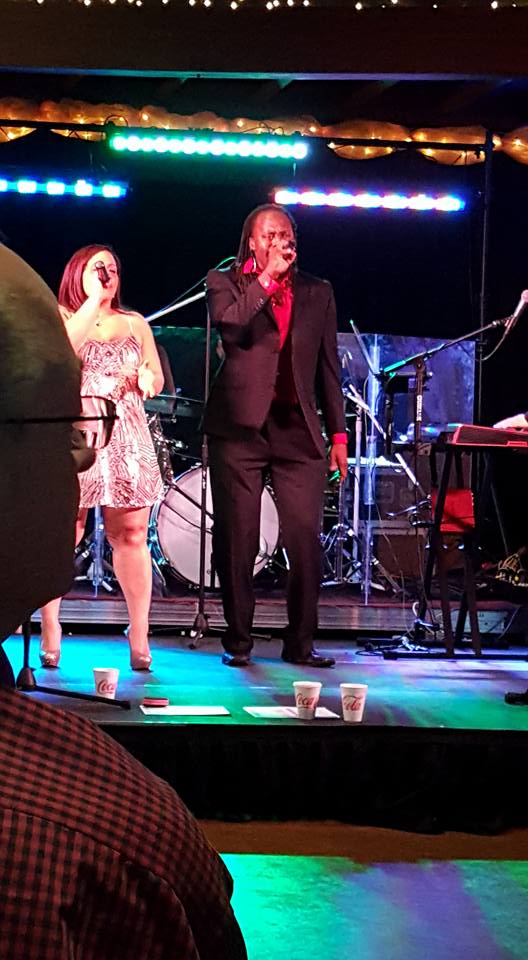
So, I feel it’s pretty established my main discipline is audio. I want to discuss some of the other things I do to supplement my audio work. I work with a band, Funk Syndicate, here in Kansas City. I’m a full-fledged member of the band, which is great. I’m their sound engineer, although I typically tell people I’m their Production Manager. Getting their sound dialed in is my #1 priority. But I do so much more. I’m their monitor engineer, their FOH engineer, their lighting designer, and I run their social media page.

All 8 band members use IEMs, so getting their monitors correct is an on-going and delicate task. As much as it hurts me to admit it, the monitors are arguably more important than FOH (please don’t throw anything at me). I have all gig to get the FOH dialed in. I need to get the monitors dialed in ASAP, and check-in throughout the gig (they often request changes throughout every set).

There are many, many times that I’m trying to fix something for FOH and one of the musicians needs an immediate change in their ears. I need to drop everything and fix that. When their monitors are precise, their performance is better, and it makes my FOH job easier. Musicians finding the ‘pocket’ can take a performance from okay to incredible.

Next, I design their lighting. I don’t do anything crazy because I don’t consider myself a lighting engineer. We’ve got LED bars and some other lights in the works, as well as DMX lighting software. I’ve bothered to learn all I can about the lights and the software so they can have as incredible of a show as possible. I want them to look great, and I enjoy seeing an entire show come together. I also know every song forwards and backwards, who is singing which parts, who’s got solos, and how long each song is. I learn all this because it helps me with not only mixing FOH, but also which FX and lighting presets to use when. I have a real hoot with Uptown Funk (people go crazy for this song, it’s ridiculous). So now my tasks are up to 3 different things at once, lighting, monitors, and FOH. I find it very thrilling to be doing so much at once.

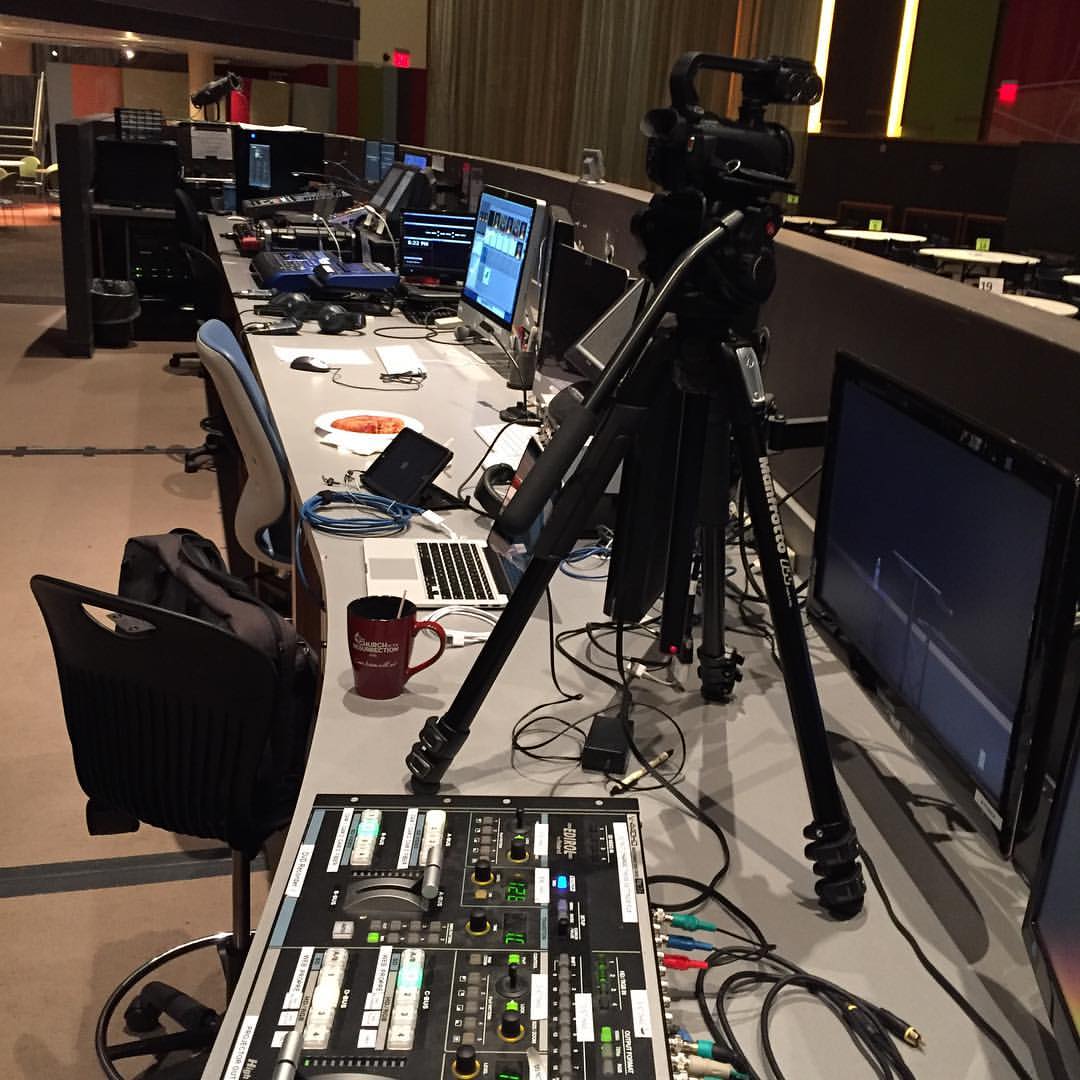
Except then, I add in photos, videos, and social media. I’m not afraid to admit that I’ve been doing video work at the same time as the monitors, FOH, and lighting. I need to add the caveat that I make sure one thing is as perfect as it can be in a certain moment before moving on to the next thing. I don’t give 4 mediocre performances. That’s unacceptable. I give 4 fantastic performances only because I can stay calm and I know my technology as thoroughly as possible. Don’t take on more tasks if you can’t handle them, and don’t sacrifice quality for ego. I see it way too often.Outside of the band, I often do more than just audio. I’m an IT Media Supervisor for a large church and a graduate seminary. I take care of all their media-related needs like chapel production, videos, and large events. I’m my absolute happiest when I get to focus on audio, but I get a lot of fun from other disciplines. Actually, I’m most excited when I’m handling more than one thing because there isn’t a single moment where there isn’t something to be done. Then it becomes a challenge to wrangle every single thing in and see if you can make it all calm for a few precious moments. It’s a game for me. For some of the simpler events, I can set up audio and keep referencing back to it, but then I also run graphics, and cameras, and the streaming switches. I often jokingly say, “Why do one thing, when I can do all of them?”. I also have the luxury of working with the same musicians every week, and mostly the same people outside of the band. I know these people, and thanks to digital boards, my work gets saved for each event so that I’m not starting from scratch every time. Doing 4 things at once may be a little more complicated when it’s total chaos with 3 different bands you just met 2 hours ago.

There isn’t anything wrong with focusing on and sticking with audio. I’m an audio person, and if I needed to pick one thing to do for the rest of my life, it’d be audio. But I have made my value higher and made myself indispensable because I have the skills to do other things along with it that nobody else can do. If you love FOH, learn monitors. You’ll have doubled your possible gigs. Vice-versa if you love monitors. If you love audio, learn how to do some graphics work. If you love lighting, learn some video work. Not only is it fun to learn about new things, but it can up your work value, which is really important. Why, when all other things are equal, would a company/client hire someone who can only do one thing, when they could hire someone that can do two? Or three? Or four?

Never stop learning. Never quit aspiring for more information and more experience. Never become stagnant. Always be moving, and always be striving.

Female Frequency Hosts a Twitter Chat

Twitter chats continue to grow in popularity within the Twitterverse. The variety of subjects that can be found to discuss is amazing. A chat can boost engagement with customers, influencers, and like-minded individuals all over the world. That’s why I love Twitter chats and participate in a handful of different chats myself. From time to time I even get to host one. But if you have never heard of a Twitter chat or participated in one, let me provide you with a quick rundown.

A Twitter chat takes place on Twitter (of course). Each chat covers a different topic, providing knowledge on a specific subject or platform, and has an associated hashtag. For example: #ChatSnap touches on all things related to the SnapChat app. #TwitterSmarter covers tools and techniques to help expand reach and engagement on Twitter. #ggchat targets indie music artists around the world, focusing on everything indie.  Some chats take place weekly, bi-weekly, monthly or even bi-monthly – each group is different. Usually, a chat will last anywhere from 30mins to an hour, with a designated host leading the charge.

ffreqFemale Frequency, a sister company of ours here at SoundGirls, is a collective dedicated to empowering women and girls through the creation of music that is entirely generated by women. They have started a new weekly chat, hosted by Angela Sheik every Monday at 8pm EST. So far, the chat has covered topics on recording preparation and choosing/working with a producer. You can participate in the weekly chat by using the hashtag #ffchat. I look forward to seeing some new and familiar faces during next week’s #ffchat.

To connect with me or any of the platforms mentioned here on twitter, you can click the hyperlinks or follow each as listed –

Female Frequency: @FemaleFreq

Host of #ffchat Angela Sheik: @AngelaSheik

SoundGirls.org: @SoundGirlsOrg

Alesia Hendley: @thesmoothfactor


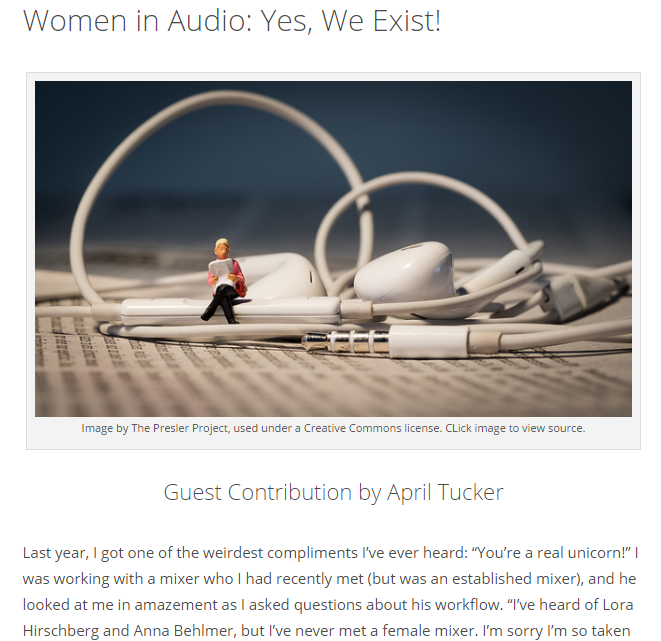
“Yes, we exist!” A year later…

A year ago, I contributed a post to Designing Sound about being a Woman in Audio.

To everyone’s surprise, it had the most day-one traffic of any post in the site’s history. The response has been overwhelmingly positive. The article has been used as a resource for industry panels and audio classes, and I’ve been invited to speak publicly about it. It was through the post that I was introduced to SoundGirls and invited to write this monthly blog.

The enthusiasm and support (from men and women) is really encouraging. However, I’ve also gained perspective this year meeting a lot of people and hearing their stories. There is bias and discrimination in the audio industry beyond women and it often goes unspoken. Here are some challenges and stories shared:

In last year’s article, I said, “Be aware of biases (or discrimination), and speak up if you see it happening.” While it’s great that we are building awareness about the issues women face in the industry, I question if we should stretch our mission a bit further. For example, we’re seeing more panel discussions and talks at trade shows about women in audio. Why do we not have panel discussions that are more broad and inclusive – like, “minorities in audio” or “personal challenges working in audio”? Are there ways we (as members of SoundGirls) can be more inclusive of anyone seeking help for discrimination regardless of gender or other perceived advantages?

We shouldn’t have to announce our differences – such as race, sexual orientation, economic background or age – to gain support from our colleagues. But, sharing our unique challenges, perspectives and experiences could help us better understand each other. Creating that kind of environment is going to help us build a path towards equality for everyone in our industry.

Investing In Your Education


Nelson Mandela once stated, “Education is the most powerful weapon which you can use to change the world.” Wise words from someone with extraordinary life experiences.

Continuing education in life is important, and it is vital in any audio professional’s career. The learning curve is large, the technology is always changing, and to continue improving your craft it will be important to keep studying. Surprisingly, there are many avenues to learn and expand your horizons that will make you a well-rounded professional. There are educational opportunities for everyone at any level of knowledge or career, from beginner to veteran.

Here are some continuing educational opportunities to keep you at your audio best!

Attend a conference or convention

Usually a weeklong or so, InfoComm and NAMM offer seminars, courses, vendor booths, training, networking, and so much more.  These are some of the biggest gatherings of audio professionals each year, where the vendors introduce many new pieces of equipment and you can learn about the next big audio trends.

Take a class online or in person

Classes are a great way to get some advanced hands-on training. Groups like SynAudCon and Harman have many online and in-person courses available. Many companies also offer in-person demos by partnering with sound companies to showcase their newest products. Demos, like DiGiCo offers, are a great chance to learn about the product directly from the developer.

And don’t forget the awesome opportunities that Soundgirl provides, like the Live Sound Camp for Girls, Live Sound Workshop, the Resources page, and articles by fellow bloggers.

Do some casual reading to brush up on your skills:

There are many places online to find quality articles and information to start or continue your education. Yamaha offers a great beginners guide; FOHonline and ProSoundWeb offer a wide variety of articles and update their content regularly.  There are also webinars like the ones offered at Live Sound Advice and books such as Paul White’s series that covers topics such as MIDI, studio design, mastering, mixers and more.

Learn one-on-one or network with colleagues in the field

Another way to learn is through hands-on training and watching others work. Opportunities to experience all of these options are to shadow someone at an event, develop a mentorship, and network with colleagues in the field.  Attending the classes and conventions listed above is an excellent way to network and develop relationships that could lead to mentorships and shadowing opportunities. You could also consider joining an association such as the Audio Engineering Society (AES)  or the Production Music Association (PMA).

Expand your knowledge to other show topics

knowledge2You can also continue your education by expanding your horizons through gaining knowledge in other areas of event planning and technology by taking courses such as CM Entertainment Training or by reading about or attending an Event Safety Alliance event.

With so many opportunities to continue learning, we can keep ourselves forever young and employable by keeping up with the times. For each opportunity we take, we invest in ourselves, build our skills (and resumes), and put ourselves one step ahead of the competition. So keep learning, because as Benjamin Franklin said, “An investment in knowledge pays the best interest.”


X