Empowering the Next Generation of Women in Audio

Join Us

SUGGESTIONS FOR MANAGING STRESS AT WORK

The environment where we are is essential to have a good quality of life in addition to good work performance, but there is an important issue that we do not take into account, how can we work in a relaxed environment when our work does physically wear us out?

Lack of sleep, poor diet, frequent schedule changes, and mainly stress are fundamental pieces to potentiate the mental and physical fatigue of any human being, which is why I will share some exercises to help counteract mental and physical fatigue.

STRESS, a problem unfortunately very common in today’s society and can end up causing serious health problems.

The first thing is to define what is stress? People have an alert system that starts up in situations of stress and can cause different psychic and physical reactions such as increased alertness, muscle tone or heart and respiratory rate. This alert mechanism has an adaptive purpose without which we would not have been able to survive in our evolutionary beginnings and that makes us respond adequately to certain changes or situations of danger. But when this reaction continues over time it becomes a problem because it generates a constant state of alert that ends up being detrimental to our physical and mental health.

What are the situations that cause us stress?

Any type of change, both negative and positive, can cause stress. Some examples may be, situations as diverse as illnesses of our own or those around us, economic problems, the birth or care of a child, having to study or take tests and losses of a loved one; Focusing directly on the pace of work that we have in the entertainment industry, we are faced with highly stressful situations such as schedule changes, constant trips, working under pressure, being away from family and friends, among many others. But the same changes do not affect people equally.

What do I have to do to learn to manage stress?

We must learn to identify the signs that warn us of a possible excess of stress. These signs can be emotional: tiredness, sadness, bad mood, anger, aggressiveness, anxiety, restlessness, nervousness, pessimism or conflicts in relationships with other people. There may also be physical signs of stress: sweat, palpitations, muscle contractures, pain or heartburn, headache, neck or back, and insomnia. If we encounter any of these signals, we must recognize their possible triggers and try to control them before becoming ill. That said it seems very easy, but it is not. You have to make some changes in your habits and ways of thinking, as well as learn the resources and skills to deal with these causes. If you succeed, the effort will be worth it:

Face the problems and don’t look the other way.

Analyze the problems calmly, try to solve them and accept that you cannot change them. Have a positive attitude and let yourself be helped by others. Instead of worrying, you should take care of them. Try to see the changes as a challenge, not as a threat. Trust more people. Share your emotions with others. Do not isolate yourself. It is very useful to talk with people who have gone through similar situations. Relativize and recover the sense of humor.

Learn to say NO

It is very important to mark your limits. You don’t always have to meet the expectations and wishes of others.

Enjoy every day and take care of yourself. Reserve a time to do some activity that you like (read, watch series or movies, go to the cinema or the theater, listen to music, go out with your friends, go to the countryside, see exhibitions, travel, paint …) and do it without hurry.

Exercise regularly. It is the healthiest way to relieve energy and accumulated tension. Eat and drink in moderation. It may seem that alcohol and food abuse reduce stress, but they actually increase it.

Take breaks at work.

Avoid excess stimulants (such as caffeine, alcohol, etc.) and stop smoking (nicotine is another stimulant and also causes symptoms of stress).

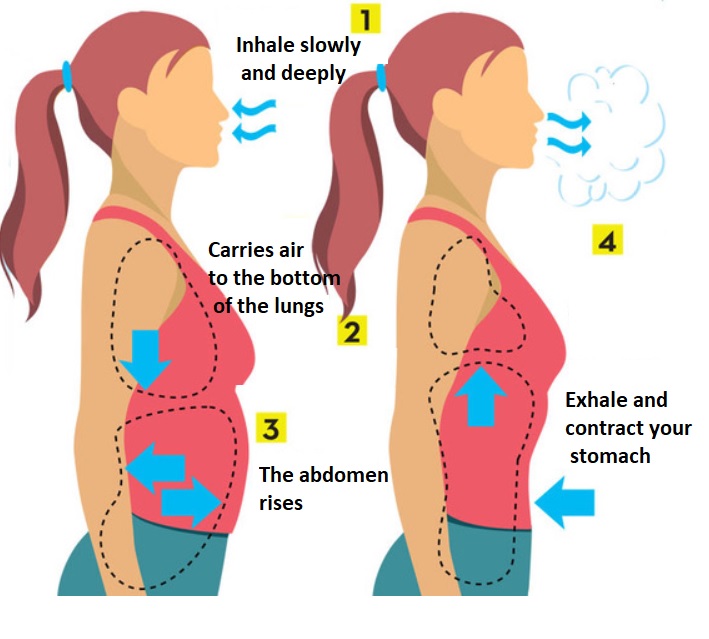
I share some suggestions and exercises to reassure our mind and body that have personally helped me cope with moments of tension, tours and long working hours with very good results.

– Listen to music that reassures you, in my case, I always carry recordings of Bowls that I usually listen to on flights and long journeys.

– The aromas are also great alloys to achieve relaxation along with deep breaths. Currently, you can get vaporizers where you can place natural oils I highly recommend them.

The exercise and stretching work incredibly to remove discomfort from being long-standing or in the same position, backaches, headache, and neck.

I share basic and very simple exercises that you can do anytime, anywhere. If you have a more severe injury, do not hesitate to see a doctor.

Take care of your body and your mind at all times.

Exercise to relax and stretch back and neck

Exercise to relax the lower back, hip, and legs.

Press 4 to 5 seconds when you feel a headache. You will feel discomfort; breathe deeply while pressing the points and the relief will begin very soon.


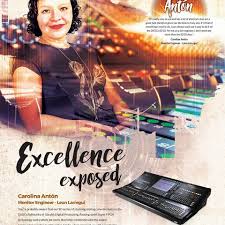
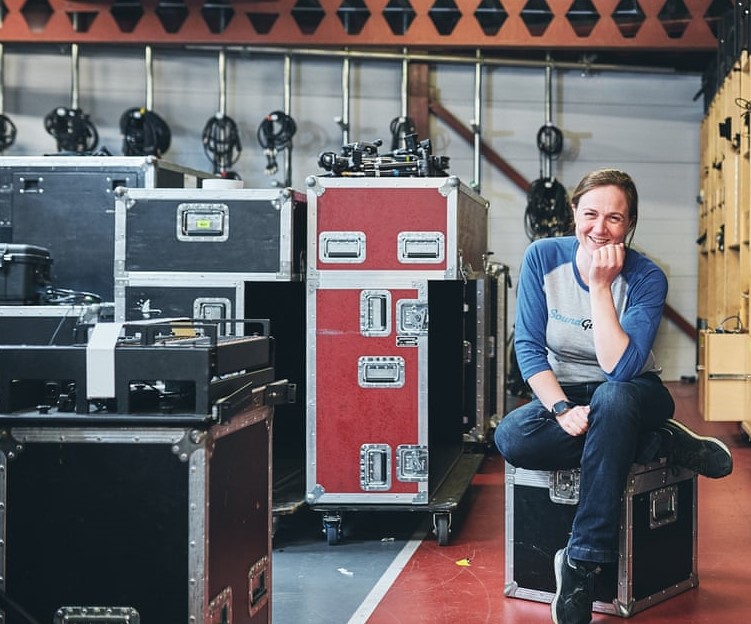
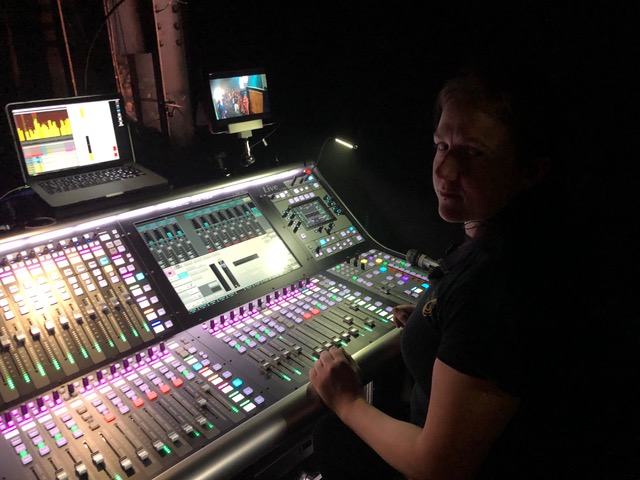
Carolina Anton is an internationally recognized leader in the field of live sound mixing, system design, and sound reinforcement optimization. For more than 15 years, Carolina has established a career path, collaborating with distinguished artists and productions.

Carolina’s first approach to music was as a drummer studying at the University of Berklee College of Music. Shortly after returning to Mexico City, she began working within professional audio companies, being one of the few women in Mexico who performed technical and sound mixing work.

With more than 20 national and international tours Carolina has participated as part of the production of several festivals such as KnotFest, PalNorte, President (Dominican Republic), Electric Forest (USA). She currently works as a freelancer for companies such as 2handsProductions, Eighth Day Sound, Britannia Row Productions, among others. She has mixed for artists such as Kool & The Gang, Gloria Gaynor, Natalia Lafourcade, Mon Laferte, Leon Larregui, among the most important.

In addition, Carolina is co-founder of the 3BH company with whom she develops integration projects for the audiovisual area in LATAM. After an outstanding professional career, in 2016 Carolina began representing the Soundgirls.org organization in Mexico with the aim of supporting women in the middle of the show.


SoundGirls Tour of Manley Labs

Eveanna Manley is opening her doors to SoundGirls.

Come Tour Manley Labs

The large warehouse is the main headquarters for Manley  Labs. This is where everything happens, including operations, manufacturing, and even some design work. EveAnna will give us a tour, share fun facts, stories, and insight into producing tube-based gear. Manley broke away from its originating company Vacuum Tube Logic (VTL) and formally settled in its Chino location in 1993. Now sales cater to the world stage (and studios) as well as a good chunk of tube tech-oriented at the analog-loving audiophile market.

Women in Sound Design

An Interview With The Only Two Women Ever Nominated for a Tony Award in Sound Design

This year, Jessica Paz changed history by becoming the first woman to receive a Tony Award nomination for Sound Design for the Musical Hadestown.  Jessica won that Tony, which also gave her the distinction of becoming the first woman to EVER win a sound design Tony in either category. Prior to this, only one other woman, Cricket S. Myers, had received a nomination for Sound Design of the play Bengal Tiger at the Baghdad Zoo in 2011.

The Sound Design category has existed since 2007, and in 12 years, only these two women have received nominations. As we have seen from The EQL Directory, there is no shortage of talented, professional women Sound Designers in this industry, so why is it so difficult for them to get work in Broadway theatre, and more importantly, what can we do to change that dynamic?  In an effort to gain a little more clarity on this subject, and to learn a little more about Jessica and Cricket and their work processes, I decided to go straight to the sources.

Here’s what they had to say

Elisabeth: How long have you been a sound designer, and what first drew you to this industry?

Jessica: I have been a Sound Designer for about 15-20 years, I first started as a mixer for community theater.

Cricket:  I’ve been a Sound Designer for 20 years now. I have always loved theater, I fell in love with the crazy energy backstage and knew that the theater life was for me. I didn’t find sound until much later in life but it fits me well. I started as a physics major before switching to theater, so acoustics and all the technical side of sound comes very naturally to me. But it’s the creative side of sound design that fuels me from day to day.

E:  What were some of the stepping stones that helped you move from regional theatre to Broadway/Off-Broadway?

J:  I answered a job posting for a sound operator for an off-broadway play with LAByrinth theater company, which is how I met one of my mentors who then hired me as an assistant on shows going forward.

C:  I went to grad school at CalArts and graduated in 2003, and started assisting people around town. In 2004 I assisted on a show at SCR that transferred to Manhattan Theater Club, and which gave me my very first Broadway credit. I got my first BIG design (at the Mark Taper Forum) in 2006, there were four sound cues and I was SO excited and so nervous! But I developed an amazing relationship with Center Theater Group, and which lead to me sending a very bold email in 2008. I saw Bengal Tiger on the list of announced shows at the Kirk Douglas Theater, which is operated by CTG. Moises Kauffman was directing and I emailed the production manager, to let her know that if they didn’t already have a sound designer, I was REALLY interested. Sure enough, they set up a meeting with Moises, who is amazing, and I was in. The next year, the show was remounted at the Mark Taper Forum, and then in 2011, it transferred to Broadway with Robin Williams playing our Tiger.

E:  What has been your favorite design, and why?

J:  Hadestown because I feel it’s the show that helped define my style.

C:  I think one of my favorite designs was for a production of Bent at the Mark Taper Forum. Moises Kaufman directed, and the focus was always about storytelling. The whole second act takes place in a concentration camp, with a giant electric fence dominating the stage. I had a series of buzzes and hums that shifted and came and went throughout the act, subtly changing the tension in the room as the characters’ stories developed. There was a lot of collaboration between the lighting designer, Justin Townsend, the scenic designer, Beowulf Boritt, and myself as we created this world and as it changed thought out the show.

E:  What’s the one piece of gear or software you can’t live without?

J:  Apple Mainstage

C:  Well, it’s hard not to say QLab. It changed the way I design. I no longer had to mix things down in headphones, burn it on a CD and then hope it sounds the same in the theater. I can leave sounds as individual files and mix them in the actual theater.

E:  What are your thoughts on the phrase “In show business, it’s all about who you know”?

J:  I think who you know is helpful, but it isn’t the only road to success.

C:  I have found that to be very true! Almost all of my work comes from word of mouth. Someone recommends me, whether it is a director, or a production manager, or another designer. Networking is a huge part of the job. Now, this goes both ways. If you are a pain to work with, or treat someone poorly or do an awful job, that gets “known” very quickly too. Be careful not to burn bridges as you go!

E:  Who are your role models?

J:  Nevin Steinberg, Abe Jacob, Mark Menard

C:  I have been so lucky to have a lot of great mentors and role models! Jon Gottlieb and Drew Dalzell were so incredibly supportive and instrumental in starting my career. I got to assist some amazing designers while working at the Mark Taper Forum, gentlemen such as Darron West, Mark Bennett, Obadiah Eaves, and Paul Prendergast. All of them became role models and were very supportive of me as I found my way in theater.

E:  Cricket, you made theatre history when you became the first woman to be nominated for a Tony for Sound Design.  Jessica, you made theatre history when you became the first woman to win a Tony for Sound Design. Can you describe the feeling you had when you found out the news?

J:  I was elated, not only to have been nominated, to win but because I hope it will inspire other women in the field.

C:  I never thought it would happen! I had a friend, Brian, ask if I was going to wake up at 5:30 am to watch the announcement online and I laughed and said there was absolutely no reason to do that. Brian stated that he would get up and watch for me. I smirked and said “well, call me if you hear my name” Sure enough, 5:38 am, my phone rings and it’s Brian! I admit I continued to check the website ALL DAY long because I was pretty sure the Tony committee would come to their senses and take the nomination away. I was designing an outdoor concert for a middle school that day and the drama teacher spent the entire day grabbing folks and proudly declaring that she had a TONY nominee running her concert! It was surreal and exciting and amazing.

E:  In your opinion, what else needs to happen in the industry to give women in audio an even ground to stand on?

J:  I’m not sure I know the answer to that other than to keep encouraging women to show up and take a seat at the table.

C:  Producers need to take a chance. Hire someone they might not know. Directors have to ask for women designers. Designers need to hire more women as assistants and on the sound crew. And when a designer can’t do a show and is sending recommendations to the producers, include women on that list.

E:  What advice do you have for the next generation of women in audio?

J:  Show up, bring your whole self to the table, do your best work each day, keep learning. Be generous.

C:  Keep kicking ass every day. There’s absolutely no reason why those jobs shouldn’t be yours and don’t let anyone tell you anything different. Treat the folks around you with respect, and they will treat you the same way.

I also asked Cricket why she thought that in the history of the Sound Design Tony Award category, only one other woman besides her had been nominated.  She said, “Because there have only been seven women who have even designed on Broadway, designing less than 20 shows over the past 17 years. With 35-50 shows opening each year on Broadway, women Sound Designers make up a TINY percentage of the hired designers. If women aren’t given the opportunities to design the shows, then how can they get the recognition for them? Producers need to start recognizing the extraordinary talent and experience that women Sound Designers can bring to a show.”

For the past 5 years, Porsche McGovern has been doing a study on gender parity in theatre, and to quote her, she says that “we have been getting closer to gender parity in design in LORT theatres, “albeit very slowly and with a good chunk of caveats….the percentage of she designers in sound design positions only went up by 0.3 percent (in 2019).”

The rest of the statistics from Porsche’s study are equally alarming, and you can read all about the all too slow rise in gender parity in theatre here: Who Designs and Directs in LORT Theatres by Pronoun: 2019

If you are a Producer of theatre, I challenge you to reach outside the box for the 2020-2021 season.  Make it a personal goal to hire at least 50% of your designers and directors OUTSIDE of the “Straight white male” category, and I’m speaking to Producers of ALL theatre, not just Broadway.  Designers, follow Cricket’s advice, and staff your shows with women! Recommend each other, speak up for each other, fight for each other, because we all know that change is not going to happen without our strong voices on the forefront.  And since I can’t share it enough, here’s The EQL Directory to get you started.


Clothes or Leaking Focus

Let’s start with clothing, shall we?

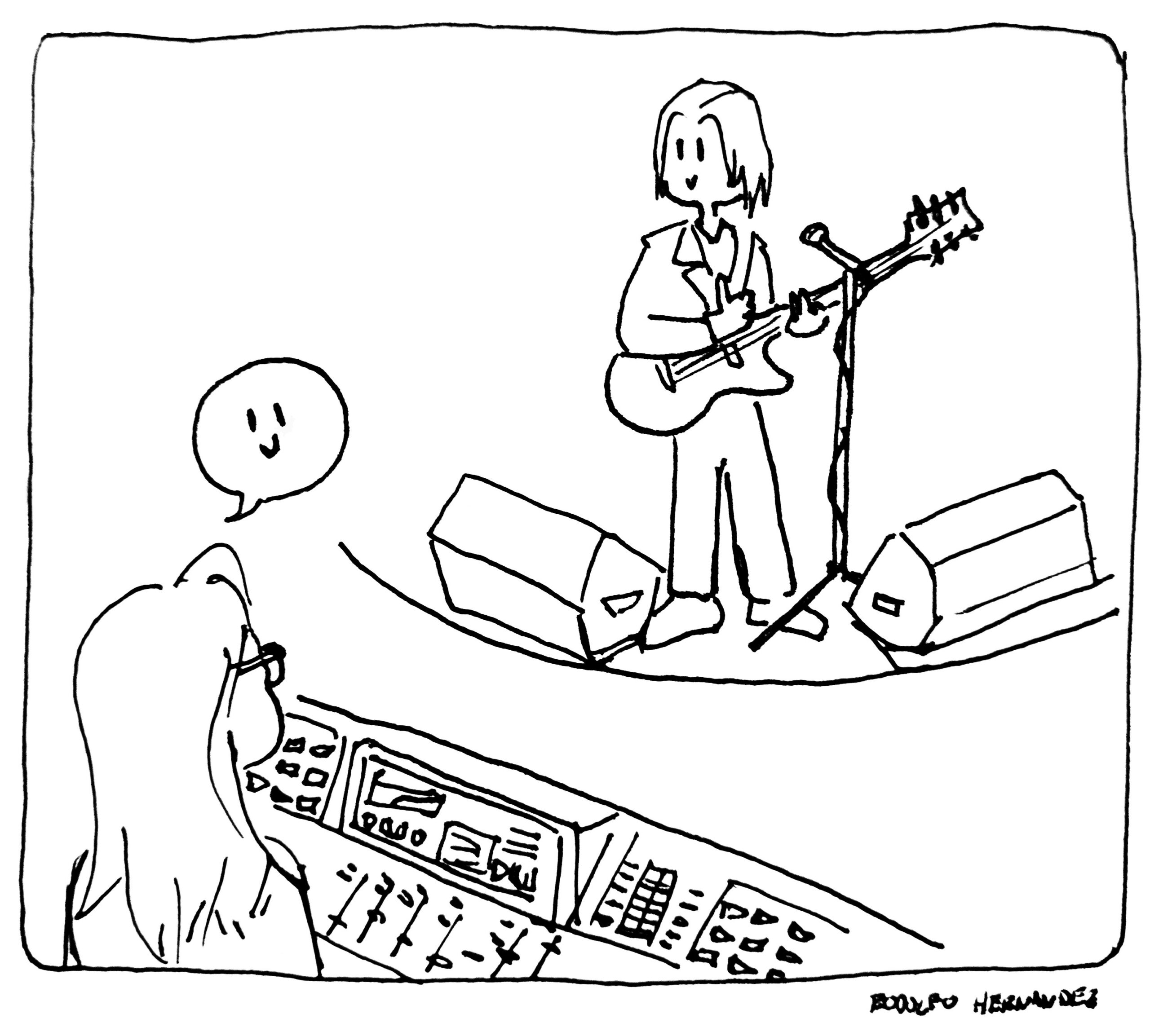
I wear clothes. Being a musician, I even wear them to perform.  Someone asked me why I wear what I wear on stage.

I’m a jeans-and-t-shirt woman. On stage, I’m a nice-jeans-and-nice-t-shirt woman, often with a button-down – clean, patchless.  All clothes must pass the Goldilocks Test; they’ve got to be jusssssst right.

First of all, they’ve got to FIT.  My body changes often due to a million and two factors (menstruation, inflammation, diet, exercise, how many hours I spent in the car yesterday, the passage of time) so there are various jeans for various size-shapes of me.  I can’t be on stage sucking in my belly or pulling up my pants and wasting precious energy that should be spent on doing my job. I can’t leak focus on discomfort.

I have to be able to MOVE in whatever I’m wearing.  Nothing fancy. No Martha Graham stuff, just move like a person in the world.  Stand up, sit down, grab a guitar, lean back from the piano, feel my feet ground down and my chest and belly open easily for air.  (Bra too tight, I can’t breathe. Bra too loose, potato sack – or my boobs feel like they’re falling into the world. If it’s over ninety-five degrees, maybe no bra, but that has to fit my mood and the feel of the shirt. Sodden boobers, yech.)  If I’m wearing a belt, it has to do its hold-up job without corseting me. Pants don’t have to stretch, but if they don’t they must allow for my actual shape and motion. Shirts can’t snag my armpits and they have to be long enough to address the irremediable case of plumber crack. Socks, cushion me enough in my boots. Boots, light enough to let energy move through my legs.

The clothes have to FUNCTION.  Certain kinds of cotton will make me sweat out a shirt in minutes. Too light a color and I’m a blur in bright lights. Polyester will stink faster than it takes me to look up how to spell “polyester.” (Selling merch or hugging friends post-set I don’t want to worry about armpit-tear-gas. Side note: Please stop with the tri-blend nonsense; It stinks!!!)

Maybe this is the night to wear my WOMEN 2020: BECAUSE FUCK THIS SHIT shirt. Or maybe that’s tomorrow night. Ruffling feathers is great, but if I’m going for impact, I want it to land. If I need layers, they’ve got to fit and move, too. Blazer with nothing under it? Probably not in a freezing cathedral.

And on the road, all this needs to be easy to pack and easy to clean.

Slightly more ineffably, the clothes have to FEEL right. I need to feel like myself. After a lifetime of dysphoria and dis-ease, I simply refuse to be uncomfortable. (You think I “look like a boy”? Get out more.)  Further: I dress for myself. Yes, I like to feel attractive (to the people I like to feel attractive to, which may be a smaller sliver of humanity than some) but I find that if my clothes fit, function, move and delight me, I probably do feel attractive.

The stronger at home I am the better I can bring my Voice through. On stage (at work) and off. The more at home I feel, the easier it is to access Delight, Groove. Fun, Surprise, and MUSIC.

And THAT really is my job.

So I ask you, women, especially, what are you wearing to work?  Does it fit? Honestly? Do you have clothes for all the shapes and sizes of you, physically and emotionally?  Can you move enough to do your job? Do the clothes function for what you’re doing? Did you put those clothes on as yourself, for yourself?  Put differently: do you feel safe and at home? Do you feel strong, capable, available to yourself and your work?

If anything on or near your body makes you leak focus, GET RID OF IT.  Set that shit on fire. And then get some clothes that, whatever your profession, allow you to make music of your work.

PS: When something has fallen out of rotation or no longer matches the criteria, it’s out.  Clothing exchanges and trading at consignment shops are my faves. When I find things that work, I hunt down their siblings on eBay for cheap. (And keeping stuff out of the waste stream makes me happy.)  Line-drying helps jeans, button-downs, and black cotton band T-shirts (yep, a whole drawerful) last longer. What tips have you got?


Willa Mamet: Singer and songwriter, Willa was born in a trunk and raised by performers of all kinds. She’s made music since about that time, singing irrepressibly and playing piano and guitar. With her musical partner, Paul Miller, she recorded two albums, East Hill Road and Let Somebody Love You, both of which won the VT Times Argus “Tammy” Album of the Year in 2013 and 2015. Her next album will be born in Spring 2020. Meanwhile, she plays out sola, with Miller, and other beloveds, bringing her unique blend of rapier tongue and honey heart to her audiences. Hear the voice that Patti Lupone calls, “Heartbreaking. Musical. Contemporary and ancient.”

Willa lives in Oakland, CA, with her beloved upright, her uncle’s guitar, a whole lot of elderberry bushes, and her six-pawed cat. She travels. A lot. For music.

Read Willa’s Blog

Shadow FOH & Monitors on Milky Chance

SoundGirls have been invited to shadow Marcus Wimmer (monitor engineer) and Achim Lindermeir (FOH Engineer) on Milky Chance. SoundGirls will be able to shadow both engineers and will get a chance to observe a large scale production. You must be 18 to apply and be pursuing a career in live sound. You will be expected to show up for load-in and stay until load-out.

Apply Here

We will be adding more dates in the future.

Marcus Wimmer Monitor Engineer: Started working in the industry in 1999 and is still touring as aFOH/MON engineer for different live acts mostly in Germany and the rest of Europe. In 2009 he started working as a lecturer for technical communications at the IHK adult education: Bachelor professional of event technique and in 2018 started giving workshops for Vectorworks Spotlight. He has been touring with Milky Chance since 2014. He has worked with Milky Chance, Sasha, MightyOaks, Bananafishbones, Shelly Bonet, Liquido, Killerpilze, Itchy Poopskid, Livingston, Django3000, theHeimatdamisch

Achim Lindermeir FOH Engineer: Started in the industry in 1991 as a musician and switched over to a mixing console in 2000. He has worked with Heather Nova, Emil Bulls, Schandmaul, Milky Chance, Martin Herzberg, Andreas Kümmert, Royal Republic, SSIO, Parcels, Claire, Agnostic Front, Mighty Oaks and more.

Shadow on Hello Dolly w/ Tim Schmidt

SoundGirls Members have been invited to shadow Tim Schmidt the A1 on Hello Dolly.

Tim will be walking you through the show from start to finish. You will get a tour of the full system and how they load it in and set it all up. Of course, answering any questions you may have along the way about any topics.

Important Info:

Please only apply if you are pursuing a career in theatre sound production or are currently working in the field. Apply Here

Dates Available

Providence, RI – Providence Performing Arts Center

Buffalo, NY – Buffalo Theatre

Rochester, NY – Rochester Auditorium Theatre

Hello, Dolly!

Broadway legend Carolee Carmello stars in Hello, Dolly! Breaking box office records week after week and receiving thunderous raves on Broadway, this Hello, Dolly! pays tribute to the original work of legendary director/choreographer Gower Champion—hailed both then and now as one of the greatest stagings in musical theater history.
SYNOPSIS: High-spirited matchmaker Dolly Gallagher Levi helps three sets of young people find romance while angling to win for herself the “well-known half-a-millionaire” Horace Vandergelder. Based on Thornton Wilder’s “The Matchmaker,” this long-running musical includes the songs “Before the Parade Passes By,” “It Only Takes a Moment,” and the title song.

Review of Pink Noises: Women on Electronic Music and Sound

Recently there has been some press about how articles about female scientists are frequently deleted from Wikipedia, especially when compared to their male counterparts.  As a casual Wikipedia editor, my initial reaction was anger and betrayal. There had to be something I could do about it. One of the underlying reasons behind articles disappearing resides in Wikipedia’s strict resource guidelines.  Personal websites and aggregate websites are not accepted, and print media is preferred. Setting aside the fact that the male-dominated editor community enforces these guidelines with bias (that solution involves more women editors, which I have addressed in previous articles), there are rippling consequences for lack of representation.  Then what is our solution? Write about women and gender-fluid folk. Interview them. Write reviews of their work You are seeing that solution in action, here, at SoundGirls.

Dr. Tara Rodgers is also part of that solution with both Pinknoises.com and Pink Noises: Women on Electronic Music and Sound.  I do not know exactly how this text came across my radar, possibly from stumping Amazon’s suggestion algorithm, but it called to me and my bottomless appetite for reading.  Pinknoises.com, when it was active in the early 2000’s, was a collection of interviews curated by Rodgers focusing on women in electronic music. The book is formatted similarly and is a highlight reel of the website.  It received the Pauline Alderman Book Award from the International Alliance for Women in Music in 2011.

“Pink noise” is a double entendre of sorts: referring to the association of pink and femininity paired with noise as a jarring a-musical sound, and pink noise as a broadband collection of frequencies with equal energy per octave.  Each artist Rodgers interviews is an iconoclast in her own right, noise to the established system, and each has their own musical philosophy. While Rodgers does devote at least one question per interview to address the lack of diversity in electronic music, not one interview is stuck on that issue. In fact, several of the artists bristle at the question, angered by its apparent necessity and inclusion.  The honesty is refreshing. These are artists who just happen to be women. Their work is what defines them, not their gender.

Before opening Pink Noises, I had not heard of any of the artists interviewed, but I recognized some of their male contemporaries.  Their accomplishments are too numerous, too awe-inspiring to be kept a secret. This book needed to be published.  From their hand’s synths were invented, software developed, movements revolutionized. And the interviews focus on the why and how.  “What drew you to music?” “How does a piece get realized?”

Rodgers guides the interviews with an anthropological lens. Although this book was published in 2010, the answers are timeless and not based on one software or operating system.  A reader from 2020 or even 2050 has something to gain here. What also gives Pink Noises depth is the diversity of artists picked for the collection.  From Pauline Oliveros to Riz Maslen (aka Neotropic), they traverse the history of electronic music as well as the breadth of its expressions.  They are from all over the world, there are both artists and engineers, and the work ranges from museum installations to nightclub sets. Rodgers bucks elitism and gatekeeping to archive what should never have been ignored in the first place.

Let this book inspire you to create your own masterpiece, but not just that.  Let it inspire you to collaborate, to write, to share. Be inspired to update “normal” to include the diversity we know is there.  Help others to make their works heard and seen, help them get recognition. We can and will cross the threshold of notability. This starts with us


Church Sound University Scholarships

Church Sound University Scholarships

Church Sound University is presented by worship sound practitioners for worship sound practitioners. The curriculum has been specifically tailored to focus on the KEY essentials for church tech teams – volunteers in particular – to attain consistent sonic quality at every worship service and event.  A One-Day Program Designed To Improve Your Worship audio Experience.

Church Sound University is providing members of SoundGirls Scholarships to its 2020 courses. SoundGirls will award one scholarship to each of the upcoming courses.  In addition, SoundGirls Members can receive a 25% discount on any of the courses.  (email soundgirls@soundgirls.org for discount code).

Upcoming Dates

Apply for scholarships by clicking on the links above.

Who Church Sound University is for and what you will learn…

Instructor Samantha Potter walks you through what church tech teams — of all levels — can get out of attending the day-long program. It has much to offer in fellowship, community, and education.

LEARNING  and Breakout sessions

MICROPHONES & LOUDSPEAKERS
BREAKOUT SESSION A

– Microphone Mechanics
– Microphone Techniques
– Basics of Amplifiers
– Loudspeaker Mechanics
– System Tuning for Beginners

MIXING & STREAMING BREAKOUT SESSION B

– Technique vs Artistry
– Message Intelligibility
– Processing Techniques
– Multitracking and Virtual Soundcheck
– Online Ministries and Broadcast Mixing

WIRELESS SYSTEMS & MIC TECHNIQUES BREAKOUT SESSION C

– RF 101
– Successful System Design
– Future of RF

AUDIO 101 MAIN HALL

– Audio and Sound 101
– Acoustics 101
– Ear Training
– Fundamentals

WRAPPING IT UP MAIN HALL

– Stagecraft 101
– Cable Management
– Power and Safety
– Hum, Buzz, and Troubleshooting

Shadow FOH, Monitors, and Lighting Designer

SoundGirls have been invited to shadow the FOH and Monitor Engineers, and Lighting Designer on Billie Eilish.

SoundGirls will be able to shadow both engineers and LD and will get a chance to observe a touring production. You must be 18 to apply and be pursuing a career in live sound or lighting. You will be expected to show up for load-in and stay until load-out.

There are only two dates available, and we will select three people per date (FOH, Monitors, L.D.)

April 8th – Sacramento

April 11th  -Vancouver.

You will be notified if you have been accepted on Feb. 26. SoundGirls applying are responsible for all travel expenses.

Apply Here


X