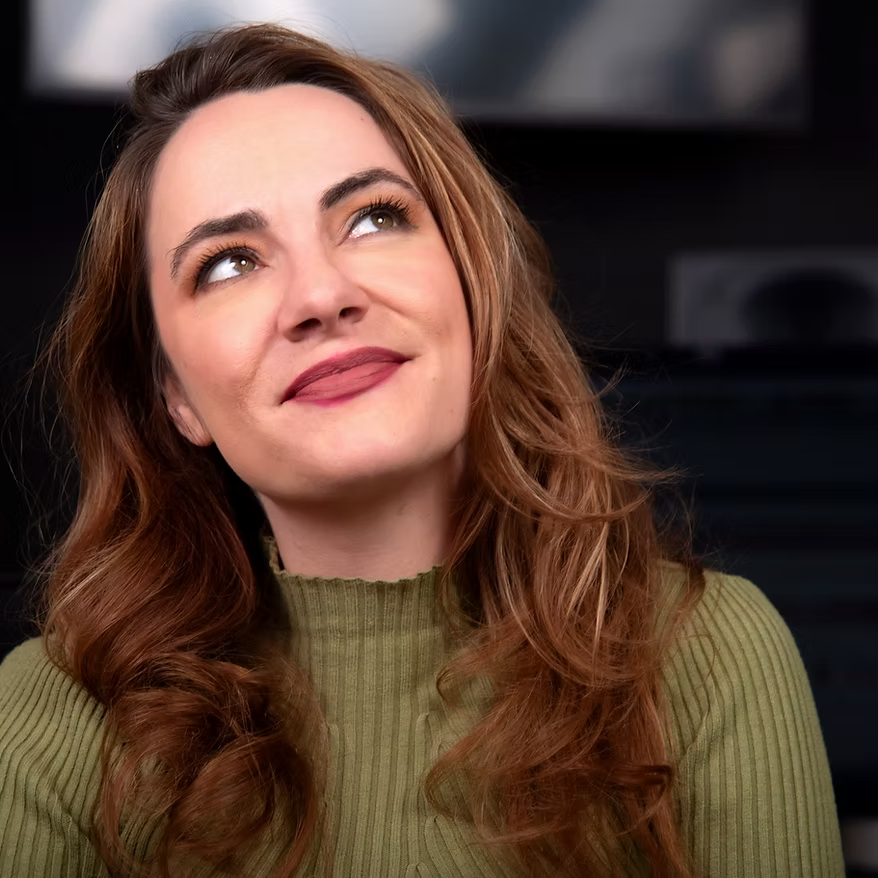
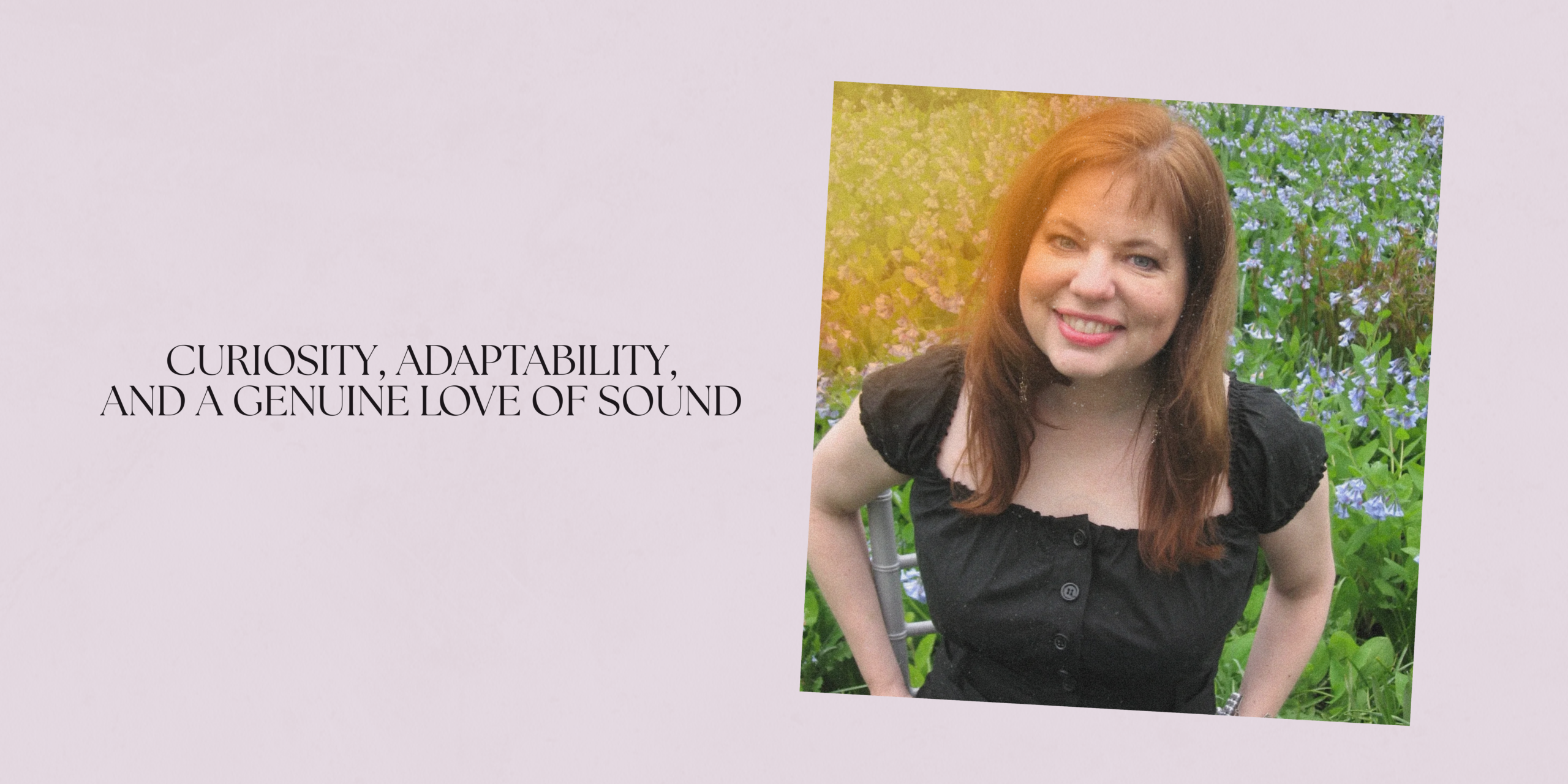
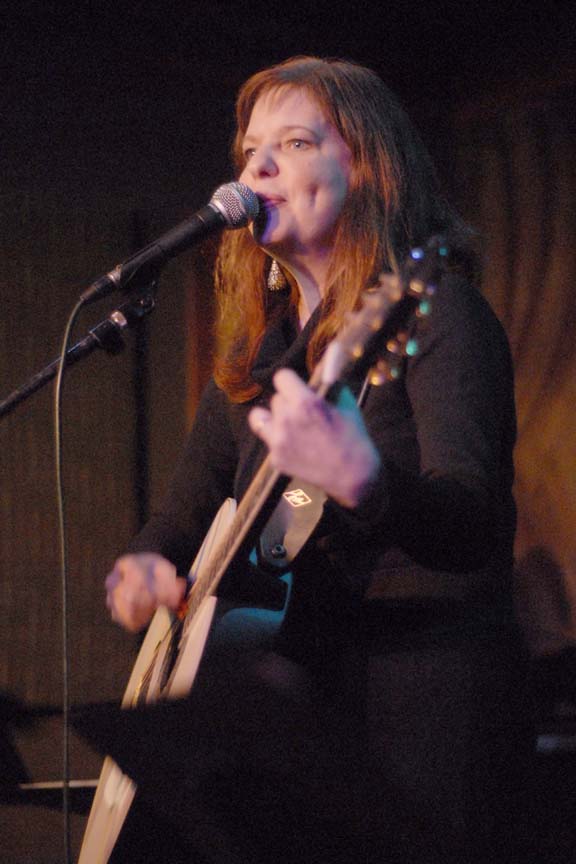
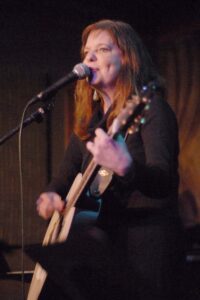
Joan Hammel is a Chicagoland-based singer, songwriter, and producer with over three decades of experience in both live and recorded audio. As the founder of Paxton Productions, Joan’s work spans performance, production, and engineering, rooted in a lifelong commitment to music and storytelling.
Raised in a deeply musical home, Joan was surrounded by a wide range of sounds from an early age, including diverse global recordings and nearly every genre of music across the United States. Both of her parents were musicians, and that early exposure shaped her open, curious approach to sound. She began performing professionally in high school, eventually putting herself through college through music without initially intending to pursue it as a long-term career.
Joan’s path into audio evolved organically from her work as a performer. Her early interest in sound was driven by a desire to present her voice and music at its best, leading her to learn how to mic and mix for live performances. In the studio, she developed her skills by closely observing engineers, asking questions, and expanding her role from contributor to session leader. Over time, she transitioned into producing and running sessions for both herself and other artists.
She studied at Columbia College Chicago, where her coursework included broadcasting, biology, theatre, and music, alongside extensive private study and training. While formal education played an important role, Joan credits hands-on experience and mentorship from respected producers and engineers as essential to her development.
Throughout her career, Joan has often been the only woman in the room across live performances, recording sessions, and industry spaces. While she remained focused on the work, she also navigated challenges with humor, grace, and a strong sense of personal boundaries—even when those choices came at a professional cost. Her experiences have shaped her perspective on resilience, integrity, and the importance of creating more inclusive spaces in audio.
Today, Joan continues to bring a deep musical sensibility, technical expertise, and collaborative spirit to every project, with a career defined by curiosity, adaptability, and a genuine love of sound in all its forms.
Career Beginnings
 How did you get your start in audio?
It really began with performing…
What were your first jobs, gigs, or internships like?
My first paid job was a wedding. It was not a big step as I had already been singing publicly in other spaces especially school. My next level up gigs had lots of rehearsals so the performance felt ready. It was a hard transition from rehearsed shows to doing shows that had little to no rehearsal as it felt like I was freefalling. After many years of learning to improvise in the moment as needed, you gain confidence to handle whatever happens on stage or in a professional setting. My first producing/engineering projects were for professional colleagues with whom I had friendships who asked me to do their albums. After that, the network expanded, more work happened, and I was eventually inducted into the Grammy Producers and Engineers Wing.
What skills or lessons did you learn early on that still serve you today?
Discipline has served me well, whatever the task at hand. Learning to break down big tasks into smaller doable steps was also a life lesson that has been incredibly helpful. It can be easy to feel overwhelmed especially when you are traveling in new territory. Breaking things down into specific jobs, figuring out how much time you think it might take to do it, and then putting first steps on a calendar to hold myself accountable helped me to better shape the use of daily and weekly time. Still a work in progress!
Did you have a mentor or someone who significantly supported your growth?
I would first have to mention my parents who were both encouraging in their own ways. In college, there was a performer/producer who mentored me in a number of ways, and with whom I still have a loving friendship. I would also like to add that there were a variety of adults that offered me advice when I was a young person on a personal level that helped me. My mom passed when I was a kid and my dad worked 2nd shift an hour away so the advice of those other adults spilled into my professional life particularly for making good life decisions and building on strengths.
What barriers did you encounter early in your career, if any?
One of them was having a music business partner for a while that was charming but deceitful. He had some very good qualities and was talented, but was also a thief and a liar. He was a well-known professional in our area so it took me a while to figure this out. I learned later that he had done similar things to others. It taught me ask to see all work contracts and learn how to negotiate them when I am doing the contracting.
Your Career Today
 What does a typical workday look like for you now?
I try to put in blocks of time to manage my tasks. My calendar is usually mapped out about a month or two out. I check emails in the morning to make sure I see whatever needs to be addressed. Afterward, I work on things on my goals list or other work that has come up. Life is very full as I have a lot of immediate and extended family/friends that I help so carving time for goals has to be flexible.
How do you stay organized and manage the demands of your work?
I keep a calendar with everything slotted in as needed. I make a goals list each January and keep it in view above my desk so I can see it regularly to stay on task. I also try to leave room for those things that always come up that are opportunities which I could not have planned.
What do you enjoy most about what you do?
I love that every day is different and that it involves so much creativity. Creating especially collaborating is the happy space for me!
What aspects of the job are the most challenging or least enjoyable?
Balancing my time is something I always feel like I want to do better. I always want more hours in the day.
If you tour or travel for work:
I love to travel. It is fun to see new places, learn something new or meet new people.
What do you find most difficult?
Sometimes just the logistics can be a challenge like long travel days, weather delays or leaving something back at the hotel.
What is your favorite way to spend a day off or time away from work?
I adopted a boy years ago who is now a teenager so watching him play travel basketball is a lot of fun. I also love to be outside whether it is gardening or just being out in nature. Time with family and friends fills my heart.
Challenges, Growth & Perspective
 What obstacles or systemic barriers have you faced in the industry?
Occasional misogyny and hidden sabotage by a couple of colleagues were some surprise obstacles. Thankfully, that only happened a couple of times and those people are long gone from the scene because of their behavior with others.
How have you navigated or pushed through those challenges?
You have to keep moving. Yes, acknowledge that it happened, at the very least to yourself, but don’t wallow in it. If you can affect change by going up the food chain in a professional way, then do that. One organization with a terrible local leader refused to listen to us about him, so we stopped complaining about him and started telling them that if they loved him so much, they should promote him to another market. They did and he was later fired for doing the things that we complained about.
Have you seen the industry change during your career? If so, how?
Support organizations like SoundGirls are here now and make such a huge impact. Yes, it provides professional experiences and knowledge, but it is also for the whole person with mental health resources and just the general support of one another that is so incredibly helpful. Also, there are more women around, which is awesome. It is exciting to see such excellence in new creatives and I think we are much better for banding together to be there for each other for both moral and professional support.
What still needs to change to better support women and marginalized genders in audio?
We still need to strive to have all music spaces be professional spaces like any corporate environment. Professional is professional. That doesn’t mean stuffy. That means safe, productive and that all employees are informed about standards of behavior. I also think it takes a shift in culture to think of hiring or bringing on a woman instead of just relying on the old network and status quo.
Advice & Looking Forward
 What advice would you give to women or young people interested in entering audio?
Spend as much time in a professional setting as you can. Even if you are not allowed to ask questions, observing is a powerful way to learn. Find a person you trust to let you tag along to sessions or live events. And the internet is a powerful tool loaded with helpful content.
What skills—technical or otherwise—do you think are essential for success?
Good ears! What I mean by that is being aware of what good sound is in the first place and then learning how to get what you are working on to meet those levels of excellence. I also think patience is essential. In a studio setting particularly, you may listen to the same song all day long over and over as it is worked on as the others try to create what they want. I would also add that being flexible is a great skill. Being easy to work with, while having helpful but not stubborn opinions, makes for a good team member.
What long-term goals or aspirations do you have?
I have some solo projects that I am working on as well as some collaborations. A new work I am composing is a choral piece for the Pope. I would also like to finish some solo recordings that have been waiting for an open window. Finally, I have also been asked to write more pieces for the stage, so I know that will happen by the end of the year.
Is there something you wish you had known earlier in your career?
To recognize and embrace the closed doors for the re-directional signs that they really are. It is a fine line between determination and recognizing when something is just not going to happen. I still try to figure out when to keep knocking on the door, and when to move on to the next one.
Favorites & Personal Touch
Favorite or most-used gear (and why):
For live shows, SM58 mic – it is the industry standard that most FOH engineers understand. And for the studio – a Neumann mic – it has good high end for female voices which other mics often miss.
A piece of gear you can’t live without:
Good mics!
A moment in your career that made you feel proud or affirmed:
While it has been really lovely to earn different awards, some of the most meaningful moments are the times when someone with whom I have worked has come back to me and given me sincere compliments that I made a real difference to them. I would also say that I am very proud to have been the singer on the America song which is a part of the National 9-11 Memorial and Museum in NY and also brought moving letters from survivors who were helped by the song.
Anything Else
Is there anything else you’d like to share or contribute?
I just wanted to add a few thoughts. My father had a great work ethic, and I think a lot of people in the Midwest have that. I always try to work hard and do my best in whatever situation I am in. It is not that I have confidence in myself per se, it is that I have confidence that hard work makes a difference by making the most of whatever the opportunity is in front of you. Not everyone can understand what your passion is, including those close to you, and some may even try to interfere. While it would be lovely to have someone believe in you and be a champion in your corner, you are the one who has to believe in the path and do the work. A friend’s mom told me that you can’t please everyone, and while that is an obvious truth, it is true, especially when it comes to making choices in your life. The most important person to please…is you! And finally, I hope that you will move through life with kindness whenever possible, as you will leave a loving footprint in people’s hearts and choosing kindness will come back to you in unexpected ways.