INTRO
Dynamic compressors are a vital part of the signal chain for audio engineering in a variety of scenarios. Their usage to tame the dynamic range of sound is important in giving listeners the ideal experience. The basic knowledge for using compressors remains the same across all the types; however, knowing the intricacies of each type can enhance the resulting mix, and enrich geeky curiosities. The “type” of compressor, in this article, will refer to the type of gain reduction element used in the circuit.
This article involved a lot of research and reading, so if one wants to read further on this topic, there are online and book sources provided at the end. But if one decides to engage in this rabbit hole, good luck.
REVIEW ON COMPRESSORS
A quick review about dynamic compressors. The basic intention of a dynamic processor is to alter the dynamic range of the audio material passed through. The dynamic range is the difference between the softest and loudest sound. A compressor is used to decrease the audio’s dynamic range. It is to avoid the scenario of a listener having their hand constantly on the volume knob, having to anticipate suddenly turning up the volume at super quiet sections and then turning down the volume when the audio is blasting to prevent their eardrums from bursting.
The basic controls we all know and love are tuned by the user to get the desired output. The threshold is the set level of the audio signal input that’s supposed to trigger the compressor to engage. The ratio controls how much compression is applied to the input signal. A ratio of “X:Y” said to mean that any signals X dB above the threshold gets attenuated by Y dB. The attack time is the time it takes from the uncompressed signal to become a fully compressed signal after the input signal goes over the threshold level. The release time is defined as the time it takes the compressed signal to go back to being an uncompressed signal after the input signal goes back below the threshold level.
Some compressors have additional features such as a knee control or makeup gain with the knee controlling the abruptness of the input signal goes between the compressed and uncompressed upon output. The makeup gain control is present to compensate for the decrease in overall level that’s inherent to the compression process. Another form of the makeup gain control is saying it has an output level control. Some compressors have a control to change how much input level, or uncompressed signal, will initially be sent into the compressor.
Compressors’ central mechanism is the gain reduction element. This usually involves the input signal getting split and routed into two separate paths: the detector path and output path. The detector path will determine how much compression the input signal will undergo in the output path. The output path, of course, undergoing the compression effect itself and routed to the output of the compressor and is what gets heard by the user.
VCA COMPRESSOR TYPES
The first type of gain reduction element to be examined in compressors will be the VCA compressor type. VCA stands for “voltage-controlled amplifier.” The “VCA compressor” designation indicates that the VCA is housed in an integrated circuit chip. These types of compressors are sought after for their ability to have fast attack and release times, transparent and clean sound, and precision in user controls. The fast attack and release times make this type the ideal for controlling and catching transient spikes. VCA compressor types are most likely to have all of the controls everyone is used to seeing and associating with compressors and are the most common.
In the gain reduction circuit for VCA compressors, the integrated circuit (IC) chip contains transistors that read the input signal/voltage. This chip splits the signal into the detector and output paths. Back in the days of analog consoles, consoles had VCA faders. The engineer would switch what other channel faders, on the console, that they wanted to control in a group by linking said channel faders to the VCA group. Then the engineer would be able to physically move the VCA fader level up and down. The VCA fader movement would enable the engineer to control the overall level of the channel faders in the VCA group while maintaining the relative fader mix of those channel faders.
In the VCA compressor, the control signal can be thought of in a way as the engineer moving that VCA fader level up and down, controlling if the signal level in the output path is brought up or down. Among the many things one can use, voltage is capable of being used to control the amount of signal that passes through the VCA. The input signal is copied, and one copy goes to the control path, the other is sent to the audio path. The one in the control path gets converted to DC and then undergoes other alterations through resistors and capacitors based on the user settings of attack and release times. Then, the altered converted DC signal makes its way to the VCA where the effect of the ratio is determined by the levels of the audio signal path input and the altered DC signal being compared. A bigger level difference means the VCA applies more gain reduction. With the IC chip, there’s great precision over gain reduction and an ability to fine tune the sound along with the user’s ability to affect the control path through the front panel controls.
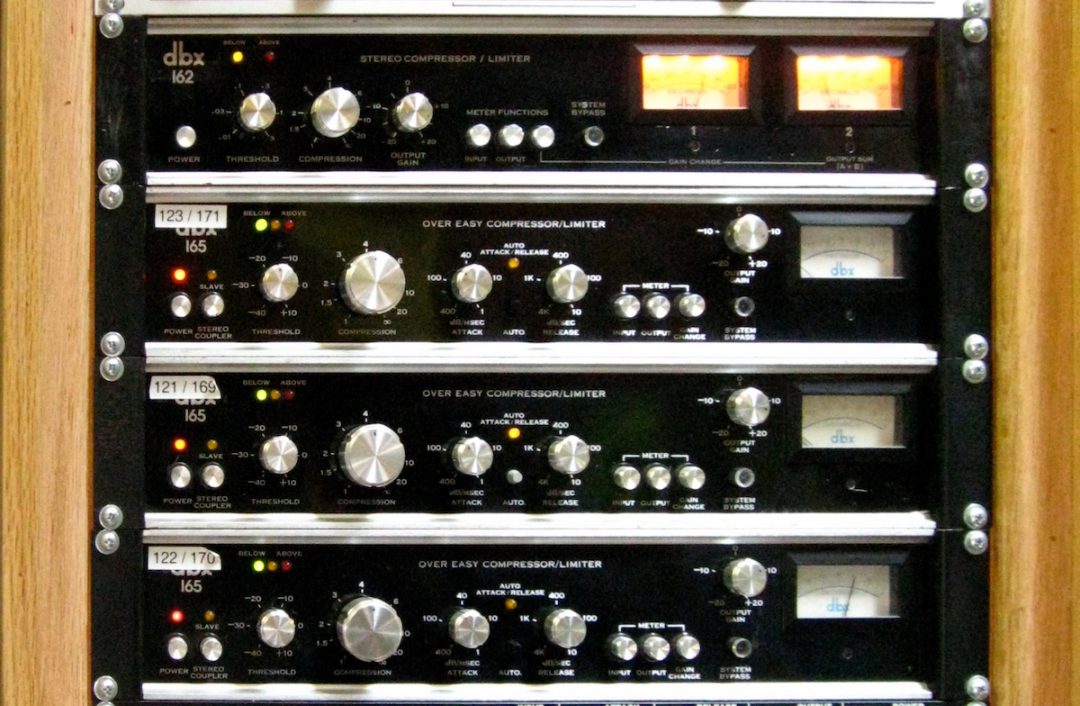
One of the examples that a lot of articles name as the go-to example of the VCA-type compressor is the dbx 160. Other examples include the SSL G and SSL E buss compressors, the API 2500, Empirical Labs EL8 Distressor, Focusrite Red 3 and Red 7, Smart Research C2, Alesis 3630, Maxon CP9 Pro Plus, and the Boss CS-3.
FET COMPRESSOR TYPES
Compressors with this type of gain reduction element were designed with the idea to emulate the sound of compressors with vacuum tube gain reduction elements (more on that later) by use of solid state and transistor circuits. FET stands for “field effect transistor.” These compressors are claimed to be more suited when engineers desire a more aggressive compression on the sound. They usually brag a feedback design and give a program-dependent compressor. Their sonic characteristics include being described as punchy, bright, colorful, and being able to preserve transient information. Colorful merely means the compressor adds harmonic distortion that wasn’t present in the original input signal. Another way of thinking of that is saying the FET compressors are less clean sounding than the VCA compressors, for the most part. These for the most part use the feedback configuration.
FET’s are a type of transistor. The word transistor comes from the words “transmitter” and “resistor” put together. A transistor is a type of semiconductor. Semiconductor atoms require a certain amount of charge to conduct electricity, putting them in between being an insulator and a conductor. The FET is a 3-terminal unipolar device, so it depends on one type of charge carrier: electrons or holes. These are voltage-controlled devices. The input voltage determines the output current. The terminals include the drain, source, and gate(s). The gates are located on the sides of the FET and control current flow. The current flow is dependent on the drain-source voltage and drain-source resistance.
In FET compressors, the FET is used as a voltage-controlled variable resistor, where the FET would be the resistor with a resistance that’s determined by the voltage applied to its gate. More voltage applied to the FET gate means a smaller drain-source resistance. Lower FET resistance results in less gain from the FET, so higher strength input signals make the FET reduce in gain, resulting in the reduced signal level.
The famous FET compressor everyone refers to first is the UREI 1176. It also had a less famous stereo version called the UREI 1178. Other FET compressors include the Chandler Little Devil and Daking FET III.
OPTICAL “OPTO” COMPRESSOR TYPES
Electro-optical (opto). compressors employ light-sensitive resistors (LSR) and photocells in their compression mechanism. These compressors are said to be ideal for averaging and smoothing out the dynamics instead of catching transients.
As the name would indicate, the gain reduction circuits from these compressors center around the element of light. The optical isolator circuit inside the compressor is made up of this newly transduced light source and a photocell. Even though audio signal gets converted into voltage by a microphone (a transducer), there is another transducer that converts the voltage into a light signal with proportional brightness in the compressor. The photocell is the detector. The audio signal (voltage), now transduced into light has a brightness that corresponds to the amplitude of the input signal. A higher input signal strength means a brighter light. This light usually is in the form of a light bulb or light emitting diode (LED). The light shines onto a light-sensitive resistor (LSR) which has less resistance when exposed to higher brightness of light. A higher input signal means the light bulb or LED shines brighter onto the LSR. This means the LSR resistance decreased. This LSR is usually configured in a feedback loop or voltage configuration that determines how the input signal will be altered in the output path.
The amount of resistance in the light sensitive element in the LSR determines how much and how fast the compression circuit brings down the input signal when it goes over the threshold. The time it takes for the filament in the light bulb to adjust to the signal input strength is relatively slow (compared to the other compressor types). There’s a lag time between the detection of the light and acting gain reduction on the input signal. There’s also a very nonlinear attack and release response. A big transient may have a quick initial release, but this characteristic will eventually become nonlinear as the output becomes uncompressed again. This is why the opto compressors are not recommended for straight-up taming of transients.
As mentioned, these types of compressors are said to be more ideal in smoothing and averaging out the dynamics. In the days of yore, the light and light sensitive resistor were separate parts, but today the light and LSR are found in one small cylinder. Originally, they were used a lot on bass and guitar tracks, but of course everyone uses them everywhere now.
The big name among opto compressors out there is the Teletronix LA-2A. It’s relative, the Teletronix LA-3A, is also of the opto compressor type. Other opto compressors include the Manley Laboratories ELOP (stands for “Electro Optical”) Limiter, Avalon AD2044, and Shadow Hills Mastering compressor.
VACUUM TUBE AND DELTA-MU COMPRESSOR TYPES
These compressors rely on vacuum tubes as their gain reduction element. “Delta” is a Greek letter and in science is used as a symbol meaning change. The special trait of the tube compressors is their nonlinear compression characteristic resulting in a compression ratio that’s automatically adjusted based on gain reduction and not by the user, which is why these compressors don’t really ever have a separate ratio control. A lot of other compressors use tubes in their circuitry but can’t be defined as a tube compressor because their use of tubes in the circuit is to color the sound instead of using the tube as a gain reduction element. Tube compressors are said to be gentle hitting with a slower reaction than other types, able to add warmth and color, adding good saturation characteristics, and having pleasant distortion.
These compressors live and breathe by their vacuum tubes also known as valves. The Edison Effect says that if a light bulb, where its air has been removed, electrons will flow from the light bulb’s heated filament to a separate electrode. The parts of a vacuum tube include the cathode, electrode(s), anode(s), and envelope. The cathode is what gets heated to supply electrons. An electrode is a part that controls and collects the electrons supplied by the cathode. The anode is a positive electrode. It supplies positive voltage in the space around the cathode. The envelope is where the electrodes are mounted. The plate is usually one of the anodes of the tube, and the goal during operation is for the electrons to flow from the negatively charged cathode to the positively charged plate, which only works if there’s a positive voltage applied to the plate.
As more electrodes and anodes are added to the tube configuration, there’s a different name for the tube. With three electrodes, it’s referred to as a triode. This is where another electrode, the control grid, is put between the cathode and plate. If the plate is positively charged in this setup, the control grid’s DC voltage becomes more negative, repelling more electrons, so the plate current decreases. Correspondingly, if the control grid’s DC voltage is more positively charged, the plate will attract more electrons, increasing the plate’s current. So, in the triode, the plate current varies with the applied signal voltage. Add another electrode, screen grid, between the control grid and the plate, then the tube is called a tetrode. Add a fifth electrode, the suppressor grid, to the cathode, and now the tube can be called a pentode.
In vacuum tubes, as the input signal increases, less current will go to the control grid (one of the electrodes of the vacuum tube), meaning the output signal level decreases. The control grid is where the input usually gets applied. It controls the electron flow between the cathode and another part of the tube called the plate. The plate is where the output is usually taken from. The delta-mu type tube is a pentode vacuum tube built with a special grid. The gain in the grid can be varied by raising the negative bias on the control grid.
The Manley Laboratories Variable Mu® is the unit that usually comes to mind nowadays when thinking of a delta-mu type compressor. This compressor operates based on its re-biased vacuum tube. So much, in fact, the term Variable Mu® is used more in the engineer vernacular than “delta-mu” today. Manley Laboratories has owned the trademarked Variable Mu® term since the year 2000.
A variable-mu tube, in the prime days of radio broadcasting, was also called a remote-cutoff amplifier tube. This was a specific type of tetrode or pentode, made to reduce modulation distortion and cross modulation. It’s claim to fame is being able to handle both large and small strength input signals in a large dynamic range with a result that yields minimum levels of distortion. The remote-cutoff tube’s grid is specifically structured to allow a variation in the tube’s amplification factor due to any change in the grid’s bias. The control grid is specially wound with open spacing in the middle and closed space at its end. So, if low strength input is applied to the tube’s input, the grid bias will be low and the tube output acts like a normal tube. But as the input signal increases, the grid bias will become more negative to handle this, so the electrons flowing from the end cathode sections (that have winding that’s not as spaced) will get cutoff, meaning the plate current will only have the middle section of the cathode (with the spaced out winding) to rely on to operate. The result is the tube’s gain has changed so the larger signal doesn’t get distorted.
The other famous delta-mu compressors are the Fairchild 660 and its relative the Fairchild 670. Other delta-mu compressors include the RCA BA-6A, Altec 436, Universal Audio 175, Universal Audio 176, Collins 26UI, Collins 356E1, Federal AM864U, and the Gates Sta-Level.
OTHER TYPES OF COMPRESSORS
These types of compressors also exist, but you don’t really hear about them as much for various reasons. It was probably due to complexity or money.
There are the diode ring compressors. Diodes are components that only allow electrons to flow in one direction. These are based on the diode ring or diode bridge configuration and are said to add color due to the inherent harmonic distortion from the diodes and the transformers in the circuitry. The input signal is sent through 2 opposite corners of the diode bridge, and a control signal is sent across the other 2 opposite corners of the diode bridge. The diodes act as a VCA but only in a certain range and under a bunch of specific circumstances and specific transformer setup. Then the diodes’ conductance varies with applied voltage. Even then, it requires a bunch of other specific conditions before it starts being compressed. These compressors have a long and proud history in radio broadcasting for auto level control but aren’t really seen in the modern compressor scene. The compression curves, attack, and release characteristics can be independently configured from the compression element in the circuit. Some examples include the Neve 2264, Neve 33609, Neve TG12413, Chandler TG1, Chandler TG12413 Zener, Rupert Neve Designs 5254, and the Rupert Neve Shelford Channel Strip Compressor.
There are compressors based on operational transconductance amplifiers (OTA). The circuitry, in the simplest terms, can be thought of like a VCA chip, but the output is a varied current instead of a varied voltage. Transconductance is a measurement of amplifier gain that relates input voltage with output voltage. Usually, transconductance is measured in Siemens. The OTA has a pair of differential inputs and a single output. The output is a current. The gain in the OTA is expressed as conductance. The inner workings of this compressor go beyond this article. The epitome OTA-based compressor is the original MXR Dyna Comp. It ran on the CA3280 OTA originally manufactured by RCA and released in 1971. The original CA3280’s are not manufactured anymore. There were a lot of company acquisitions and mergers that ultimately led to MXR being buried somewhere under the reorganized Intersil (not the original Intersil – it’s a rabbit hole if one chooses to research further). Now the modern alternatives that don’t live up to the original, according to many, include the LM13600 (also discontinued as of 2005) LM13700 – both licensed by National Semiconductor. The rarity of the original CA3280 as a replacement part no doubt contributes to the lack of mentions of the OTA-type compressors.
MORE COMPRESSOR TRIVIA
Remember that a dynamic equalizer is NOT the same as a multi-band compressor. The multi-band compressor involves the frequency range getting split into bands via crossover networks (in a passive circuit). Each of these split frequency bands has a fixed center frequency and each of them get their own dedicated compression controls. In a dynamic equalizer, the crossover filter EQ slopes are not fixed so the user can the center frequency of the frequency band they want to compress.
Sometimes on compressors, there’s an option near the release called “auto-release.” This means each of the time constant circuits in the unit will have different dedicated capacitors for different input signal level. The loudest signal voltages will charge one of the capacitors that’s set to have a super quick discharge time. The quietest signals will have a capacitor that’s set to have the slow discharge time. There may be other capacitors that are set to work with input signals with levels in between loudest and quietest levels. This setup allows a more natural sounding release and recovery to the uncompressed state on a signal. Once the signal goes below the threshold, the recovery back to uncompressed is initially quick, but then slows down, with the intention to avoid the pumping effect and goal of letting ambient noise not being so obvious.
CONCLUSION
With the various sources viewed in researching for this article, the best conclusion that can be drawn about analog compressor types is that one needs to find a hardware unit or watch videos of people with them to hear different output qualities of different compressor types. The different opinions of people’s subjective experience with each one, compounded with the added ideas of using it outside of intended straightforward level control, means one needs to draw their own conclusion about the different types of compressor gain reduction circuits. Just use your ears.
Technical Consultants
EveAnna Dauray Manley
Robert Morin
Joe Vezzetti
Online Sources (there are a lot)
audiohertz.com/2017/08/07/what-are-the-different-types-of-compressors/
create.routenote.com/blog/what-are-the-different-types-of-compressors/
masteringtuition.com/tutorial/limiters/
reverb.com/news/reverbs-guide-to-audio-compressor-types
reverb.com/news/what-are-the-types-of-compressor-effects-the-basics
samplecraze.com/product/multiband-compression/
smmastering.com/know-the-types-of-compressors-and-how-they-work/
samplecraze.com/product/the-4-modes-of-compression/
samplecraze.com/tutorials/compressor-types-fet-opto-vca-and-vari-mu/
till.com/blog/archives/2005/06/last_of_the_ota.html
www.electrosmash.com/mxr-dyna-comp-analysis
www.izotope.com/en/learn/4-types-of-analog-compression-and-why-they-matter-in-a-digital-world.html?srsltid=AfmBOopVMibVnl0jLRv7qAw7HkYe62-k44-I9FZIMLXfFHPPYhnEdh13
www.manley.com
www.masteringbox.com/learn/audio-compressors-vca-opto-fet-compression-circuit-types
www.ovnilab.com/articles/comptypes.shtml
www.practical-music-production.com/different-types-of-audio-compressors/
www.soundonsound.com/techniques/compressor-circuits
www.soundonsound.com/sound-advice/q-what-does-compressors-auto-release-control-do
www.soundonsound.com/techniques/classic-compressors
www.uaudio.com/blog/audio-compression-basics/?srsltid=AfmBOormoeJAm-pluO8DNk7SlMMXn7A2UdLaOWnfzxn1brtjyfpmF6fc
www.uaudio.com/blog/teletronix-la-3a-origins/
www.uaudio.com/blog/tube-v-solid-state-compressors/
www.youtube.com/watch?v=_4mgsNN7glo
Books and Scanned PDFs
Audio Cyclopedia 2nd ed.; Howard M. Tremaine; 1979
Grob’s Basic Electronics 11th ed. Mitchel E. Schultz, 2011
Manley ELOP®+ Owner’s Manual Manley Laboratories, Inc., 2015
Manley Stereo Variable Mu® Owner’s Manual Manley Laboratories, Inc., rev. Oct. 2023
Model 1176LN Solid-State Limiting Amplifier Universal Audio, Inc. 2009
RCA Receiving Tube Manual 1975