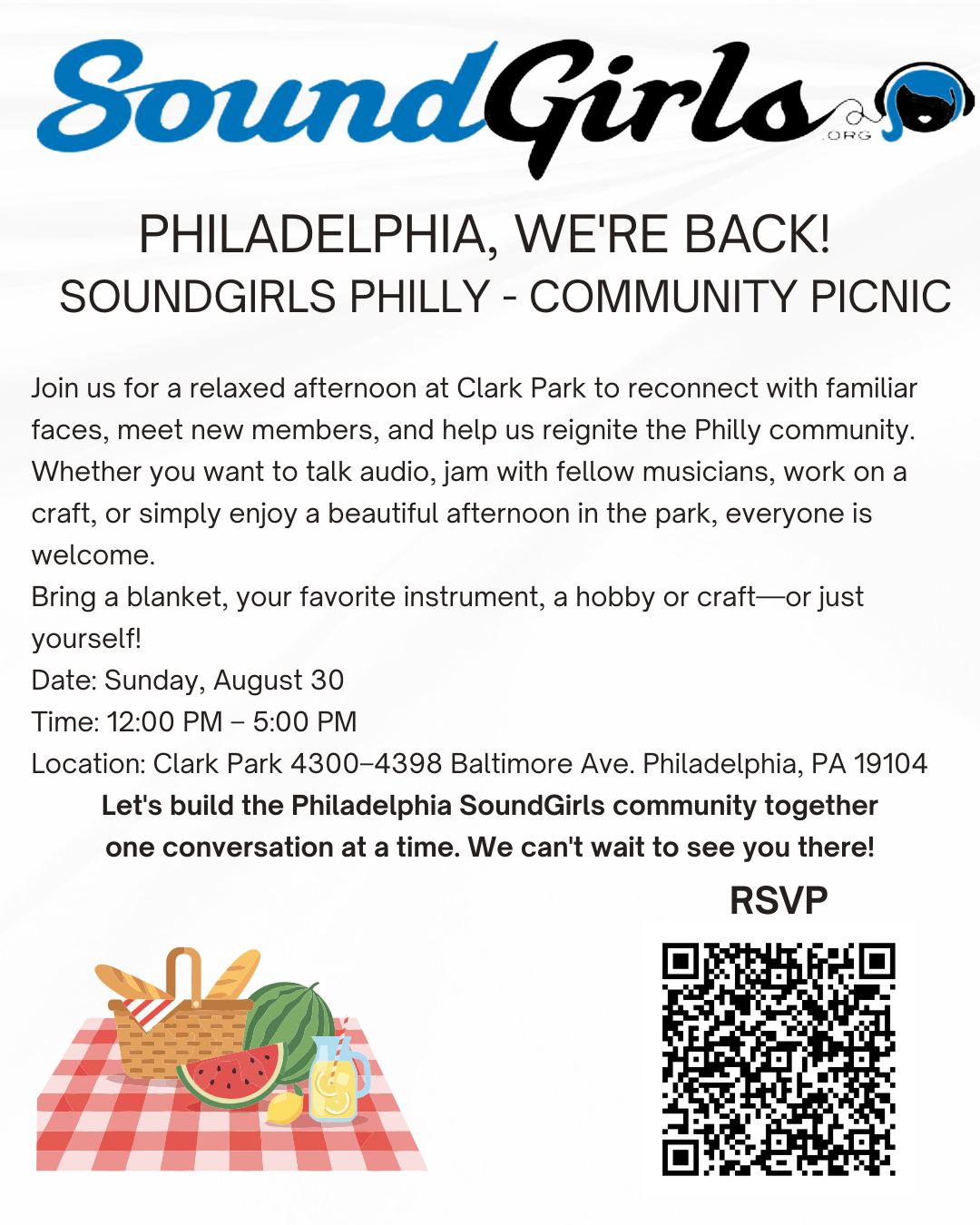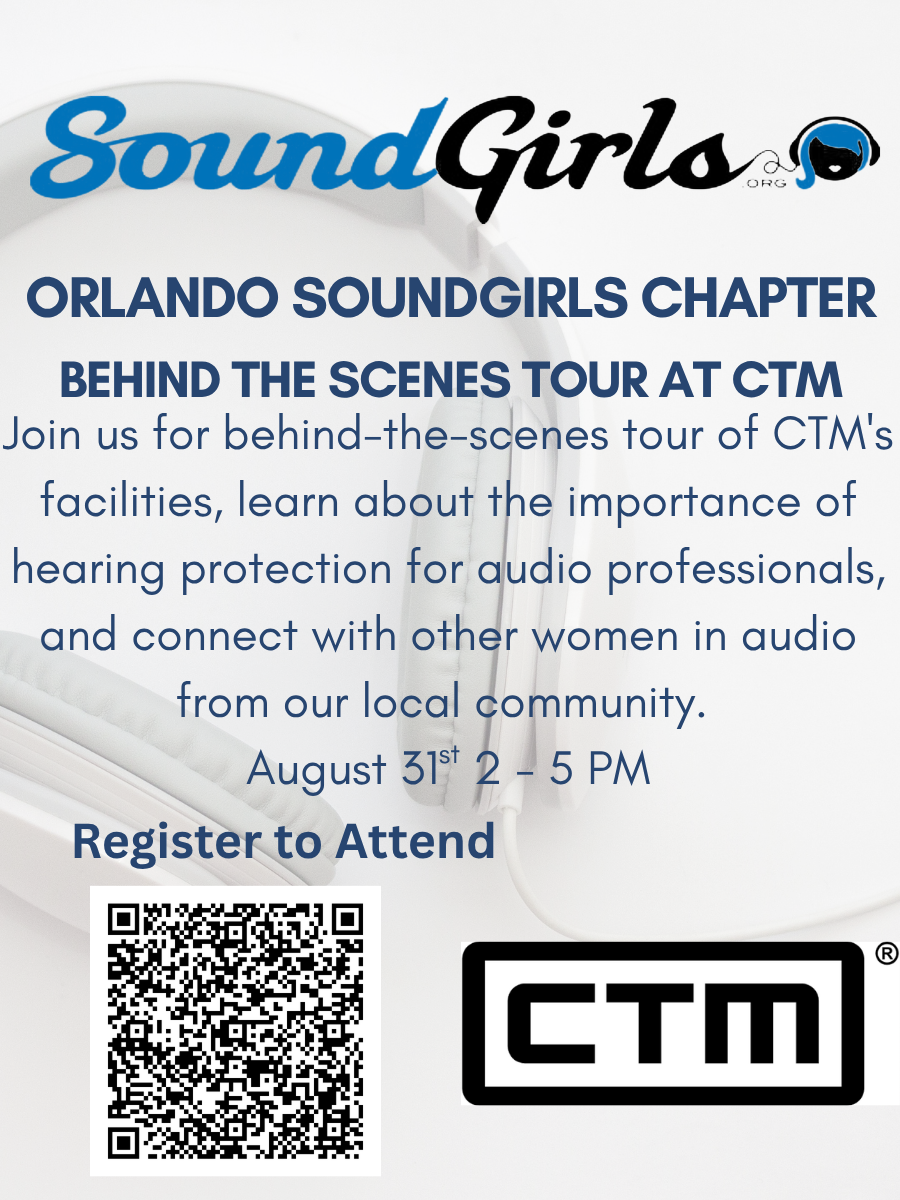
Empowering the Next Generation of Women in Audio

Join Us

Inside the Mix with Atmos Engineer Eva Reistad

Join SoundGirls for an afternoon conversation and listening session with Atmos mix engineer Eva Reistad at Fancy.

Fancy Film Post Services (address will be emailed with confirmation)

June 7, 2026
1–4 PM PDT

Eva will break down the anatomy of a recent mix, share her path into immersive audio and Atmos engineering, and discuss her creative process followed by a Q&A.

Pizza, snacks, and time to connect with fellow attendees will be available throughout the afternoon.

Register Here

Space is limited registering does not guarantee your spot. You will receive a confirmation email with location address.


Eva Reistad is a Grammy-winning audio engineer recognized for her range of work across all genres of music (An Adoption Story), film (Naked Gun, Planet Earth, Alien, Dune), and live sound (Hans Zimmer). Eva has engineered for acclaimed artists and engineers on projects that push creative and technical boundaries, earning a reputation for her knowledge of different audio platforms, thoughtful collaboration, and attentive ear. Beyond the studio, she is a passionate advocate for inclusion and mentorship in the audio industry, regularly speaking on panels about the industry, career growth, and the evolving role of women in sound. Whether behind the console or in front of an audience, Eva brings an authentic, inspiring voice to the craft of engineering and the art of listening.

Joan Hammel – Singer, Songwriter, and Producer

Joan Hammel is a Chicagoland-based singer, songwriter, and producer with over three decades of experience in both live and recorded audio. As the founder of Paxton Productions, Joan’s work spans performance, production, and engineering, rooted in a lifelong commitment to music and storytelling.

Raised in a deeply musical home, Joan was surrounded by a wide range of sounds from an early age, including diverse global recordings and nearly every genre of music across the United States. Both of her parents were musicians, and that early exposure shaped her open, curious approach to sound. She began performing professionally in high school, eventually putting herself through college through music without initially intending to pursue it as a long-term career.

Joan’s path into audio evolved organically from her work as a performer. Her early interest in sound was driven by a desire to present her voice and music at its best, leading her to learn how to mic and mix for live performances. In the studio, she developed her skills by closely observing engineers, asking questions, and expanding her role from contributor to session leader. Over time, she transitioned into producing and running sessions for both herself and other artists.

She studied at Columbia College Chicago, where her coursework included broadcasting, biology, theatre, and music, alongside extensive private study and training. While formal education played an important role, Joan credits hands-on experience and mentorship from respected producers and engineers as essential to her development.

Throughout her career, Joan has often been the only woman in the room across live performances, recording sessions, and industry spaces. While she remained focused on the work, she also navigated challenges with humor, grace, and a strong sense of personal boundaries—even when those choices came at a professional cost. Her experiences have shaped her perspective on resilience, integrity, and the importance of creating more inclusive spaces in audio.

Today, Joan continues to bring a deep musical sensibility, technical expertise, and collaborative spirit to every project, with a career defined by curiosity, adaptability, and a genuine love of sound in all its forms.

Career Beginnings

How did you get your start in audio? 

It really began with performing…

What were your first jobs, gigs, or internships like?

My first paid job was a wedding. It was not a big step as I had already been singing publicly in other spaces especially school. My next level up gigs had lots of rehearsals so the performance felt ready. It was a hard transition from rehearsed shows to doing shows that had little to no rehearsal as it felt like I was freefalling. After many years of learning to improvise in the moment as needed, you gain confidence to handle whatever happens on stage or in a professional setting. My first producing/engineering projects were for professional colleagues with whom I had friendships who asked me to do their albums. After that, the network expanded, more work happened, and I was eventually inducted into the Grammy Producers and Engineers Wing.


What skills or lessons did you learn early on that still serve you today?

Discipline has served me well, whatever the task at hand. Learning to break down big tasks into smaller doable steps was also a life lesson that has been incredibly helpful. It can be easy to feel overwhelmed especially when you are traveling in new territory. Breaking things down into specific jobs, figuring out how much time you think it might take to do it, and then putting first steps on a calendar to hold myself accountable helped me to better shape the use of daily and weekly time. Still a work in progress!

Did you have a mentor or someone who significantly supported your growth?

I would first have to mention my parents who were both encouraging in their own ways. In college, there was a performer/producer who mentored me in a number of ways, and with whom I still have a loving friendship. I would also like to add that there were a variety of adults that offered me advice when I was a young person on a personal level that helped me. My mom passed when I was a kid and my dad worked 2nd shift an hour away so the advice of those other adults spilled into my professional life particularly for making good life decisions and building on strengths.

What barriers did you encounter early in your career, if any?

One of them was having a music business partner for a while that was charming but deceitful. He had some very good qualities and was talented, but was also a thief and a liar. He was a well-known professional in our area so it took me a while to figure this out. I learned later that he had done similar things to others. It taught me ask to see all work contracts and learn how to negotiate them when I am doing the contracting.

Your Career Today

What does a typical workday look like for you now?

I try to put in blocks of time to manage my tasks. My calendar is usually mapped out about a month or two out. I check emails in the morning to make sure I see whatever needs to be addressed. Afterward, I work on things on my goals list or other work that has come up. Life is very full as I have a lot of immediate and extended family/friends that I help so carving time for goals has to be flexible.

How do you stay organized and manage the demands of your work?

I keep a calendar with everything slotted in as needed. I make a goals list each January and keep it in view above my desk so I can see it regularly to stay on task. I also try to leave room for those things that always come up that are opportunities which I could not have planned.

What do you enjoy most about what you do?

I love that every day is different and that it involves so much creativity. Creating especially collaborating is the happy space for me!

What aspects of the job are the most challenging or least enjoyable?

Balancing my time is something I always feel like I want to do better. I always want more hours in the day.

If you tour or travel for work:

I love to travel. It is fun to see new places, learn something new or meet new people.

What do you find most difficult?

Sometimes just the logistics can be a challenge like long travel days, weather delays or leaving something back at the hotel.

What is your favorite way to spend a day off or time away from work?

I adopted a boy years ago who is now a teenager so watching him play travel basketball is a lot of fun. I also love to be outside whether it is gardening or just being out in nature. Time with family and friends fills my heart.

Challenges, Growth & Perspective

What obstacles or systemic barriers have you faced in the industry? 

Occasional misogyny and hidden sabotage by a couple of colleagues were some surprise obstacles. Thankfully, that only happened a couple of times and those people are long gone from the scene because of their behavior with others.

How have you navigated or pushed through those challenges?

You have to keep moving. Yes, acknowledge that it happened, at the very least to yourself, but don’t wallow in it. If you can affect change by going up the food chain in a professional way, then do that. One organization with a terrible local leader refused to listen to us about him, so we stopped complaining about him and started telling them that if they loved him so much, they should promote him to another market. They did and he was later fired for doing the things that we complained about.

Have you seen the industry change during your career? If so, how? 

Support organizations like SoundGirls are here now and make such a huge impact. Yes, it provides professional experiences and knowledge, but it is also for the whole person with mental health resources and just the general support of one another that is so incredibly helpful. Also, there are more women around, which is awesome. It is exciting to see such excellence in new creatives and I think we are much better for banding together to be there for each other for both moral and professional support.

What still needs to change to better support women and marginalized genders in audio?

We still need to strive to have all music spaces be professional spaces like any corporate environment. Professional is professional. That doesn’t mean stuffy. That means safe, productive and that all employees are informed about standards of behavior. I also think it takes a shift in culture to think of hiring or bringing on a woman instead of just relying on the old network and status quo.

Advice & Looking Forward

What advice would you give to women or young people interested in entering audio?

Spend as much time in a professional setting as you can. Even if you are not allowed to ask questions, observing is a powerful way to learn. Find a person you trust to let you tag along to sessions or live events. And the internet is a powerful tool loaded with helpful content.

What skills—technical or otherwise—do you think are essential for success?

Good ears! What I mean by that is being aware of what good sound is in the first place and then learning how to get what you are working on to meet those levels of excellence. I also think patience is essential. In a studio setting particularly, you may listen to the same song all day long over and over as it is worked on as the others try to create what they want. I would also add that being flexible is a great skill. Being easy to work with, while having helpful but not stubborn opinions, makes for a good team member.

What long-term goals or aspirations do you have?

I have some solo projects that I am working on as well as some collaborations. A new work I am composing is a choral piece for the Pope. I would also like to finish some solo recordings that have been waiting for an open window. Finally, I have also been asked to write more pieces for the stage, so I know that will happen by the end of the year.

Is there something you wish you had known earlier in your career?

To recognize and embrace the closed doors for the re-directional signs that they really are. It is a fine line between determination and recognizing when something is just not going to happen. I still try to figure out when to keep knocking on the door, and when to move on to the next one.

Favorites & Personal Touch

Favorite or most-used gear (and why):

For live shows, SM58 mic – it is the industry standard that most FOH engineers understand. And for the studio – a Neumann mic – it has good high end for female voices which other mics often miss.

A piece of gear you can’t live without:

Good mics!

A moment in your career that made you feel proud or affirmed:

While it has been really lovely to earn different awards, some of the most meaningful moments are the times when someone with whom I have worked has come back to me and given me sincere compliments that I made a real difference to them. I would also say that I am very proud to have been the singer on the America song which is a part of the National 9-11 Memorial and Museum in NY and also brought moving letters from survivors who were helped by the song.

Anything Else

Is there anything else you’d like to share or contribute?

I just wanted to add a few thoughts. My father had a great work ethic, and I think a lot of people in the Midwest have that. I always try to work hard and do my best in whatever situation I am in. It is not that I have confidence in myself per se, it is that I have confidence that hard work makes a difference by making the most of whatever the opportunity is in front of you. Not everyone can understand what your passion is, including those close to you, and some may even try to interfere. While it would be lovely to have someone believe in you and be a champion in your corner, you are the one who has to believe in the path and do the work. A friend’s mom told me that you can’t please everyone, and while that is an obvious truth, it is true, especially when it comes to making choices in your life. The most important person to please…is you! And finally, I hope that you will move through life with kindness whenever possible, as you will leave a loving footprint in people’s hearts and choosing kindness will come back to you in unexpected ways. 

Free JBL Training Opportunities for SoundGirls Members – Los Angeles (June 2–4, 2026)

We’re excited to share a great opportunity from our partners at JBL for SoundGirls members in the Los Angeles area.

JBL is offering 10 free spots for SoundGirls members to attend their VTX 2-Day Training on June 2–3, 2026 at their Los Angeles headquarters in Northridge.

In addition, there are 10 free spots available for the Venue Synthesis Prediction Software Training on June 4, 2026.

This is a valuable opportunity to gain hands-on experience with JBL’s VTX systems and deepen your knowledge of system design and prediction software—skills that are increasingly in demand across live sound and installation environments.

Attendees of the VTX training will also receive a behind-the-scenes tour of JBL’s development facility, offering a rare look into the technology and engineering behind their products. Members of the JBL team will be onsite, including Daniella Peters, who will be there on June 2 to welcome participants.

JBL also regularly receives requests for referrals of trained engineers, making this training not only educational but potentially beneficial for future work opportunities.

If you’re interested, you can sign up here

For any questions, you can reach out directly to Dale West at dale.west@harman.com.

Spots are limited, so we encourage you to sign up soon.

She Rocks® Showcase Lights Up Lodi, CA on July 25, 2026

The Women’s International Music Network is seeking a Live Sound Engineer and Intern for this event. These are paid positions $350 for the Engineer position and $175 for the Intern position.  If you are interested in either of these positions send your resume to soundgirls@soundgirls.org. In the subject line please WIMN – Sound Engineer or WIMN – Intern.

She Rocks® Showcase Lights Up Lodi, CA on July 25, 2026
Live music event featuring female-fronted artists set for July 25 at Five Window Beer Co.

This exciting new live music event will feature a dynamic lineup of female-fronted bands and women artists, celebrating creativity, confidence, and the power of women on stage. Building on the legacy of WiMN’s globally recognized She Rocks Awards, the showcase brings that same spirit of empowerment and community into a vibrant live performance setting.

The evening will highlight a mix of emerging and established talent from across the region, offering audiences the opportunity to discover new artists while enjoying a high-energy, community-driven experience.

Performers include:
The Heracanes
The Sweet Taunts
Isolde Fair
Tia Penny
And more…

“The She Rocks Showcase is about creating a platform where women artists can be seen, heard, and celebrated,” said Laura B. Whitmore, founder of the Women’s International Music Network. “We’re excited to bring this energy to Lodi and build something that connects artists and audiences in a meaningful way.”

The event will take place from 4:00 PM to 10:30 PM at Five Window Beer Co., known for its lively atmosphere and strong ties to the local community. Attendees can expect an engaging indoor/outdoor experience, artist merch, and special activities throughout the evening.

The She Rocks Showcase is made possible with support from sponsors including:
Sponsor name

Tickets are $15 and are available at:
https://givebutter.com/she-rocks-showcase-july-2026


DiGiCo and L-Acoustics Workshop – U.K.

Join us for an exclusive workshop with DiGiCo and L-Acoustics where you’ll gain experience with the DiGiCo T software and L-Acoustics L-ISA Processor hear advanced spatial audio mixing techniques. You’ll gain experience with the L-ISA Processor and learn more about DiGiCo’s Industry-standard Theatre Software extension. This session is designed for creatives, audio professionals and engineers, looking to explore immersive sound mixing and elevate their creative approach.

May 27, 2026 – 9:30 to 4:30 GMT

Location: Highgate Studios in Kentish Town. (Specific location will be sent after confirmation of attendance).

Note: This event is open to 15 People and is in-person. Please only sign up if you can attend. We will be confirming everyone’s attendance before sending out confirmation and location.  Thank you for your understanding.

Register to attend here

In this workshop you will learn:

Whether you’re mixing for musicals, plays, special events, concerts, corporate events, or immersive installations, this workshop will give you the knowledge to step confidently into the future of sound.

Why Does This Sound So Good?

 Vol. 2: The Art of Loving by Olivia Dean

I have never been so in love with an album’s lyrical content that I did not pay much attention to the production of the album until much later. The Art of Loving by Olivia Dean did that for me, though. Dean has a relatable yet complex way of expressing love in all its iterations that completely consumed me. It is intimate yet universal, all-encompassing yet specific. This dichotomy also carries over into its wonderful music production elements, giving us as listeners plenty of ear candy. The Art of Loving takes us through stages of love while utilizing space and layering to create a synergy between the production and the lyrics. Close Up, Loud, and A Couple Minutes will be examined further to explain this.

Close Up

Olivia Dean and her team of producers play with mix depth and sound layers. The producers on this song are Dean, Zach Nahome, John Ryan, Julian Bunetta, Matt Zara, Bastian Langebæk, and Wolfgang Zimmerman. The song starts with just piano, but the texture soon thickens, like a gumbo stewed low and slow. String pads and low-end support slip into this stew. By the pre-chorus, drums and bass add to deepen the depth of flavor, and by the time we reach the chorus, we are enveloped in the sound. Muted guitar melodies, flutter-like guitar picking, punctuated horn lines farther back in the mix, soft guitar strums all acting as splashes of broth as we bring this gumbo to a boil. Then it simmers down as we enter verse two— a hallmark of classic R&B songs.

The mix depth and placement are something very reminiscent of the Motown Sound. When I hear this song, I am reminded of Smoky Robinson and the Miracles’ version of My Girl. The horns and strings both add texture to the songs in similar fashions. There’s even a low and distorted organ sound that comes up a few times throughout this song, but is especially noticeable at times where Dean’s lyrics reflect that same distortion and uncertainty. Around 1:15 in the second verse, this sound enters the mix as she sings, “You’re treating me like I’m one of the rest / I feel stupid for wearing that dress / Yeah, I guess I saw something you didn’t.” From what she describes in the lyrics, she is with a lover after time apart, but the rendezvous is flooded with ambiguity and perhaps even disregard. This lovely example of text painting is due to the lyrics working with the layers of the song in a compelling way.

Loud

Loud is a masterclass in how to fill up a song without a full rhythm section. It was produced and arranged by Olivia Dean, Rosie Danvers, Tommy Danvers,  Zach Nahome, Bastian Langebæk, and Wolfgang Zimmerman. The hard panning of the guitar picking, almost all the way left in this song, took me by surprise initially. Yet the way layers are placed in the mix gives the song depth. All the layers come to a climax in the second chorus, one of my favorite voices being the electric bass from 2:22 until 2:35. I am an absolute sucker for anyone who can make the bass sing. I believe that in another life I must have been a bass player because, outside of saxophone, it is the instrument I am drawn to most.

This song is almost exclusively string instruments, and for each line, melody, and instrument to have its own distinct space in the mix is no small feat to accomplish with such similar-sounding instruments. And to know that the take on the album is the final take she sang in the room with the string players makes it that much more impressive. I would have loved to be a fly on the wall in that recording session.

I would be remiss if I did not stress the beautiful examples of text painting in this song. The first one appears at 1:08 when Dean sings, “The silence is so loud.” All the layers pause in silence as she sings “loud” and the subsequent few beats after that. Furthermore, at 2:35, the texture changes drastically as she sings, “Here I am, two hands at the piano / The one I let you play.” The texture becomes— you guessed it— two-hand piano playing and voice. Not only is this a callback to when it was “four hands at the piano,” to show the difference before and after this person left Dean’s life, but the rhyme scheme of this outro is also the same as the one Dean crafted in the opening lines of the song. The intentionality Olivia Dean puts into each second of her album is an act of devotion and love that I try to embody in my own creative endeavors.

A Couple Minutes

The producers on A Couple Minutes are Dean, James Hawkins, Nahome, Louis Ragland, and Michael Stafford. I can tell the producers of The Art of Loving take influences from classic R&B of the 1970s.  The melodic bass line, the backbeat, the role of the guitar— it all stems from that “Motown Sound.” And the producers rarely waste space on this record. The reverb on Olivia Dean’s voice has such a full yet succinct tail to it. The reverb itself is used as a layer and tool of production within this song and many others on the album.

Dean’s lyrics are really able to breathe and shine because of the production of A Couple Minutes. The bass, guitar, and drums often all play this walk-up to the IV chord together. It builds continuity and something steady so that listeners are drawn to the message being conveyed in Dean’s introspective lyrics. “Love’s never wasted when it’s shared,” is a line of the chorus that sticks out to me. Even if love has come and gone, it was never for nothing; we learn so much from loving if we take the time to acknowledge it.

I’ve Seen It

This album is clearly an act of devotion. Inspired by Bell Hooks’ All About Love, Olivia Dean spoke on themes of love in all its capacities. That love seeped into every chord, every lyric. And she has seen it— the effects of love and intentionality on a global stage. Dean won Best New Artist at the Grammys and Album of the Year at the Brit Awards for the Art of Loving. And more than anything, it seems she has experienced love at a deeper level because of this project. And as artists, as living beings, that is the pinnacle of our existence. “The more you look, the more you find it’s all around you all the time.” These are some of the last lyrics of the project. Olivia Dean reminds us that love is everywhere if we look. The same can be said for the intentional production of The Art of Loving.

What melodies and text painting stood out to you on this project? Let me know in the comments!

Review of ‘The Come Apart’

Set in the late 2000’s and the start of streaming, The Come Apart by Susannah Felts covers the cusp of a new era of music media.  Indie bands, faced with the stress of touring with limited venues, are cautiously optimistic of new ways to reach potential fans.  We follow main character Maggie, a singer-songwriter to a new band of an indie darling.  The Spinning Birds have just released their first album and are at the tail end of the promotional tour.  With the initial rush over, Maggie has to figure out her next steps, with the band, and herself.

Chapters switch between Chicago and Nashville at two points in Maggie’s life.  It reflects in a back and forth between the Midwest and the South.  Two cultures playing a tug-o-war with Maggie at its center.  We feel the tension burst through the pages of this emotive read.  Maggie seems to self-sabotage, she is almost uncomfortable without drama as we step into her shoes without the whole picture.  Her relationships overlap, even circling back and enveloping Maggie with emotional turmoil.

The writing is raw and visceral.  It sets you not only in Maggie’s world, but inside her.  We are looking through a point of view of a lone woman in an indie touring band.  We see glimpses into the touring process, and that of music writing and criticism.  The story is presented as Maggie experiences the world:  through song verse, texts, interviews, and thought.  Felts makes sure the reader uses all five of their senses.  I wonder if there is an official playlist to accompany the book.  There certainly is a menu.  Beyond the tactile, spirituality also permeates Maggie’s narration.  Maggie sees a mysticism hiding in the alleys between buildings and flowers blooming in spring.  That magic is captured through the bits of lyrics peppered through every observation.  It gives a stream of consciousness style to The Come Apart that makes it feel more alive.

In the acknowledgements, Felts divulges the journey The Come Apart took to becoming realized.  And reading it feels similarly cathartic.  Her own journey from Chicago to Nashville surfaces in Maggie’s life.  If I had to guess who this story was written for, it would be for the lone woman in a band, but more importantly it would be for her band mates and family to walk in her shoes.  Additionally the character of Matt Turkish feels like an amalgamation of the “male frontman.”  He travels through the world like another story’s main character, and treats those around him as supporting players.  It is his turn to play second fiddle in Maggie’s story.  We see Felts appear in a different portion of the book as well.  Maggie is interviewed by a graduate student in journalism from University of Chicago, Felt’s alma mater.  The student is creating a music publication to support women in music.  This is the only other character that we see their point of view, without Maggie.  Instead of being a jolt out the story, it clarifies what Felts is building towards.

The Come Apart is available for pre-order and will release in June 2026.  Just in time for beach reading season or in the case of SoundGirls:  tour season for those long hours on the tour bus.  Just make sure to grab a plate of chocolate chip cookies, and maybe a mint julep.

A Yes Is A No

I just worked an intense month. Financially and professionally, it was the best month I’ve ever had. I worked with an engineer that had won a Grammy for Best Engineered Album, I recorded students on a field trip. I worked in a famous church in San Francisco, I cleaned up after engineers and clients, over and over, and I mentored students in an audio class. Then I worked with a friend and a team of volunteers for two theatrical productions where we unflinchingly shot down a gallery of problems. It was exhilarating, exhausting, eye-opening, and also left me feeling oddly jaded and annoyed.

Today, I listened to some audio art by my friend. In fact, it was the winner of the Judges Award for the Columbia School of Journalism’s 2026 Radio Race. I met my friend through an event that they originated called Audio Potluck, where people just showed up and played an audio piece and everyone listened to it.

That was it. What did you make? I want to hear it. 

Let that echo in your heart. I want to hear you.

Getting started in studio recording has been a wild ride. It’s highly individualistic right now, because the days of big studios with staff engineers are largely over. It’s all about hustling for your own clients and building a reputation, and it’s a kind of life that doesn’t preclude building community, but does hamper it a bit. I tend to thrive as an ensemble player in most scenarios, and although the studio experience has, one day at a time, made me stronger in myself, it has also eroded my focus down to surviving, shields up and striding forward with glowing red laser eyes on the prize.

Listening to audio art felt like dropping into warm water and opening up like a tea flower. Like there was a part of me that had withered until I had forgotten what shape it was, and suddenly my gaze became soft and expansive, and I put out swimming, translucent petals of gratitude for the whole world.

For the first time I wondered: Is what I’m doing worth it?

I said yes to everything when I was first starting out. As a student, I volunteered, interned, and shadowed. Kind people referred jobs to me and I took them, no matter what they were. I worked for an outdoor theater company that performed in a different location almost every time. I worked with an engineer who had a hair-raising temper. I loaded gear, ran up and down streets from stage to stage at community events, wrangled with accounting and budgets, emailed endlessly with bands and organizers. I worked 12-14 hour days for minimum wage, or for nothing, and sometimes paid for the privilege.

All that experience made me grow, as a person and as an engineer. Any thought of quitting ran straight into the brick wall of I can’t imagine doing anything else. I love my life.

Now, I hear my friend’s art and the loveliness of the world stings, like a sleeping limb coming back to life. It comes at a time when I’m already considering my next steps. I’m remembering that I got into this because I want to hear people and I want to hear what people make.

One of the many things that I’ve learned over the past few years is that, every time you say yes to something, you’re saying no to something else. If I say yes to a live sound job, I’m saying no to the possibility of working in the studio that day. If I say yes to a well-paid job that makes me feel bad about myself, I’m saying no to feeling good about myself. If I say yes to that sixth and seventh workday of the week, I’m saying no to walking to the store in the sunshine with a boba, listening to the same birdsong that I used to hear in my mother’s backyard as a child.

It’s been worth it, at times, to say no to those things, because I was also saying yes to challenging my limits. In hindsight, some of those things may not have been worth what I gave up. In all cases, I gained strength and judgement, anyway, and that was the point.

Maybe the right question is: Is how I’m doing this worth it? I am realizing that I always want to say yes to meeting life with an open heart, and I never want to give up the roots, stems, and blossoms of community. I want to say yes to challenges, hard work, and of course, survival, and also to the space in between, where life just breathes.

I’m not sure I’ll be able to have all those things, but hopefully, I should be able to know them when I see them, and with luck, to say yes. I wish the same for you, whatever matters to you.

The Sonic Blueprint

Building confidence in the studio

one young woman, one session, and one song at a time


Imagine we are sitting together again by that fire. The Kenyan night is still cool, the crickets are still handling percussion duties, and tonight… the sparks aren’t just floating into the sky. They’re trying to draw a map.

Not a perfect map. More like the kind you sketch on a napkin and hope for the best.

In my last post, I told you how I almost let the music sleep because the “gatekeepers” made the studio feel smaller than it should have been. I eventually found my way around those walls—sometimes by climbing, sometimes by squeezing through. But along the way, I kept asking myself one question:

Why do we wait until we are adults to start fighting for space in the control room?

Because by the time you’re fighting, you’re already tired.

The Missing Piece of the Map

I spent some time at the Institute for the Musical Arts (IMA) in the United States, and it shifted something in me.

Over there, many girls are introduced to music and technology early. Not just singing into a hairbrush (which, to be clear, is a valid starting point), but actually touching the equipment, learning signal flow, and understanding what all those mysterious knobs do.

By the time they say they want to be an engineer, producer, or technician, it doesn’t sound like a wild dream. It sounds… normal.

Back home in Africa, we don’t lack rhythm. Rhythm is part of who we are. But access to technical spaces? That’s where the gap has been.

Somewhere along the way, the story became: the stage is for girls, the studio is for boys.

I don’t know who wrote that story, but honestly, the studio didn’t agree to it.

The booth doesn’t care who you are. It only cares if you know where to place the microphone.

The SWAN Moment

At the Support Women Artists Now (SWAN) event, I spoke about my upcoming April launch: The Sonic Blueprint: Teen Music & Tech Boot Camp.

I was excited—talking a little too fast, hoping my passion was making sense.

Then I looked at the girls in the room.

Curious eyes. Sharp minds. That quiet kind of hunger that says, “I just need a chance.”

And then, the reality we all know too well showed up.

Even with a small fee, for some of them, the camp might as well have been on the moon.

That part never gets easier to see.

So I made a decision on the spot. Pink Pulse Institute (a program of Pink Pulse Media) will sponsor two girls for the camp.

Two is not enough. I know that.

If it were up to my heart, we would remove the fee entirely and just say, “Come, bring your dreams—and maybe a notebook.”

But for now, we start with two. Because sometimes change doesn’t begin as a flood—it begins as a crack in the wall.

From Blank Page to First Record

This April, these girls won’t just be learning theory.

They will be in it.

They will write. They will record. They will sit in front of software that may look confusing at first (and yes, we will all pretend we understand it immediately… then figure it out together).

By the end of the camp, each of them will have a solo track they created—from idea to final output—guided by us.

Not just as artists, but as engineers, producers, and technicians.

That part matters.

Because there is something powerful about pressing record on your own story.

Still a Student, Always

Even as I prepare to teach, I am still learning.

I’ll be returning to the Institute for the Musical Arts in the United States for a residency this year, and I’m excited in the way that only someone who genuinely loves sound can understand. New techniques, new perspectives, new questions.

Every skill I gain is something I carry back home.

Because this isn’t just about access—it’s about building excellence.

Building the Future Studio

The goal of the Sonic Blueprint is simple.

I don’t want the next generation of engineers in East Africa to have to be “brave” just to walk into a studio.

Bravery is overrated when it’s required for basic access.

I want them to be prepared.

I want them to walk in and think:
“Okay… where should I place this mic?”

Not:
“Do I even belong here?”

That shift—that’s everything.

The fire is still burning.

But this time, we’re not just sitting around it.

This April, we start building something around it.

Something that lasts.


X